Best Some Alternatives to Contentful in 2026: 8 Headless CMS Platforms Compared
Looking for some alternatives to Contentful? We compare 8 headless CMS platforms on pricing, editing, APIs and hosting to help you pick the right one.

- Editor's choice
 Sanity
Custom editorial workflows
Starts at$15 per seat per monthVisit sanity.ioFull review - Great alternative
 Strapi
Self-hosted open source control
Starts atFreeVisit strapi.ioFull review - Also consider
 Storyblok
Visual editing for marketers
Starts at$99 per monthVisit storyblok.comFull review
TL;DR:
- Sanity and Strapi are the strongest picks when developer control matters, with Sanity hosted and Strapi free to self-host.
- Storyblok is the friendliest choice for marketing teams that want visual editing without giving up a headless setup.
- Contentful pricing climbs fast once you pass its free tier limits, so check user counts, locales and API usage before you commit elsewhere.
- Directus and DatoCMS suit smaller teams that want a clean admin interface and a predictable bill.
Quick comparison
| Tool | Best for | Starts at | Free plan? | |
|---|---|---|---|---|
| Sanity | Custom editorial workflows | $15 per seat per month | Yes | Visit |
| Strapi | Self-hosted open source control | Free | Yes | Visit |
| Storyblok | Visual editing for marketers | $99 per month | Yes | Visit |
 Hygraph | GraphQL-first content APIs | See website | Yes | Visit |
 Contentstack | Enterprise governance | See website | Free trial | Visit |
 Prismic | Slice-based page building | See website | Yes | Visit |
 Directus | Data platform with a polished admin | Free | Yes | Visit |
 DatoCMS | Small teams that want simplicity | See website | Yes | Visit |
The best alternatives to Contentful
Contentful set the standard for headless content, but its pricing and its form-based editor push many teams to look elsewhere. These eight platforms cover the same ground with different trade-offs.

Sanity treats content as structured data, and that is its main appeal. Developers define content types in code, then shape the editing Studio around the team that will use it. Editors get live collaboration, so two people can work on the same document without overwriting each other.
Our pick for most teams that are comfortable with code is Sanity. The free tier covers up to 20 seats, which is generous for a small publisher. The catch is the build cost. You will spend real engineering time designing schemas and custom input components before editors feel at home.
- Flexible schema as code
- Real-time collaboration
- Generous free tier for small teams
- Setup needs developer time
- The Studio is a project in itself, not a plug-and-play editor
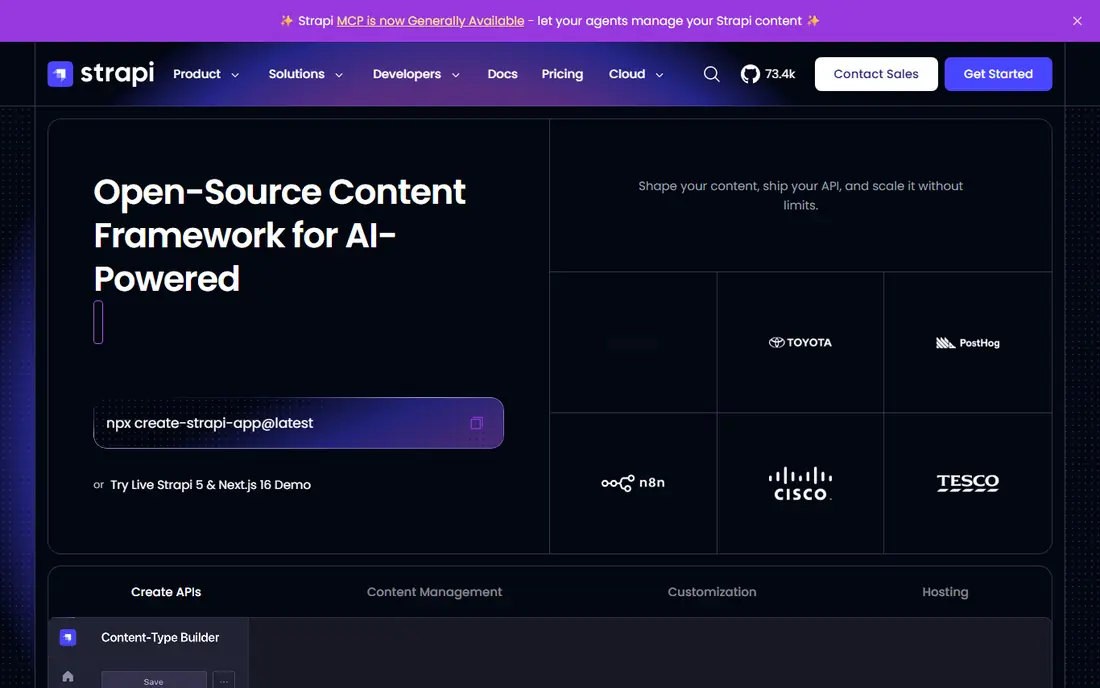
Strapi is the open source answer to Contentful. Install it on your own server, define content types through its admin panel, and publish through REST or GraphQL. Paid Strapi Cloud plans start at $35 per month if you would rather not manage a server.
The trade is clear. Nobody can change your pricing or retire a feature you rely on, because the code is yours. The downside is maintenance. Backups, upgrades and scaling sit with your team, so Strapi fits best where someone already owns infrastructure.
- Full source code access
- Self-hosting keeps data on your infrastructure
- REST and GraphQL APIs included
- You own hosting, updates and security
- The default admin is functional rather than beautiful
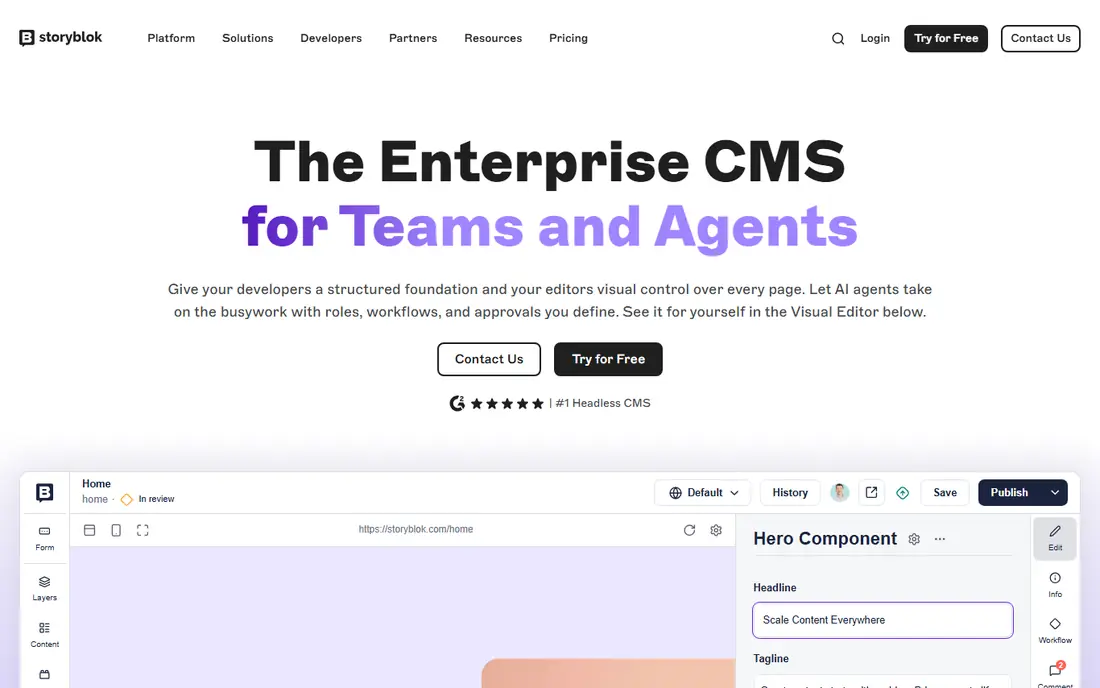
Storyblok answers the complaint we hear most about headless tools, that marketers cannot see what a page will look like until it is published. Its visual editor lets editors click a component on the page and edit it in place. That makes it a strong fit for marketing sites, landing pages and brand sites.
Component thinking runs through the whole product. Designers build reusable blocks, editors assemble pages from them, and developers control the rendering. If your content is mostly pages rather than complex data, Storyblok is hard to beat for editor happiness.
- True visual editor with live preview
- Component-based pages
- Strong for marketing sites
- Paid plans start higher than some rivals
- Less suited to heavy non-page content models
Hygraph, formerly GraphCMS, is built around GraphQL from the ground up. If your front end already speaks GraphQL, you avoid the translation layer that other platforms add. It can also federate content, pulling in data from outside systems alongside your CMS content.
This is a developer-first tool with a capable editor interface on top. Teams that live in a GraphQL stack will feel at home quickly. Teams that want a visual page builder should look at Storyblok instead.
- Native GraphQL API
- Federated content from other sources
- Solid localization support
- Pricing is not as transparent as some rivals
- The editor experience is more technical
Contentstack is the closest like-for-like enterprise replacement for Contentful. It offers the governance features large organizations expect, including granular roles, approval workflows and multi-environment publishing. It also has a visual page builder for marketing teams.
The main drawback is opacity around price. You will need a sales conversation to get a number, which makes budgeting harder for small teams. For a large publisher that needs compliance and support guarantees, that conversation is usually worth having.
- Deep roles, permissions and workflows
- Strong enterprise support
- Proven at large scale
- Pricing is quote-based
- Smaller teams may find it more platform than they need
Prismic keeps things simple on purpose. Content is organized into documents, and pages are built from Slices, which are reusable sections like a hero, a testimonial row or a pricing table. Developers define the Slices, editors fill them in.
Setup is fast, and the editor is one of the cleanest here. The limit shows up on complex data models. If you need deeply nested, relational content with lots of custom logic, Sanity or Strapi will give you more room.
- Slices make reusable page sections simple
- Quick setup
- Clean editor experience
- Model depth is shallower than Sanity or Strapi
- Costs rise with team size
Directus takes a different route. Instead of storing your content in its own system, it wraps a SQL database you already have and gives it an API and a polished admin interface. That makes it a good fit for teams with existing data, internal tools or dashboards to build.
The open source version is free to self-host, with paid cloud plans for teams that want hosting handled. Editorial workflow features such as approvals are present but less developed than in a dedicated publishing CMS, so weigh that before switching a newsroom onto it.
- Open source and self-hostable
- Wraps any SQL database
- Attractive admin app
- It is a data platform first, so pure editorial features are thinner
- Self-hosting needs care
DatoCMS is the quiet, dependable option. It covers the headless basics well, with a tidy interface, strong media handling and a GraphQL API. Small agencies and product teams often pick it because editors need almost no training.
It is not the most flexible tool on this list, and very large, complex content models can strain it. For a team that wants to migrate from Contentful without a long implementation project, DatoCMS keeps the move short.
- Fast to learn
- Clean interface
- Good video and image handling
- Less flexible for very complex models
- Higher tiers are quote-based
How we picked these
We compared official feature pages, pricing pages, API documentation and public reviews for each platform, and checked that each one is actively maintained and available in October 2026. We favored tools that cover the core Contentful job, structured content delivered by API to any front end, and we left out page builders that cannot serve content headlessly. Pricing reflects published plans where available, and we marked anything unclear as See website rather than guessing.
What to check before you migrate
Start with your content model, not the feature list. Count your content types, locales, editors and API calls, then test each shortlisted platform against those numbers. A tool that looks cheap at five editors can get expensive at fifty, and API limits can bite a high-traffic site.
Migration effort is the second check. Export a sample of your Contentful content and try importing it into your top two choices. Watch for rich text, linked entries and assets, because those are where migrations usually stall. Run the new CMS alongside the old one for a few weeks if you can, so editors can compare the daily experience before you cut over.
Finally, ask who owns the editor experience. If marketers publish daily, visual editing and preview matter more than API elegance. If developers ship the front end, schema flexibility and API quality matter more. Pick the tool that serves the people who use it most, not the one with the longest feature list.
FAQ
Is there a free alternative to Contentful?
Yes. Strapi and Directus are free to self-host as open source software, and Sanity, Storyblok, Prismic and DatoCMS all offer free tiers. Free tiers carry limits on seats, API calls or projects, so they suit small sites and trials better than large production sites.
Which Contentful alternative is best for marketers?
Storyblok is our pick for marketing teams, because its visual editor shows the page as editors build it. Prismic is a close second for teams that build pages from reusable sections. Both reduce the back-and-forth between marketing and development on everyday publishing.
Is Strapi really free?
The Strapi open source code is free, and you can run it on your own server at no license cost. You still pay for hosting, and you take on maintenance. Strapi Cloud is the paid hosted option, starting at $35 per month, for teams that want that work handled.
Can I migrate content from Contentful to another CMS?
In most cases, yes. Contentful has export tools and APIs, and most rivals offer import tools or migration guides. Rich text, linked entries and media assets need the most checking, so run a test migration with a sample of real content before committing to a date.
Do I need developers to run a headless CMS?
For setup, usually yes. Headless CMS platforms need a front end built against their API, which is development work. Day-to-day publishing is designed for non-technical editors, and tools like Storyblok and Prismic keep that part simple once the build is done.