Best Mailchimp Alternatives in 2026: 9 Tools Compared
Discover the best Mailchimp alternatives in 2026 for email marketing, covering cheaper plans, automation, landing pages, and tools for creators and shops.

- Editor's choice
 Brevo
Large lists, low send volume
Starts at$9 per monthVisit brevo.comFull review - Great alternative
 MailerLite
Simple small-list email
Starts at$12 per monthVisit mailerlite.comFull review - Also consider
 Kit
Creators and newsletters
Starts atSee websiteVisit kit.comFull review
TL;DR:
- Brevo is often cheaper for large lists you email rarely, because it prices by emails sent rather than contacts.
- MailerLite suits small lists that want simple pricing and a clean editor without a steep learning curve.
- Kit fits creators best, while Klaviyo fits online shops that need deep purchase data and flows.
- Before you switch, check contact counting rules, automation limits, and deliverability support, since those drive the real cost.
Quick comparison
| Tool | Best for | Starts at | Free plan? | |
|---|---|---|---|---|
| Brevo | Large lists, low send volume | $9 per month | Yes | Visit |
| MailerLite | Simple small-list email | $12 per month | Yes | Visit |
| Kit | Creators and newsletters | See website | Yes | Visit |
 Constant Contact | Local businesses and events | See website | Free trial | Visit |
 ActiveCampaign | Behaviour-based automation | See website | Free trial | Visit |
 GetResponse | Webinars plus email | See website | Free trial | Visit |
 Klaviyo | Ecommerce email and SMS | See website | Yes | Visit |
 Campaign Monitor | Polished agency campaigns | See website | Free trial | Visit |
 Moosend | Low-cost automation | See website | Free trial | Visit |
The best Mailchimp alternatives
We compared official feature pages, pricing pages, app store listings, and public reviews for these platforms. Our focus was list pricing, automation, templates, deliverability help, and how each tool fits a real sender rather than a generic marketing claim.
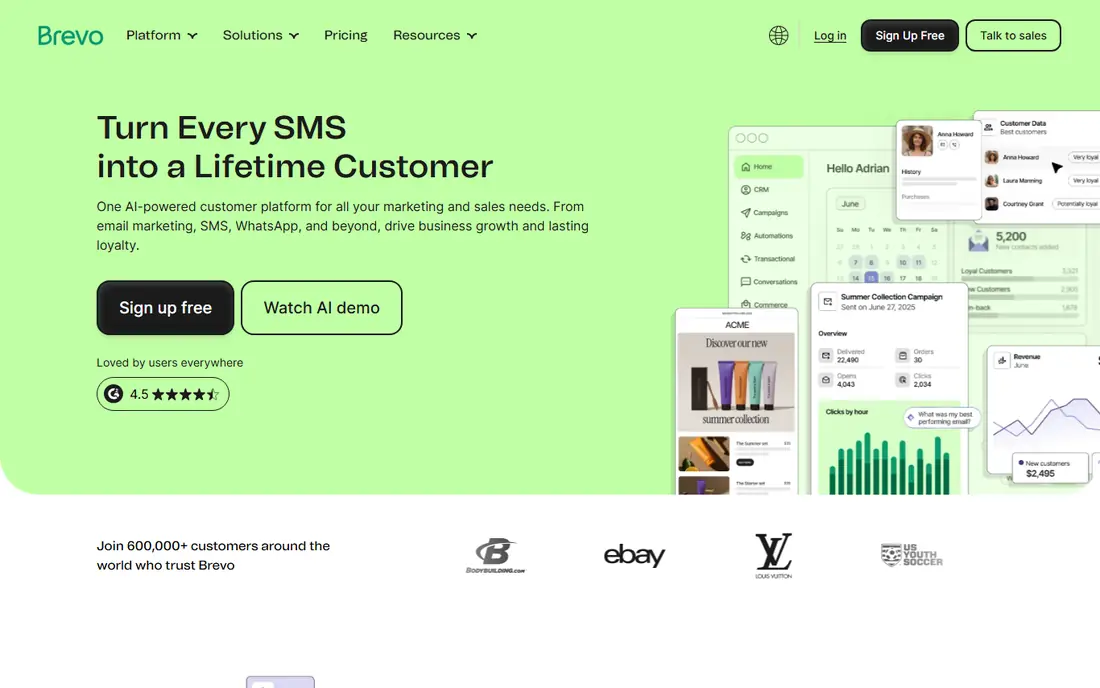
Brevo fits senders who hold a large list but do not email it every week. Its free plan allows 300 emails per day and many stored contacts, and its Starter plan starts at $9 per month for 5,000 emails. That model can be far cheaper than Mailchimp alternatives that charge per contact. The catch is automation depth. Basic automation is included, but richer flows and A/B testing need higher plans. Brevo also bundles transactional email, SMS, and a basic sales CRM, which helps small teams keep tools in one place. If you send often to a small list, MailerLite may cost less in practice.
- Prices by emails sent
- Free plan allows many contacts
- Includes SMS and basic CRM
- Full automation needs higher plans
- Branding removal costs extra on Starter

MailerLite suits small businesses that want email marketing without a maze of settings. The editor is straightforward, templates look clean, and you can build landing pages and a simple website in the same account. Its Comfort plan starts at $12 per month for 500 subscribers on recent pricing pages. The limit is scale and depth. The free plan covers only a small list, and advanced triggers sit on higher tiers. For a local shop, a nonprofit, or a new blog, that trade is fine. MailerLite is our pick for most people who want a cheaper Mailchimp alternative and do not need complex branching flows.
- Clean editor
- Clear subscriber pricing
- Landing pages and sites included
- Free plan is small
- Advanced automation needs higher plans
Kit, formerly ConvertKit, fits writers, podcasters, and course creators who grow an audience first. Forms, landing pages, and simple visual automations are built for that workflow, and the free plan covers up to 10,000 subscribers for basic newsletter sending on recent pages. Paid plans add automations and more. The weakness is commerce. Kit is not built for product catalogues, abandoned cart flows at shop depth, or complex store segmentation. If you sell mainly through a store, Klaviyo or ActiveCampaign will fit better. For a creator who wants to send, segment by interest, and sell digital products, Kit stays focused and easy to use.
- Creator-focused forms and landing pages
- Simple automations
- Paid newsletter tools
- Weak for shops
- Ecommerce features are limited
Constant Contact fits local businesses, clubs, and nonprofits that send regular updates and event invites. The editor is friendly, templates are plentiful, and event registration tools help groups that meet in person. Support is a real strength for teams without a marketing specialist. The trade-off is automation depth and long-term cost. Flows are simpler than ActiveCampaign, and pricing climbs as your list grows. If you need only newsletters, announcements, and event emails, Constant Contact is a safe, low-stress choice. If you need behaviour-based journeys, look elsewhere.
- Very easy for beginners
- Event tools
- Strong phone and chat support
- Automation is basic
- Price rises with list size
ActiveCampaign suits businesses where follow-up depends on what a person actually does. You can trigger emails from page visits, purchases, tag changes, and form actions, then branch the journey by behaviour. The built-in CRM helps small sales teams track leads without a second tool. The catch is complexity and cost. There is no free plan, only a trial, and the builder takes time to learn well. Starter plans limit automation actions, so the useful tier may cost more than the entry price suggests. For teams that will truly use automation, that investment pays off. For simple newsletters, it is more tool than you need.
- Deep automation builder
- CRM included
- Strong segmentation
- No free plan
- Learning curve is steeper
GetResponse fits teams that run webinars, courses, or live demos alongside email. You can host webinars, build landing pages, and run automations from one account, which cuts the need for a separate webinar tool. Templates for funnels and follow-up sequences speed up setup. The interface packs a lot in, so new users may need a few sessions to find everything. Pricing also depends on list size and feature tier, so compare the plan that includes webinars and automation, not just the headline price. For webinar-led businesses, the bundle is a genuine saving.
- Webinar hosting included
- Landing pages
- Automation templates
- Interface can feel busy
- Pricing tiers vary by feature
Klaviyo fits online shops that want email and SMS driven by real purchase behaviour. It pulls order, product, and browsing data from major shop platforms, then powers abandoned cart, welcome, post-purchase, and win-back flows. Segmentation by purchase history is far deeper than a generic newsletter tool. The weakness is price at scale. As profiles grow, costs climb, and you should clean inactive profiles regularly. Setup also needs care with tracking, consent, and SMS rules. For a shop where email drives a large share of revenue, Klaviyo often earns its cost. For a simple blog list, it is too much.
- Deep shop data
- Strong flows for carts and post-purchase
- SMS in same account
- Costs rise fast with profiles
- Setup needs care
Campaign Monitor suits agencies and brands that care most about design and reporting. Templates are polished, the builder is smooth, and client management tools help agencies run many accounts. Reports are clear enough to share with clients without extra work. The limit is automation depth and price. It does not match ActiveCampaign for complex journeys, and budget senders will find cheaper options. If your main need is beautiful campaigns sent well, Campaign Monitor delivers. If your main need is complex flows, pick a tool built for that job.
- Beautiful templates
- Strong reporting
- Agency and client tools
- Automation is less deep
- Pricing is higher than budget tools
Moosend fits small businesses that want automation without paying ActiveCampaign prices. The visual builder covers welcome series, cart recovery, and common triggers, and landing pages are included. Pricing has historically undercut many rivals at similar list sizes. The trade-off is breadth. The template library is smaller, and some niche integrations need workarounds. For a team that sends regular campaigns and a few core flows, Moosend gives good value. Check its integration list for your shop or CRM before you migrate, since that is where a cheap switch can stall.
- Affordable paid plans
- Visual automation builder
- Landing pages included
- Smaller template library
- Fewer native integrations than leaders
How we picked these
We compared official feature pages, pricing pages, app store listings, and public reviews for each platform. We favoured tools that are still sold and supported in October 2026, that truly replace Mailchimp for a clear sender type, and that publish pricing in a way we could check. We did not claim hands-on testing, and we did not invent ratings or deliverability scores.
What to check before you switch
Price your real list, not the headline tier. Some tools count unsubscribed contacts, some count only active subscribers, and some price by emails sent. Export your list, clean bounces and old non-openers, and price each tool at that cleaned size.
Deliverability and migration
Check domain authentication, dedicated IP options, and migration help before you move. A good alternative should help you set up SPF, DKIM, and DMARC records and warm up sending if your volume is large. Ask about import tools, template rebuilding, and automation mapping, since those tasks take longer than signup.
Automation fit
List the flows you actually run today, such as welcome, cart recovery, and re-engagement. Then check each tool for those exact triggers and limits on free or entry plans. The best alternatives to Mailchimp are not the cheapest on paper, but the ones that run your flows without forcing an immediate upgrade.
FAQ
What are the best alternatives to Mailchimp for small businesses?
MailerLite and Brevo are strong for small businesses because both offer free plans and clear pricing. MailerLite suits frequent senders with small lists, while Brevo suits large lists sent less often. Constant Contact suits local businesses that want simple newsletters and event tools.
What is the best Mailchimp alternative for creators?
Kit is built for creators, with forms, landing pages, and simple automations for newsletters and digital products. Its free plan covers a large subscriber count for basic sending. If you run a shop as well, Klaviyo or MailerLite may fit the commerce side better.
Are there cheaper Mailchimp alternatives?
Yes. Brevo, MailerLite, and Moosend often cost less than Mailchimp at the same list size, but the saving depends on how you are counted. Price each tool at your cleaned list size and send frequency, and check whether unsubscribed contacts still count.
Can I migrate my list and automations from Mailchimp?
Most tools offer list import and some migration help, but automations often need rebuilding. Export contacts, tags, and segments first, then map each Mailchimp flow to the new tool before you cancel. Keep Mailchimp active until your first campaigns in the new tool send cleanly.
What is the best alternative to email marketing for a shop?
For shops, Klaviyo is a strong choice because it uses purchase and browsing data for flows and SMS. ActiveCampaign also works well for shops that need CRM and behaviour-based follow-up. A plain newsletter tool will miss cart and post-purchase revenue.
Do Mailchimp alternatives offer a free plan?
Brevo, MailerLite, Kit, and Klaviyo offer free plans with limits on contacts, sends, or features. Constant Contact, ActiveCampaign, GetResponse, Campaign Monitor, and Moosend offer trials instead. Start free where you can, and upgrade when a limit blocks a flow you need.
Sources
- https://www.brevo.com/pricing
- https://www.mailerlite.com/pricing
- https://kit.com/pricing
- https://www.constantcontact.com/pricing
- https://www.activecampaign.com/pricing
- https://www.getresponse.com/pricing
- https://www.klaviyo.com/pricing
- https://www.campaignmonitor.com/pricing
- https://moosend.com/pricing