Best Tools for AI Search Marketing in 2026: 9 Tools Compared
Compare the best tools for ai search marketing in 2026, with AI visibility tracking, citation checks, engine coverage, and pricing for teams of every size.

- Editor's choice
 Profound
Enterprise AI visibility and analytics
Starts atSee websiteVisit profound.comFull review - Great alternative
 Peec AI
Daily AI search tracking for marketing teams
Starts at$95 per monthVisit peec.aiFull review - Also consider
 Otterly.AI
Solo marketers and small budgets
Starts at$29 per monthVisit otterly.aiFull review
TL;DR:
- AI search marketing now means tracking how ChatGPT, Gemini, Perplexity, and Google AI Overviews mention and cite your brand, not just ranking in blue links.
- Budget tools such as Otterly.AI start near $29 per month, while enterprise platforms such as BrightEdge and seoClarity are quoted case by case.
- Teams already using Semrush or Ahrefs can often add AI visibility tracking without buying a whole new platform.
- Prompt coverage, engine coverage, and citation data matter more than a single visibility score, so check what each plan actually tracks before you buy.
- Our pick for most teams starting out is Peec AI for clean daily tracking, with Profound as the deeper enterprise option.
Quick comparison
| Tool | Best for | Starts at | Free plan? | |
|---|---|---|---|---|
| Profound | Enterprise AI visibility and analytics | See website | Free trial | Visit |
| Peec AI | Daily AI search tracking for marketing teams | $95 per month | Free trial | Visit |
| Otterly.AI | Solo marketers and small budgets | $29 per month | Free trial | Visit |
 Semrush AI Visibility Toolkit | Teams already using Semrush | $99 per month | No | Visit |
 Ahrefs Brand Radar | SEO teams already using Ahrefs | $129 per month | No | Visit |
 BrightEdge | Large enterprise SEO and content teams | See website | No | Visit |
 seoClarity | Enterprise search analytics and AI Overviews tracking | See website | No | Visit |
 AthenaHQ | Teams wanting attribution and broad engine coverage | $295 per month | Yes | Visit |
 Writesonic | Content creation plus AI search tracking | $79 per month | Free trial | Visit |
The best tools for AI search marketing
These nine tools help you see, measure, and improve how your brand shows up in AI answers. Some focus only on tracking, while others add content and optimization guidance.

Profound is one of the earliest and best known names in AI visibility monitoring, and it shows in the depth of its analytics. It tracks brand mentions and citations across AI engines, and it offers prompt-level data that helps larger teams see which questions actually drive exposure. That depth suits enterprises and agencies that manage many brands and need reporting they can take to senior leaders.
The catch is cost and complexity. Entry self-serve pricing has changed during 2026, and the most complete coverage sits behind enterprise plans, so smaller teams should confirm what a quoted plan includes before signing. If your budget is tight, start with a cheaper tracker and move to Profound when you need its scale and data depth.
- Broad engine coverage on higher tiers
- Deep analytics and prompt data
- Content generation on some plans
- Pricing is largely quote based
- Full engine coverage needs an enterprise plan

Peec AI is our pick for most marketing teams because it does the core job well without a maze of settings. You pick prompts, choose engines, and watch mentions, citations, and competitor movement day by day. Unlimited seats make it easy to share results with content, product, and leadership teams without worrying about per-seat fees.
Peec AI is mainly a tracker, so it will show you gaps rather than fix your content for you. Teams that want done-for-you optimization will need to pair it with writers or an agency. For teams that want a clear daily picture of AI search performance, though, it is a strong and fairly priced choice.
- Clean daily tracking
- Unlimited seats on plans
- Tracks many languages
- Monitoring focused, with less hands-on optimization help
- Pricing has moved around during 2026
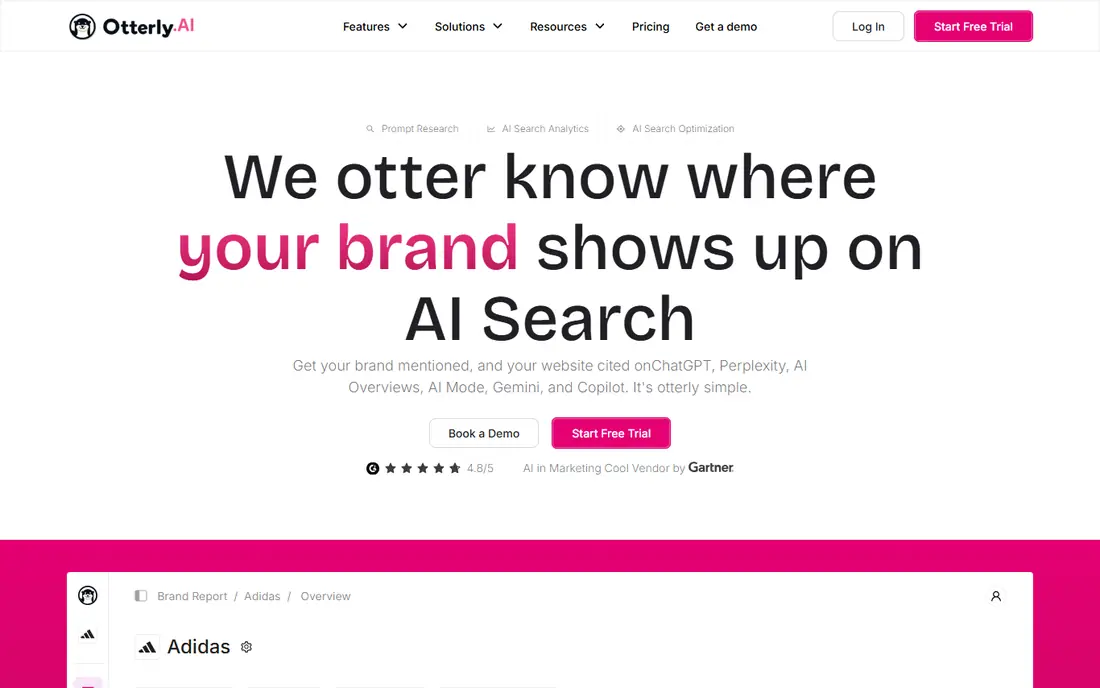
Otterly.AI is the easiest way to start tracking AI search visibility without a sales call or a large budget. The entry plan covers ChatGPT, AI Overviews, Perplexity, and Copilot, with daily tracking and unlimited team members. For a freelancer, a startup, or a small marketing team, that is enough to learn which prompts mention you and which competitors keep showing up instead.
The trade-off is scale. Prompt limits on the cheapest plan are modest, and reporting is simpler than what enterprise tools offer. If you outgrow it, moving up a tier or switching to Peec AI or Profound is straightforward, since the prompts you have already chosen carry over as a useful shortlist.
- Lowest starting price in this list
- Simple setup
- Covers major engines including AI Overviews
- Small prompt limits on the entry plan
- Fewer enterprise reporting features
If your team already pays for Semrush, the AI Visibility Toolkit is the natural first step into AI search marketing. It adds AI mention tracking and an audit of how ready your site is for AI crawlers, alongside the keyword, backlink, and content tools you already use. That keeps reporting in one place and avoids another login for the team.
The toolkit is priced per domain, so costs add up if you track many brands or client sites. It is also an SEO-first product, so its AI guidance is thinner than a dedicated platform such as Profound. Still, for Semrush shops, it is the lowest-friction way to start.
- Sits inside a full SEO suite
- Tracks ChatGPT, Google AI, Gemini, and Perplexity
- Includes an AI-readiness site audit
- Priced per domain
- Not a standalone purchase for non-Semrush users
Ahrefs Brand Radar adds AI mention and brand tracking to one of the strongest SEO data sets available. Teams that live in Ahrefs can compare AI mentions with organic rankings, backlinks, and keyword demand without exporting data between tools. That context helps you judge if an AI mention actually lines up with real search interest.
Pricing needs care. Brand Radar sits on top of an Ahrefs plan, and a full index can add meaningful cost, so check the total before you commit. It also tracks fewer engines at entry level than some dedicated tools. If Ahrefs is already your home base, though, it is a sensible add-on.
- Grounded in Ahrefs search data
- Tracks multiple AI platforms
- Useful for market-wide brand research
- Full index access costs extra on top of a base plan
- AI coverage is narrower than dedicated trackers
BrightEdge is a long-standing enterprise SEO platform that has added AI search features, including AI Overviews monitoring, to its core toolkit. Large teams get content recommendations, rank tracking, and reporting in one system, which helps when many stakeholders need the same numbers. Its scale suits companies with big sites, many pages, and formal approval processes.
BrightEdge is not a quick self-serve purchase. Pricing is quoted, onboarding takes time, and smaller teams may pay for breadth they never use. It makes most sense when you already need an enterprise SEO platform and want AI visibility folded into it, rather than as a first AI-only tool.
- Enterprise-grade SEO platform with AI features
- Strong content and reporting tools
- Suits large sites
- Quote-only pricing
- AI features are part of a much larger suite
seoClarity stands out for teams that need proof, not just scores. It captures snapshots of AI Overviews so you can compare exactly what an answer showed over time, which is useful when rankings shift and nobody can explain why. Its enterprise reporting and large keyword capacity suit agencies and big brands tracking thousands of terms.
The downside is price and fit. Entry costs are well above budget trackers, and the platform assumes a team that will use its full analytics depth. Smaller teams will get more value from Otterly.AI or Peec AI. Large teams that need audit-ready AI search data, however, should put seoClarity on the shortlist.
- Detailed AI Overviews snapshots
- Strong enterprise reporting
- Large-scale keyword data
- High entry cost
- Built for larger teams, not solo marketers
AthenaHQ appeals to teams that want to connect AI visibility to results, not just mentions. It tracks a wide set of engines and offers attribution features that help marketers argue for budget based on outcomes rather than exposure alone. A free tier lets you test the interface before paying, which is rare in this category.
At $295 per month for the starter paid plan, it sits above the budget tier, so it suits teams with real AI search budgets rather than curious individuals. Its brand is also newer than BrightEdge or Semrush, so check case studies in your industry during a trial. For attribution-focused teams, it is still one of the more interesting options here.
- Free tier to try
- Broad engine coverage
- Revenue attribution features
- Higher starting price than budget trackers
- Newer brand with a smaller track record
Writesonic takes a different angle from the pure trackers on this list. It pairs AI content creation with AI search visibility features, so a small team can draft, publish, and then watch how AI engines treat that content. That workflow suits content-led teams that need output and measurement in one subscription.
The tracking side is not as deep as Profound or seoClarity, and prompt or project limits vary by plan, so larger teams should test it against their prompt list first. For small teams that want one tool to help write and monitor, Writesonic is a practical and affordable pick.
- Combines AI writing tools with visibility tracking
- Self-serve pricing
- Good for small content teams
- Tracking depth is lighter than dedicated platforms
- Plan limits need checking for larger teams
How we picked these
We compared official feature pages, pricing pages, and public reviews for AI search and visibility tools available in October 2026. We favored tools with published or widely reported pricing, real engine coverage, and a clear use case, and we kept a mix of budget trackers, SEO suites with AI add-ons, and enterprise platforms. We did not claim hands-on testing. Instead, we weighed what each vendor documents about engines tracked, prompt limits, citation data, and reporting, and we noted where pricing is quote only so you can budget honestly.
What to check before you pay
Start with your prompt list, not the vendor demo. Write down 50 to 200 branded, competitor, and category prompts that real buyers would ask an AI assistant, then ask each vendor how many of those prompts each plan covers and which engines it checks daily. A tool that tracks only one engine, or refreshes weekly, will miss the shifts that matter most during a product launch or a news cycle.
Next, look at citation data and exports. A visibility score alone is hard to act on, while a list of which pages get cited, and which competitor pages beat yours, gives your content team a clear job. Ask for a sample export and a live test on your own prompts during any trial. Finally, check seats, languages, and renewal terms. Unlimited seats help larger teams, multilingual tracking matters for global brands, and annual billing can lock you into limits you outgrow in a few months.
Budget versus enterprise
Budget tools work well when you need a weekly or daily pulse on a modest prompt set. Enterprise platforms earn their price when you track thousands of prompts, need snapshots and audit trails, or report across many brands and regions. Buy the smallest plan that covers your real prompt list, and upgrade only when prompt limits or reporting gaps start slowing decisions.
FAQ
What is the best AI platform for search marketing?
There is no single winner, because the best pick depends on your size and stack. Peec AI suits most marketing teams, Otterly.AI suits small budgets, and Profound, BrightEdge, and seoClarity suit enterprises. Teams already using Semrush or Ahrefs should try those AI add-ons first before buying a separate tool.
What are the best AI tools for search marketing on a small budget?
Otterly.AI, starting near $29 per month, is the cheapest credible entry point in this list. Peec AI at around $95 per month adds more prompts and seats for growing teams. Writesonic can also work for small content teams that want writing and tracking in one plan.
How is AI search marketing different from traditional SEO?
Traditional SEO focuses on ranking in a list of links, while AI search marketing focuses on being mentioned and cited inside a direct answer. That means clear facts, structured pages, and trusted sources matter more, and you need new metrics such as mention rate, citation share, and prompt coverage alongside rankings.
How many prompts should I track?
Start with 50 to 200 prompts covering your brand, your competitors, and the questions buyers ask before they buy. That range is large enough to spot patterns but small enough to act on. Expand only when you have a process for turning new prompt data into content updates.
Do I need a dedicated AI search tool if I already use Semrush or Ahrefs?
Not always. Both offer AI visibility add-ons that cover the basics for teams already in those ecosystems. Move to a dedicated tracker such as Peec AI or Profound when you need broader engine coverage, deeper citation data, or reporting built specifically for AI answers.
Can these tools improve my AI visibility, or only measure it?
Most tools on this list mainly measure visibility, while some add audits and content guidance. Measurement still helps, because it shows which pages get cited and where competitors win. Turning that insight into better pages, clearer facts, and stronger sources is where the actual improvement happens.