Best Study Apps for Kids in 2026: 8 Apps Compared
Find the best study apps for kids. We compared 8 learning apps for reading, math and homework help by price, ages and free options, from Khan Academy Kids to IXL.

- Editor's choice
 Khan Academy Kids
Free early learning for ages 2 to 8
Starts atFreeVisit khanacademy.orgFull review - Great alternative
 Starfall
Phonics and first reading skills
Starts atFreeVisit starfall.comFull review - Also consider
 Duolingo ABC
Free, structured lessons for new readers
Starts atFreeVisit abc.duolingo.comFull review
TL;DR:
- Khan Academy Kids is our pick for the youngest learners: it is free, runs no ads, and Khan Academy lists it for ages 2 to 8.
- Two reading apps cost nothing for the core program: Duolingo ABC says it is 100% free, and Starfall keeps its Learn-to-Read program free (its optional home membership is $35 per year).
- IXL is the broadest option for school-age kids, with pricing that starts at $6 per month for one subject, $8 for math plus language arts, and $9 for four core subjects.
- Prodigy Math is free to play, but membership plans run from $9.95 per month on the Core tier up to $19.95 per month for Ultra, so decide before your child asks for pets and gear.
- Epic and Kahoot Kids hide their prices in the app store flow, so check the current rate before you start a trial.
Quick comparison
| Tool | Best for | Starts at | Free plan? | |
|---|---|---|---|---|
| Khan Academy Kids | Free early learning for ages 2 to 8 | Free | Yes | Visit |
| Starfall | Phonics and first reading skills | Free | Yes | Visit |
| Duolingo ABC | Free, structured lessons for new readers | Free | Yes | Visit |
 PBS KIDS Games | Playful learning with familiar TV characters | Free | Yes | Visit |
 Prodigy Math | Math practice that feels like a video game | $9.95 per month | Yes | Visit |
 IXL | Skill practice across math, language arts, science and social studies | $6 per month | No | Visit |
 Epic | A large library of books for kids 12 and under | See website | Free trial | Visit |
 Kahoot Kids | A bundle of learning games for ages 3 to 12 | See website | Yes | Visit |
The best study apps for kids
Study apps for kids cover very different jobs: teaching a four-year-old letters, giving a third grader math practice, or filling the afternoon with books. We picked apps that exist and work today, then put each one where it fits best. Prices are what the official pages showed when we checked, and promotional rates are noted as such.

Khan Academy Kids is the first app we would hand to a young child. Khan Academy describes it as made for ages 2 to 8, covering early literacy, writing, language and math, along with social-emotional skills and creative play. Lessons come through games, books and videos, and the app runs on iPhone, iPad, Android and Amazon devices.
The pricing is the standout. Khan Academy says there are no ads and no subscriptions, and it points to its nonprofit status. It also says the app does not sell personal information, asks only for a name and age at setup, and recommends using a nickname. Schools can buy a version with teacher dashboards for $5 per student.
The honest limit is the age range. Once a child reads fluently and needs school-aligned practice, you will want a second app from further down this list.
- Free with no ads and no subscriptions
- Covers early reading, writing, math and social-emotional skills
- Available on Apple, Google Play and Amazon devices
- Aimed at roughly preschool through second grade
- Older kids will outgrow it
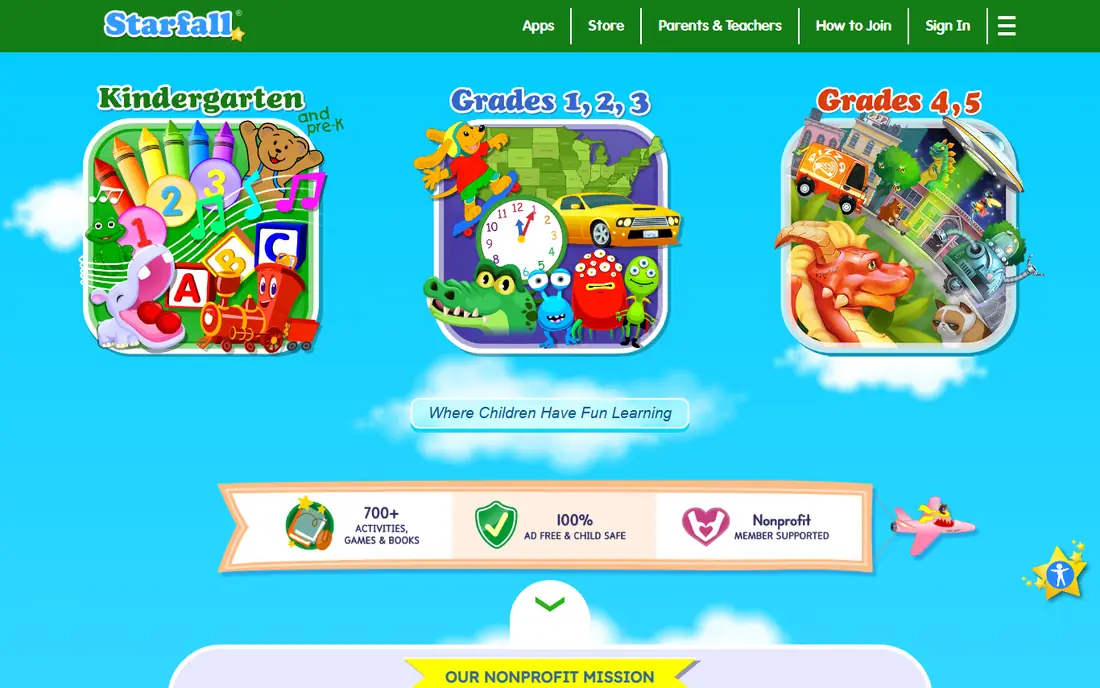
Starfall is an old name in early reading, and its site calls the Learn-to-Read program free for every child, forever. It runs in four steps, from the ABCs through phonics with simple words, early stories, and then fluent reading with fiction and nonfiction books. Starfall describes itself as a 501(c)(3) nonprofit that relies on memberships to keep reading free.
The paid side is optional and inexpensive. A home membership costs $35 per year and includes more than 700 activities, games and books on the website and the mobile app, and Starfall says that is about half the annual price of an app store subscription. Educator plans start at $70 per year.
Pick Starfall for a child who is just starting to read. The catch is that the experience is structured and calm rather than flashy, so a child used to character-driven games may find it plain at first.
- Learn-to-Read program is free for every child
- Run by a nonprofit
- Home membership is $35 per year
- Extra activities require a paid membership
- Design feels simpler than newer game-style apps

Duolingo ABC is the learn-to-read app from the language company, and its site says it is 100% free. It teaches phonics through short lessons, practices lowercase and capital handwriting, introduces tricky sight words, and builds vocabulary through character-driven stories. Duolingo says the curriculum follows recommendations from the National Reading Panel.
The company also points to research from Education Development Center, which it says found that kids who used the app for nine weeks improved their literacy scores by 28%. That figure comes from Duolingo's own site, so treat it as a company claim rather than independent proof.
One thing to check before you rely on it: the App Store listing we saw showed a last update in 2023, which is old for a children's app. It still lists as available and rated 4+, but it is worth installing and trying before you build a routine around it.
- Described by Duolingo as 100% free
- Covers phonics, handwriting, sight words and vocabulary
- Short, game-like lessons
- The iPhone listing shows its last update in 2023
- Focused on reading only
PBS KIDS Games lets children play with characters they already know, including Daniel Tiger, Wild Kratts, Donkey Hodie and Alma's Way. The App Store listing says the app has more than 280 educational games and works in English and Spanish, and that it is free. PBS describes the app as making learning fun and safe.
It works best as a supervised treat for preschool and early elementary kids. The games are playful and varied, but they are not a lesson plan. There is no sequence that moves a child from letters to sentences, so use it alongside something more structured.
If your child already loves a PBS KIDS show, this is an easy yes, since a familiar character tends to get a reluctant learner to sit down and try a math or science game.
- Free to download, with 280+ educational games listed on the App Store
- Games featuring Daniel Tiger, Wild Kratts and other PBS KIDS shows
- Available in English and Spanish
- Built around TV characters, so it leans young
- Not a structured curriculum
Prodigy turns math practice into a role-playing game, where answering questions correctly powers your character through battles. The company says its in-game educational questions are free, and it covers math standards for grades 1 to 8 in the United States and several other countries.
Membership is where the cost comes in. On the monthly plan, Core is $9.95 for one subject, Plus is $14.95 for two subjects, and Ultra is $19.95 for three. Billed annually, the page shows $4.91, $7.41 and $9.91 per month, with totals of $88.95 for Plus and $118.95 for Ultra. Memberships add pets, gear and other in-game extras, and the parent tools let you set goals and print practice sheets.
Our advice is simple: start on the free version and see whether your child plays for the math or for the pets. The catch is that a game this engaging also creates pressure to buy extras, so decide on a limit first.
- Free to play, and the in-game questions are free
- Covers math for grades 1 to 8
- Parents get goal-setting tools with membership
- Membership upsells inside a game
- Paid plans get pricey if you stack subjects
IXL is the closest thing here to a full practice program. Its family page lists more than 20,000 K-12 skills across math, English language arts, science, social studies and Spanish, plus a diagnostic that identifies the skills a child is ready for next. There are also 1,300+ video tutorials and lessons and 120+ educational games.
Pricing on the family page starts at $6 per month for a single subject (math or language arts). A combo of math and language arts is listed at $8 per month, and four core subjects are $9 per month. The page does not spell out billing terms, so confirm whether those figures assume annual billing before you pay.
IXL fits a school-age child who needs steady practice, catch-up help or enrichment, especially in homeschool settings. The catch is the feel: it is questions and feedback, so a younger or easily bored child may need a parent sitting close.
- 20,000+ skills from Pre-K through grade 12
- 1,300+ video tutorials and 120+ games
- Diagnostic that finds what to learn next
- No free plan on the family pricing page
- Looks like practice problems, not a game
Epic is a digital library rather than a study app in the strict sense, but reading daily is the habit that helps most with school. The company says it offers more than 40,000 books, audiobooks and learning videos from over 250 publishers for kids 12 and under, and describes itself as a leading digital reading platform for children.
Its site offers a free trial for families and says Epic is free for educators. The plan prices were not available on the pages we could read, and the App Store lists several subscription tiers with different prices, so check the current monthly and yearly rates inside the sign-up flow before committing.
Epic is a good fit for a child who reads for pleasure or one you want reading more. The honest catch is the paywall after the trial, and the fact that a big library on a tablet still needs a parent to guide what gets picked.
- 40,000+ books, audiobooks and learning videos
- Content from 250+ publishers
- Free for educators
- Pricing is not shown on the pages we could read
- You must sign up to see all the books
Kahoot is best known for classroom quiz games, and its kids app bundles learning games for children aged 3 to 12. The App Store listing says it contains 10 award-winning learning apps covering math, phonics, reading and more, and it states the app is ad-free. The app is free to download with in-app purchases.
On its kids page, Kahoot promoted its Kahoot+ subscription from $3 per month during a Halloween offer that ends October 31, which is a short-term promotion, not a standard price. The regular price was not listed there, so treat the cost as unknown until you see it in the app.
Kahoot Kids suits a family that wants a mix of games in one place. The tradeoff is that it feels more like an app collection than a single curriculum, and the paid tier is the main way to get everything.
- Ten learning apps in one download
- Ad-free, per the App Store listing
- Covers reading, math and coding
- Free to download but includes in-app purchases
- Pricing is promotional and changes
How we picked these
We looked for children's learning apps that exist and work today, cover real school skills, and have clear pricing on an official page or app store listing. For each app we compared the vendor's own site, plan pages, app store listings and privacy statements, and we noted what is free and what costs money.
We did not run hands-on tests with children, and we did not accept payment for placement. When a page did not show a price, we wrote See website instead of guessing. Study-result claims, such as Duolingo's reading figures, are the vendors' own and are labeled that way.
How to choose a study app for your child
Match the app to the age
Under 6, look for play-based apps with reading and counting basics, such as Khan Academy Kids, Starfall and PBS KIDS Games. For grades 1 to 8, practice-based tools like Prodigy and IXL fit better. Epic works across ages because it is mostly books.
Check the privacy basics together
Kids' apps collect names, ages and sometimes more. Use a nickname where the app allows it, read the privacy page, and look at what the app asks for at setup. Khan Academy Kids says it asks only for a name and age and recommends a nickname. If an app asks a child for personal details directly, stop and set it up yourself.
Watch for upsells
Free apps are not always free in practice. Games such as Prodigy sell membership perks inside the experience, and bundles like Kahoot Kids use in-app purchases. Turn off one-tap purchases on your device and set a monthly budget before your child starts.
Keep screen time purposeful
A study app helps most when it replaces idle scrolling, not when it adds hours to the day. Set a time limit, sit with younger children for the first few sessions, and ask your child to explain what they learned.
FAQ
What is the best free study app for kids?
For young children, Khan Academy Kids is the best free option we found: it has no ads or subscriptions and covers reading, math and social skills for ages 2 to 8. Duolingo ABC and Starfall's Learn-to-Read program are also free for early reading.
What is the best app for helping kids learn math?
Prodigy Math is the most game-like option and is free to play for grades 1 to 8. IXL is better for structured skill practice and costs from $6 per month. Khan Academy Kids covers early math for the youngest children.
Are study apps safe for kids?
It depends on the app, so check each one. Look for no ads, minimal data collection and clear privacy information. Khan Academy Kids and Kahoot Kids describe themselves as ad-free, but you should still review settings and keep purchases locked.
At what age can kids start using learning apps?
Several apps here target children as young as 2 to 4, including Khan Academy Kids and Kahoot Kids (ages 3 to 12). Younger children do best with a parent present and short sessions.
Which study apps work best for homeschooling?
IXL's family page highlights homeschooling and offers broad subject coverage. Pair it with a reading app such as Epic or Starfall and a free option like Khan Academy Kids for younger siblings.
Sources
- https://www.khanacademy.org/kids
- https://apps.apple.com/us/app/khan-academy-kids/id1378467217
- https://www.starfall.com/h/
- https://secure.starfall.com/lv/ways-to-join
- https://abc.duolingo.com/
- https://apps.apple.com/us/app/learn-to-read-duolingo-abc/id1440502568
- https://pbskids.org/apps/play-pbs-kids-games
- https://apps.apple.com/us/app/pbs-kids-games/id1050773989
- https://www.prodigygame.com/main-en/parents
- https://www.prodigygame.com/Memberships/math/
- https://www.ixl.com/membership/family/pricing
- https://www.getepic.com/
- https://apps.apple.com/us/app/epic-kids-books-reading/id719219382
- https://kahoot.com/kids/
- https://apps.apple.com/us/app/kahoot-kids-learn-play/id6444439181