Best Social Media Influencer Marketing Software in 2026: 8 Tools Compared
We compare the best social media influencer marketing software for 2026, from CreatorIQ and GRIN to Modash, covering pricing and platform fit for brands.
- Editor's choice
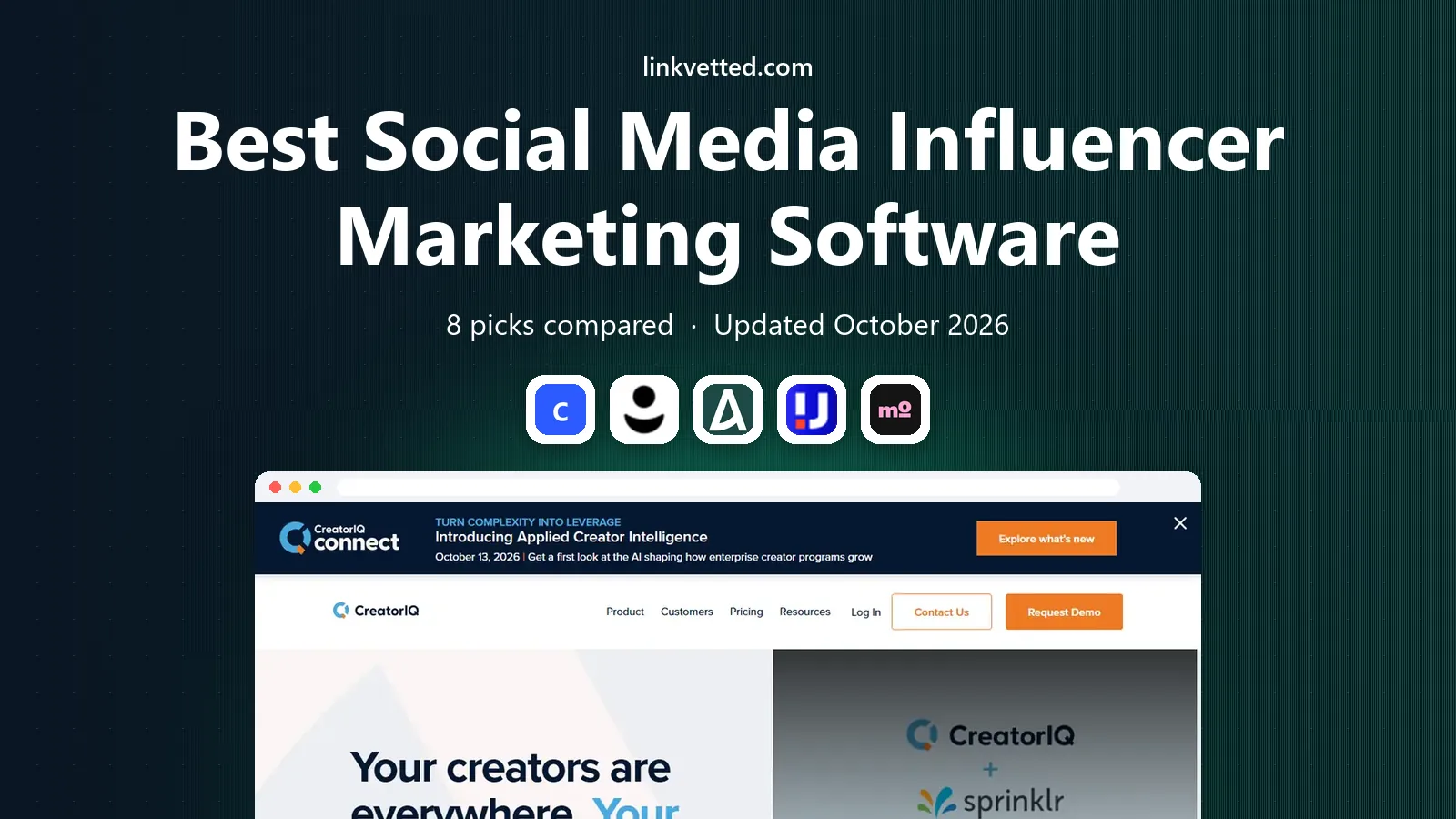
 CreatorIQ
Enterprise global programs
Starts atSee websiteVisit creatoriq.comFull review - Great alternative
 GRIN
DTC ecommerce creator CRM
Starts atSee websiteVisit grin.coFull review - Also consider
 Aspire
Ambassador and marketplace programs
Starts atSee websiteVisit aspire.ioFull review
TL;DR:
- The best social media influencer marketing software depends on program size, with Modash and Influencer Hero fitting smaller teams and CreatorIQ fitting enterprises.
- Ecommerce brands should favor tools with Shopify or WooCommerce integrations, since gifting, affiliate tracking and payouts live or die on that connection.
- Most enterprise platforms are quote only and require annual contracts, so confirm creator limits and user seats before signing.
- Audience quality checks matter more than follower counts, and tools like HypeAuditor and Traackr focus on that vetting work.
- Instagram, TikTok and YouTube dominate creator work, but the best platform for influencer marketing also depends on where your buyers spend time.
Quick comparison
| Tool | Best for | Starts at | Free plan? | |
|---|---|---|---|---|
| CreatorIQ | Enterprise global programs | See website | No | Visit |
| GRIN | DTC ecommerce creator CRM | See website | No | Visit |
| Aspire | Ambassador and marketplace programs | See website | No | Visit |
 Upfluence | Customer turned creator programs | See website | No | Visit |
 Modash | Discovery and affiliate tracking | $199 per month | Free trial | Visit |
 Influencer Hero | Mid-market all in one | $649 per month | No | Visit |
 HypeAuditor | Audience quality and fraud checks | See website | Free trial | Visit |
 Traackr | Measurement and benchmarking | See website | No | Visit |
The best social media influencer marketing software
These are the best influencer marketing platforms we found for 2026, from discovery tools to full creator management suites.

CreatorIQ is the pick for large brands running creator programs across many markets. It combines discovery, campaign management, payments and reporting with compliance controls that legal teams at big companies expect. Its API backed data and real time analytics help teams measure earned media value and campaign performance across regions.
The cost and setup reflect that enterprise focus. Pricing is quoted, annual contracts are the norm, and smaller brands will find the platform more than they need. CreatorIQ fits when you manage dozens or hundreds of creators and need consistent reporting across teams.
- Enterprise grade reporting and compliance tools
- API backed data
- Global workflow support
- Quote only pricing
- Too much platform for small programs

GRIN works like a CRM for creators, which suits direct to consumer brands that treat creators as a sales channel. Product seeding, discount codes, affiliate tracking and payouts all connect to Shopify, so revenue attribution is clearer than with a standalone discovery tool. That ecommerce depth is why many DTC brands standardize on GRIN.
The trade-off is focus. Brands outside ecommerce, or those running mostly brand awareness campaigns without sales tracking, may not use the strongest parts of the platform. Pricing is quoted, so ask how creator counts and user seats change the annual figure.
- Deep Shopify integration
- Gifting, affiliate and payout workflows
- Creator CRM approach
- Quote only pricing
- Ecommerce focus limits non-retail use

Aspire combines a creator marketplace with campaign workflow tools, which helps brands that want creators to apply to them rather than sourcing every creator by hand. Ambassador programs, gifting automation and ROI tracking suit mid-market and enterprise ecommerce brands with ongoing programs. First party data partnerships also help with measurement.
Buying is demo led and priced by quote, which slows comparison shopping. Aspire fits brands with steady, year round creator activity better than brands running a single one off campaign.
- Large creator marketplace
- Automated workflows
- Shopify integrations
- Quote only pricing
- Demo only buying process
Upfluence has a useful trick that other platforms lack, which is finding creators among your existing customers. A customer who already buys and posts about your product often converts better than a cold recruited creator, and Upfluence surfaces those people directly. Its affiliate and campaign tools then turn that discovery into tracked sales.
The database is smaller than Modash or CreatorIQ, so pure discovery across a niche topic may be thinner. Upfluence fits ecommerce brands that want to grow creator programs from their own customer list first.
- Finds creators inside your customer base
- Shopify and WooCommerce integrations
- Affiliate tools
- Quote only pricing
- Database smaller than some rivals
Modash is our pick for teams that mainly need discovery, vetting and affiliate tracking without an enterprise contract. Its database covers hundreds of millions of public creator profiles, with AI search and audience insights to narrow a long list fast. Published pricing starting at $199 per month and self serve signup make it easy to test.
Campaign workflow tools are lighter than GRIN or Aspire, so teams that need deep gifting and payout automation may pair Modash with another tool. For research heavy teams and smaller brands, that trade is usually worth it.
- Very large public creator database
- Published pricing
- Self serve signup
- Campaign management is lighter than full suites
- Support is leaner than enterprise tools
Influencer Hero packs a wide set of tools into one subscription, covering discovery, outreach automation, gifting, affiliate tracking and storefronts. Mid-market ecommerce brands get most of what GRIN offers at a published starting price of $649 per month, which makes budgeting simpler than a quote only negotiation.
The catch is commitment. There is no free trial, and buyers report a three month minimum term, so run a careful demo with your real creator criteria before paying. If the workflow fits, it is a strong all in one value pick.
- Discovery, CRM, outreach automation and storefronts in one tool
- Shopify and WooCommerce support
- No free trial
- Three month minimum term reported
HypeAuditor is the tool to add when you worry about fake followers and inflated engagement. Its audience quality scoring checks follower authenticity, engagement patterns and audience demographics before you pay a creator. That vetting work protects budgets, especially for brands buying reach from creators they have never worked with before.
HypeAuditor is stronger on analytics than on campaign workflow, so many teams use it alongside a CRM style platform. Use its free trial to run your current creator roster through it, since the results often change who gets renewed.
- Advanced audience quality scoring
- Fraud detection
- Social listening included
- Pricing not fully published
- Campaign management is secondary
Traackr suits brands that need to prove influencer impact to senior leaders and compare against competitors. Its brand vitality score and benchmarking tools put your program beside rival brands, while structured workflows keep global teams consistent. Beauty and fashion brands in particular use Traackr for visual reporting and trend tracking.
The price and enterprise focus put it out of reach for small teams. Traackr fits when measurement and benchmarking are the main purchase reason, rather than simple creator discovery.
- Brand vitality scoring
- Competitive benchmarking
- Strong global reporting
- Quote only pricing
- Enterprise focus and cost
How we picked these
We compared official feature pages, pricing pages and public platform comparisons for the leading influencer marketing tools, and we favored platforms that are actively sold in October 2026. We checked database size, ecommerce integrations, campaign workflow depth, measurement quality and pricing transparency. We also weighed team size fit, since a $199 per month discovery tool and a quote only enterprise suite serve very different buyers.
How to choose influencer marketing software
Start with your program type. Ecommerce brands need gifting, affiliate and payout tools tied to their store, while brand awareness teams need discovery and measurement more than sales tracking. Next, check which social platforms the tool covers well, since Instagram, TikTok and YouTube are the core channels for most programs, but LinkedIn matters for B2B creators.
Then test audience data on creators you already know. A tool that misreads a familiar creator's audience will mislead you on strangers too. Finally, confirm contract terms, including creator limits, user seats and renewal notice, before signing an annual deal.
Which social media platform is best for influencer marketing
Instagram and TikTok lead for consumer products, fashion, beauty and food, while YouTube suits longer reviews and tutorials. LinkedIn works best for B2B creators and professional services. Pick the platform where your buyers already follow creators, then pick software that measures that platform well.
A final practical point is to start with a small paid test before committing to an annual contract. Run one campaign with five to ten creators, check how accurately the platform tracks content, clicks and sales, and confirm that payments and content approvals work smoothly. That test reveals whether the reporting matches your own analytics and whether creators actually enjoy using the platform. A tool that looks strong in a demo but frustrates creators will cost you relationships as well as money over a full year.
FAQ
What is the best social media influencer marketing software for small brands?
Modash is a strong starting point for discovery at $199 per month, while Influencer Hero covers more workflow at $649 per month. Shopify brands can also start with Shopify Collabs for simple affiliate programs.
Which social media platform is best for influencer marketing?
Instagram and TikTok are the top choices for most consumer brands, with YouTube best for detailed reviews. The right answer depends on where your target buyers spend time and what content format fits your product.
How much does influencer marketing software cost?
Self serve tools start around $199 per month, mid-market platforms around $649 per month, and enterprise suites are quote only, often running into five figures per year. Confirm creator and seat limits in the quote.
Do I need influencer software or can I manage creators in a spreadsheet?
A spreadsheet works for a handful of creators, but it breaks down once you manage gifting, payments, content approvals and reporting at scale. Software pays for itself when manual tracking starts eating staff time or causing missed payments.
How do I check for fake followers?
Use audience quality tools such as HypeAuditor or Traackr to check follower authenticity, engagement rates and audience geography. Sudden follower spikes and engagement that does not match audience size are warning signs.