Best SEO Rank Checking Software in 2026: 8 Tools Compared
Compare the best SEO rank checking software in 2026, with 8 tools for daily rankings, local tracking, and reports, plus prices and keyword limits explained.
- Editor's choice
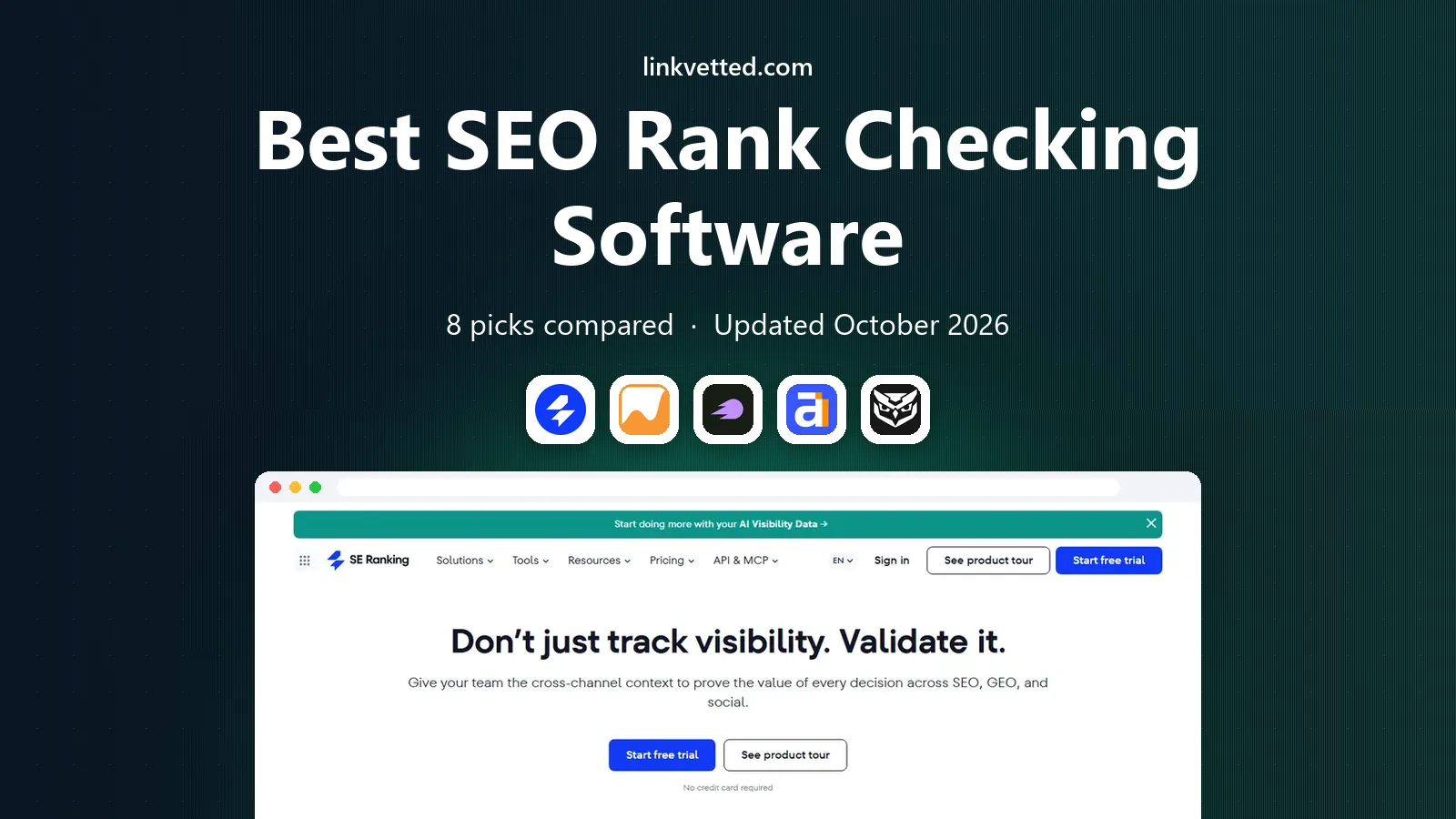
 SE Ranking
Best overall value
Starts at$129 per monthVisit seranking.comFull review - Great alternative
 AccuRanker
Large agency keyword sets
Starts at$224 per monthVisit accuranker.comFull review - Also consider
 Semrush
Rank tracking in a full suite
Starts at$139 per monthVisit semrush.comFull review
TL;DR:
- Keyword count and update frequency matter more than a long feature list, so buy for the number of keywords you truly track each week.
- SE Ranking offers the best value for many teams, with 2,000 keywords on its entry plan, while AccuRanker suits agencies with very large keyword sets.
- Google Search Console is free and should sit alongside any paid tracker, since it shows real clicks and impressions from Google itself.
- Local businesses need a different toolset, with map rankings and location grids, rather than a national rank tracker alone.
Quick comparison
| Tool | Best for | Starts at | Free plan? | |
|---|---|---|---|---|
| SE Ranking | Best overall value | $129 per month | Free trial | Visit |
| AccuRanker | Large agency keyword sets | $224 per month | Free trial | Visit |
| Semrush | Rank tracking in a full suite | $139 per month | Free trial | Visit |
 Ahrefs | Rankings plus backlinks | $29 per month | Yes | Visit |
 Nightwatch | Local and AI tracking | $79 per month | Free trial | Visit |
 Wincher | Simple daily tracking | $49 per month | Free trial | Visit |
 Moz Pro | Small business SEO learning | $99 per month | Free trial | Visit |
 Google Search Console | Free baseline data | Free | Yes | Visit |
The best SEO rank checking software
Rank checking software tracks where your pages appear in search results for chosen keywords, and the best tool depends on how many keywords you track, how often you need updates, and whether you also need keyword research, audits, or backlinks. We compared published plans from October 2026.

SE Ranking is our pick for most teams because its entry plan covers far more keywords than many rivals at a similar price. The Core plan lists 2,000 keywords tracked daily, plus site audits, keyword research, and AI search tracking, so a small agency or in-house team can run most of its SEO work in one place. Daily updates mean you can spot a ranking drop quickly rather than waiting a week.
The trade-off is breadth. SE Ranking tries to cover many SEO jobs, so its interface can feel busy, and very large portfolios will still hit keyword limits. For a team tracking hundreds or low thousands of keywords, though, the value is hard to beat.
- 2,000 keywords on entry plan
- Daily updates
- Audits, research, and AI search tracking in one plan
- Interface packs in many tools
- Keyword limits still apply on large portfolios

AccuRanker is built for speed and scale. It updates rankings on demand, handles large keyword sets with tagging and segmentation, and lets agencies share data across teams without per-seat friction. Its Professional plan lists $224 per month for 2,000 keywords, with larger tiers available, which suits agencies that report to many clients.
For a single small site, that price is hard to justify, and a simpler tracker will do the same core job for less. Choose AccuRanker when you manage many clients or many thousands of keywords and need fresh data on demand, not just once a day.
- Fast on-demand updates
- Strong tagging and segmentation
- Unlimited users on many plans
- High entry price
- Overkill for a single small site

Semrush is the all-in-one option. Its SEO plan lists $139 per month for 500 tracked keywords, and around that core it offers keyword research, site audits, backlink analysis, content tools, and PPC data. Newer AI visibility features track how brands appear in AI answers, which is useful as search changes. If you want one subscription to replace several tools, Semrush is the obvious candidate.
The limit is the keyword allowance. Five hundred keywords is enough for a small site, but an agency tracking many clients will need higher tiers or add-ons. Semrush fits best when rank tracking is one part of a wider SEO and marketing workflow.
- Huge keyword database
- Position tracking plus audits, backlinks, and PPC tools
- AI visibility features
- Entry plan covers only 500 tracked keywords
- Costs rise with seats and add-ons
Ahrefs is best known for backlinks, and its rank tracker sits inside that strength. You can see ranking changes alongside link data, which helps explain why a page moved. Its Starter plan starts at $29 per month, while the Lite plan at $129 per month covers 750 tracked keywords, and a limited free account is available for site owners.
The catch for rank-focused buyers is update frequency. Standard plans update weekly rather than daily, so Ahrefs is less ideal if you need a fresh ranking every morning. Pick Ahrefs when backlink research and competitor analysis matter as much as rankings themselves.
- Excellent backlink database
- Keyword research depth
- Free tools for site owners
- Rank tracking updates weekly on standard plans
- Lite plan covers 750 keywords
Nightwatch suits teams that track local rankings and AI search results alongside classic Google rankings. Its Starter plan lists 79 euros per month billed yearly for 500 keywords, with daily and on-demand updates and unlimited users on all plans. Local tracking, including ZIP-level detail, helps agencies that serve businesses in many towns.
The keyword allowance is modest at entry level, so large portfolios will need a higher tier. Nightwatch is a good fit for agencies that value local precision and unlimited seats over the largest keyword allowance.
- Daily and on-demand updates
- Unlimited users
- Local and AI search tracking
- Entry plan covers 500 keywords
- Pricing is in euros on some pages, so check the currency
Wincher keeps rank tracking simple. Its Basic plan starts at $49 per month for 500 keywords, with daily updates and unlimited websites, which suits a freelancer or small team that wants clear ranking charts without a suite of extra tools. The interface is easy to learn, and reports are straightforward to share with clients.
The trade-off is depth. Wincher does not match Semrush or Ahrefs for keyword research, backlink data, or audits, so you may still need another tool for those jobs. Choose Wincher when daily rankings and simplicity matter more than a full SEO suite.
- Simple interface
- Daily updates on all plans
- Unlimited websites
- Fewer research tools than full suites
- Smaller keyword database than Semrush or Ahrefs
Moz Pro has long been a friendly entry point into professional SEO, with clear guides, a well-known Domain Authority metric, and tools for keyword tracking, audits, and link research. Its Standard plan lists $99 per month, or $79 per month billed yearly, for 300 tracked keywords. For a small business learning SEO, that combination of tools and teaching material is useful.
The keyword limit is low compared with SE Ranking, and its databases are smaller than the biggest rivals. Moz Pro fits best when you track a focused keyword set and value guidance and clarity over raw scale.
- Clear learning resources
- Domain Authority metric
- Keyword tracking plus audits
- Entry plan covers 300 keywords
- Database is smaller than Semrush or Ahrefs
Google Search Console should be in every SEO setup, even if you buy a paid tracker. It is free, it shows the actual queries, clicks, and impressions Google records for your site, and it stores about 16 months of performance data. That first-party data grounds every paid report in reality, and it often reveals keywords you were not tracking at all.
It does not track competitors, and its ranking data is not presented as a simple daily position chart like a paid tracker. Use Search Console as the baseline, then add a paid tool for competitor tracking, daily positions, and client reporting.
- Free
- Real click and impression data from Google
- Shows queries your site already ranks for
- No competitor rankings
- Data has a short delay
- No daily rank position history in the same form
How we picked these
We compared vendor pricing pages and published rank tracker comparisons checked in September and October 2026, focusing on entry price, keyword allowance, update frequency, and whether the tool covers local or AI search. We favored tools with a clear published plan, and we included a free baseline tool because no paid tracker should be bought without it. Prices and allowances change, so confirm them on the vendor page before you buy.
How to choose the right rank tracker
Count your keywords honestly before you compare prices. A plan that covers 500 keywords looks cheap until you track the same terms across desktop and mobile, or across ten locations, and each combination uses a slot. List your core terms, your location variants, and your device splits, then choose a plan with headroom for growth.
Daily, weekly, and local needs
Daily updates matter when you publish often, run campaigns, or manage clients who expect fresh reports. Weekly updates are fine for a stable site that changes slowly. Local businesses should check map rankings, location grids, and Google Business Profile data, since a national rank tracker alone will miss the local pack results that drive calls.
Reports and integrations
Check whether reports can be white-labeled, scheduled, and sent automatically, since manual reporting eats agency time fast. Look for integrations with Google Analytics, Search Console, and Looker Studio, and test the export format before you commit. A tracker that fits your reporting workflow is worth more than one with a slightly larger keyword database.
FAQ
How many keywords should I track?
Track the terms that drive revenue or leads, plus close variants, rather than thousands of low-value terms. Most small businesses need 100 to 500 keywords, while agencies need thousands across clients and locations.
Is daily rank tracking worth it?
Daily tracking is worth it when rankings change often, such as after a site change, a campaign, or an algorithm update. For a stable site, weekly tracking plus Search Console data is usually enough and cheaper.
Can I use Google Search Console instead of a paid tracker?
You can for your own site, since it gives real clicks and impressions for free. You still need a paid tool for competitor rankings, daily position history, local grids, and client-ready reports.
Why do rankings differ between tools?
Tools check rankings from different locations, devices, and times, and Google personalizes results, so small differences are normal. Compare trends over time in one tool, rather than chasing exact positions across tools.
What is AI search tracking, and do I need it?
AI search tracking measures whether AI answers from ChatGPT, Gemini, Perplexity, and Google AI Overviews mention or cite your brand. It matters more each year, but classic rankings still drive most traffic, so treat AI tracking as an add-on, not a replacement.