Best Referral Marketing Software in 2026: 8 Tools Compared
Compare the best referral marketing software for 2026, with pricing, fraud controls, integrations, and picks for ecommerce, SaaS, and service businesses.

- Editor's choice
 ReferralCandy
Shopify and ecommerce stores
Starts at$39 per monthVisit referralcandy.comFull review - Great alternative
 Referral Rock
B2B and service businesses
Starts at$250 per monthVisit referralrock.comFull review - Also consider
 Friendbuy
Growing consumer and subscription brands
Starts atSee websiteVisit friendbuy.comFull review
TL;DR:
- ReferralCandy is the simplest start for Shopify stores, while Referral Rock and Friendbuy suit service businesses and larger brands.
- Watch the full cost, not just the monthly fee, because success fees, commissions, and order-volume tiers change the total fast.
- Fraud controls and approval workflows matter as much as rewards, because self-referrals and low-quality leads waste budget.
- Pick a tool that integrates with your store, CRM, and email platform, so referral results show up in revenue reports.
- Start with one double-sided reward, test it for a month, then adjust the incentive before you add more campaigns.
Quick comparison
| Tool | Best for | Starts at | Free plan? | |
|---|---|---|---|---|
| ReferralCandy | Shopify and ecommerce stores | $39 per month | Free trial | Visit |
| Referral Rock | B2B and service businesses | $250 per month | Free trial | Visit |
| Friendbuy | Growing consumer and subscription brands | See website | No | Visit |
 Yotpo Loyalty and Referrals | Shopify brands wanting loyalty plus referrals | Free | Yes | Visit |
 GrowSurf | SaaS and app referral programs | $179 per month | Free trial | Visit |
 Referral Factory | No-code referral campaigns | $95 per month | Free trial | Visit |
 Viral Loops | Launches, waitlists, and giveaways | $35 per month | Free trial | Visit |
 Mention Me | Larger retail brands with testing needs | See website | No | Visit |
The best referral marketing software
Referral marketing software gives customers a link or code to share, tracks who referred whom, and issues a reward when a referral converts. The tools below differ in who they serve best, how they charge, and how much control they give you over fraud and rewards.
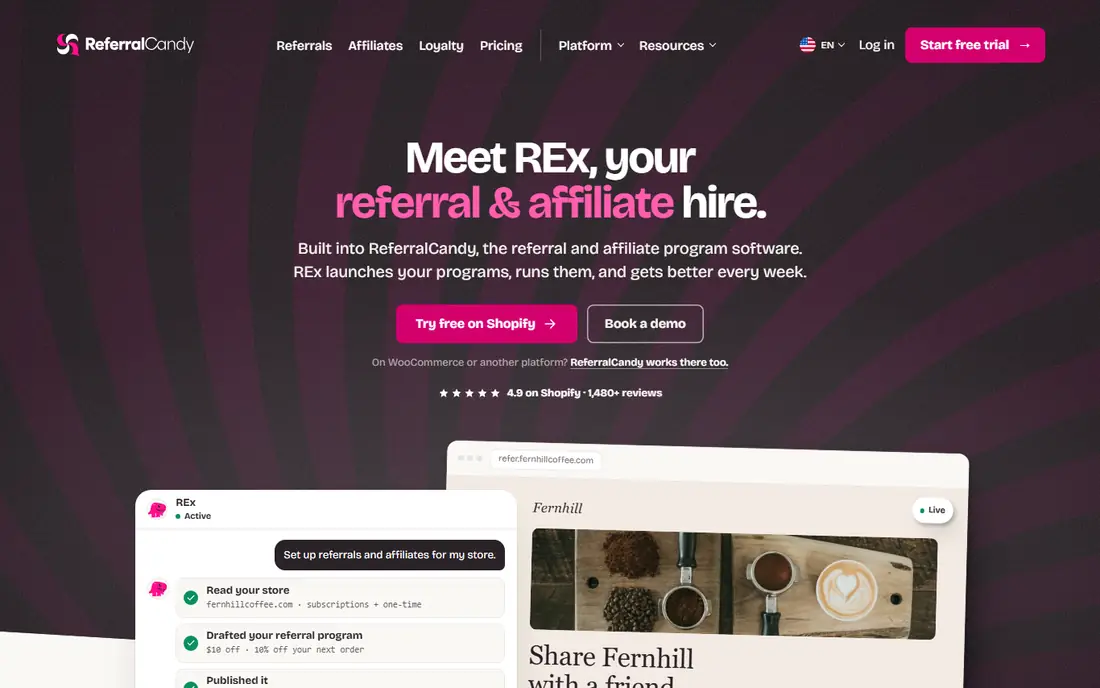
ReferralCandy is built for ecommerce stores that want referrals running quickly. Connect your store, choose a reward for the referrer and the friend, and the platform handles links, tracking, and reward emails. Its pricing combines a monthly fee with a success fee on referred sales, which keeps upfront cost low for small stores but adds up as referral volume grows.
That model is fair for stores testing referrals, but larger stores should model the total cost at their expected referral revenue. If referrals become a large share of sales, a flat-fee tool may cost less overall. For a first referral program, though, ReferralCandy's speed and simplicity are hard to beat.
- Fast setup for Shopify and WooCommerce
- Automated referral tracking
- Success-fee model ties cost to results
- Success fee applies on every plan
- Referral-only focus means no full loyalty suite

Referral Rock suits businesses that do not sell through a simple online checkout, such as agencies, clinics, home services, and B2B companies. Referrers get a portal where they can share links, track their referrals, and see rewards, while staff can approve referrals before rewards go out. That approval step matters when a referral is a lead, not an instant sale.
The price reflects that broader scope, starting higher than ecommerce-only tools. Small stores may find it heavy, but service businesses that need lead tracking, staff referrals, and partner referrals in one place will find it more useful than a checkout-focused tool.
- Hosted member portal
- Referral tracking for leads and sales
- Works beyond ecommerce
- Approval workflows
- Higher starting price
- Less ecommerce-native than ReferralCandy

Friendbuy serves fast-growing consumer and subscription brands that need referral programs to work across web, email, and mobile. It offers one-click integrations with major ecommerce platforms, plus tools for referrals, loyalty, and ambassador programs. Reporting goes beyond simple referral counts, helping teams see which segments and channels drive real customers.
Pricing is quote only, which means small businesses cannot easily budget for it without a sales call. For brands at scale, that trade-off buys depth and support. For a small store, start with a published-price tool and move to Friendbuy when referral volume justifies a custom contract.
- Strong ecommerce integrations
- Referral plus loyalty options
- Advanced segmentation and reporting
- Quote-only pricing
- Better suited to mid-market and enterprise budgets
Yotpo bundles loyalty points and referrals, so a customer can earn points for purchases, reviews, and referrals in one program. That combination suits Shopify brands that want retention in one place rather than separate tools for each job. A free tier lets small stores start, and paid tiers add more orders, features, and support.
Watch the order-volume tiers. A store that grows past the free or entry tier will pay more, and adding reviews or SMS modules adds cost too. If you only need referrals, a referral-only tool may be cheaper. If you want loyalty and referrals together, Yotpo's bundle is a strong, coherent choice.
- Free starting tier
- Loyalty and referrals in one platform
- Shopify-native setup
- Reviews and SMS add-ons available
- Realistic use needs a paid tier
- Costs rise with order volume
- Suite pricing can grow complex
GrowSurf is designed for software and app companies that want referrals inside the product, not just on a checkout page. Users can share referral links from within the app, track progress, and earn rewards tied to signups, trials, or paid conversions. Its API and webhooks help product teams connect referral data to billing and analytics.
That product focus means it is less suited to a simple retail store. The starting price also puts it out of reach for very early startups. For a SaaS company with a working product and a growth goal, GrowSurf's in-product approach usually converts better than a generic referral form.
- Built for SaaS and product referrals
- API and webhooks
- In-product referral widgets
- Fraud controls
- Higher price for small startups
- Ecommerce features are less central
Referral Factory helps teams launch a referral program without code, using templates for landing pages, emails, and reward flows. It works for customer referrals, affiliate-style programs, and offline referrals through codes, which suits startups, agencies, and mid-size companies that need to move fast. Built-in rewards and payout options reduce the manual work of fulfilling incentives.
Templates are a strength and a limit. They speed up launch, but a premium brand may need design work to match its site. Higher tiers add API access and more advanced payout options, so check which tier covers your integration needs before you commit.
- Template-based no-code launch
- Webhooks and API on higher tiers
- Built-in rewards and payouts
- Online and offline referrals
- Some advanced features need higher tiers
- Template look may need customization for premium brands
Viral Loops is best for campaigns with a start and an end, such as a product launch, a waitlist, or a giveaway. Templates cover the common campaign types, and the setup is simple enough for a small marketing team without developers. That focus makes it a good tool for startups and newsletters that need a burst of signups.
It is not a full replacement for an ongoing referral program with complex approval and payout rules. Teams that need long-term B2B referral tracking should look at Referral Rock or Friendbuy instead. For a launch campaign, Viral Loops gives you a fast, low-cost way to test whether referrals work for your audience.
- Low starting price
- Templates for waitlists, giveaways, and referral contests
- Easy setup for non-technical teams
- Less suited to ongoing B2B referral tracking
- Advanced features need higher tiers
Mention Me serves larger retail and ecommerce brands that want to test and optimize referrals systematically. Its Name Share feature lets customers refer by name at checkout, which can catch referrals that a link alone would miss. A/B testing and predictive tools help teams improve share prompts, incentives, and timing over time.
That depth comes with enterprise pricing and a sales-led process, so small stores should not start here. For a larger brand where referrals already drive meaningful revenue, Mention Me's testing and optimization tools can lift results in a way that a simple referral form cannot.
- Name-sharing referral feature
- A/B testing
- Predictive referral optimization
- Strong retail reporting
- Quote-only pricing
- Geared to larger brands, not small stores
How we picked these
We compared official pricing pages, feature documentation, and public reviews for referral marketing tools operating in 2026, focusing on tools that track referrals, issue rewards, and prevent fraud. We favored tools with clear integrations, approval workflows, and a track record in ecommerce, SaaS, or services. We excluded generic affiliate networks and simple discount-code tools that do not track referrers. Prices shown are published starting prices where available, or a quote-only note where the vendor does not publish a price.
What to check before you buy
Start with your referral journey. Where does sharing happen, in the product, at checkout, by email, or in person? A tool that fits that moment will convert better than a tool with more features in the wrong place. Map the journey first, then shortlist tools that support it natively.
Next, model total cost at three volumes: your current referral level, double that, and five times that. Success fees, commissions, and order tiers can make a cheap tool expensive at scale, and a flat-fee tool expensive at low volume. Ask vendors to model your expected volume in writing.
Rewards and fraud controls
Choose a reward your margins can support, and make it double-sided when you can, so both referrer and friend benefit. Then check fraud controls: duplicate account detection, self-referral rules, approval workflows, and reward delays until a referral is confirmed. Without those controls, a generous reward invites abuse.
Integrations and reporting
Confirm integrations with your store, CRM, email platform, and analytics tool before you buy. Referral data should flow into revenue reports, not sit in a separate dashboard. Ask for a demo using your own store or CRM data, and check whether referral attribution survives email clicks, app installs, and offline codes.
FAQ
What is the best referral marketing software?
For Shopify stores, ReferralCandy is a strong starting point. For service and B2B businesses, Referral Rock fits better. For SaaS companies, GrowSurf is built for in-product referrals. The best tool depends on where your customers share and how you define a converted referral.
What is the best referral marketing platform for ecommerce?
ReferralCandy and Yotpo Loyalty and Referrals are the most ecommerce-native options here. ReferralCandy is simpler and referral-only, while Yotpo adds loyalty points, reviews, and SMS in one suite. Choose ReferralCandy for a focused referral program and Yotpo when you want loyalty and referrals together.
How much does referral marketing software cost?
Published starting prices range from free for Yotpo's entry tier and $35 per month for Viral Loops to $250 per month for Referral Rock, with Friendbuy and Mention Me priced by quote. Add success fees, commissions, and order-volume tiers to the monthly fee to get the true cost at your volume.
How do I stop referral fraud?
Use approval workflows, delay rewards until a referral is confirmed, block self-referrals, and watch for duplicate accounts and unusual patterns. Tools such as Referral Rock, GrowSurf, and Friendbuy offer fraud controls and approval steps. Review referral quality monthly, not just referral count.
Should I offer a discount or cash for referrals?
Discounts and store credit work well for ecommerce, because they bring the friend back to buy and keep cost tied to a sale. Cash works better for services and B2B, where the referrer may not be a repeat buyer. Test a double-sided offer first, then adjust the value based on conversion rate and margin.