Best Property Management Software in 2026: 8 Platforms Compared
Compare the best property management software for 2026, with rent collection, accounting, maintenance tracking, and pricing for landlords of all sizes.
- Editor's choice
 DoorLoop
Small landlords who want an easy setup
Starts at$69 per monthVisit doorloop.comFull review - Great alternative
 Buildium
Growing portfolios that need stronger accounting
Starts atSee websiteVisit buildium.comFull review - Also consider
 AppFolio
Larger management companies and mixed portfolios
Starts atSee websiteVisit appfolio.comFull review
TL;DR:
- The right platform depends mainly on how many units you manage, not on which platform has the longest feature list.
- DoorLoop and Avail suit small landlords, Buildium and Rentec Direct suit growing portfolios, and AppFolio suits larger management companies.
- Rent collection, tenant screening, maintenance tracking, and owner reporting are the core features to compare first, before add-ons.
- Most platforms price by unit count or by plan tier, so get a quote for your exact unit count rather than comparing headline prices alone.
- Our pick for most small landlords is DoorLoop for its ease of setup, while Buildium is our pick for landlords who need deeper accounting.
Quick comparison
| Tool | Best for | Starts at | Free plan? | |
|---|---|---|---|---|
| DoorLoop | Small landlords who want an easy setup | $69 per month | Free trial | Visit |
| Buildium | Growing portfolios that need stronger accounting | See website | Free trial | Visit |
| AppFolio | Larger management companies and mixed portfolios | See website | No | Visit |
 Rent Manager | Managers who want deep customization | See website | Free trial | Visit |
 Rentec Direct | Small to mid-size landlords seeking value | See website | Free trial | Visit |
 TenantCloud | Independent landlords who want a low-cost start | See website | Yes | Visit |
 Yardi Breeze | Small to mid-size portfolios that may grow into Yardi | See website | Free trial | Visit |
 Avail | DIY landlords with a few rental units | Free | Yes | Visit |
The best property management software
Good property management software saves time on rent collection, leases, maintenance, and owner reports, and it reduces the errors that come from spreadsheets and email threads. We compared official feature pages, pricing pages, and plan structures to build this list.

DoorLoop is our pick for most small landlords because it is easy to set up and covers the daily jobs well. Rent collection, lease tracking, maintenance requests, tenant screening, and owner accounting are all in one dashboard, and the guided onboarding helps a first-time user get a property live without a long training session. For a landlord with up to about 20 units, that combination is hard to beat.
The limits appear as a portfolio grows more complex. Multi-entity accounting, advanced custom reporting, and some enterprise workflows are thinner than on Buildium or AppFolio. Pricing also rises with unit count, so a landlord with 50 units should compare the total cost carefully. For a small portfolio, though, DoorLoop offers the best balance of simplicity and completeness.
- Guided onboarding
- Rent collection and leases in one place
- Strong support reputation
- Advanced reporting is thinner than larger platforms
- Pricing rises with unit count

Buildium has long been a standard choice for landlords moving beyond a handful of units. Its accounting tools are deeper than most small-landlord platforms, with trust accounting, owner statements, and reporting that holds up when you have several owners or entities. Leasing, tenant screening, maintenance, and a tenant portal are all included, so the daily workflow stays in one system.
That depth comes with a learning curve. New users may need more time to set up chart of accounts and reporting correctly, and the entry price is now closer to DoorLoop than it once was. For a landlord with 20 to 500 units, or a small management company, Buildium is still one of the most reliable choices, especially when clean books matter to owners.
- Strong accounting tools
- Leasing and tenant portal
- Good reporting
- Higher learning curve than DoorLoop
- Entry pricing has risen
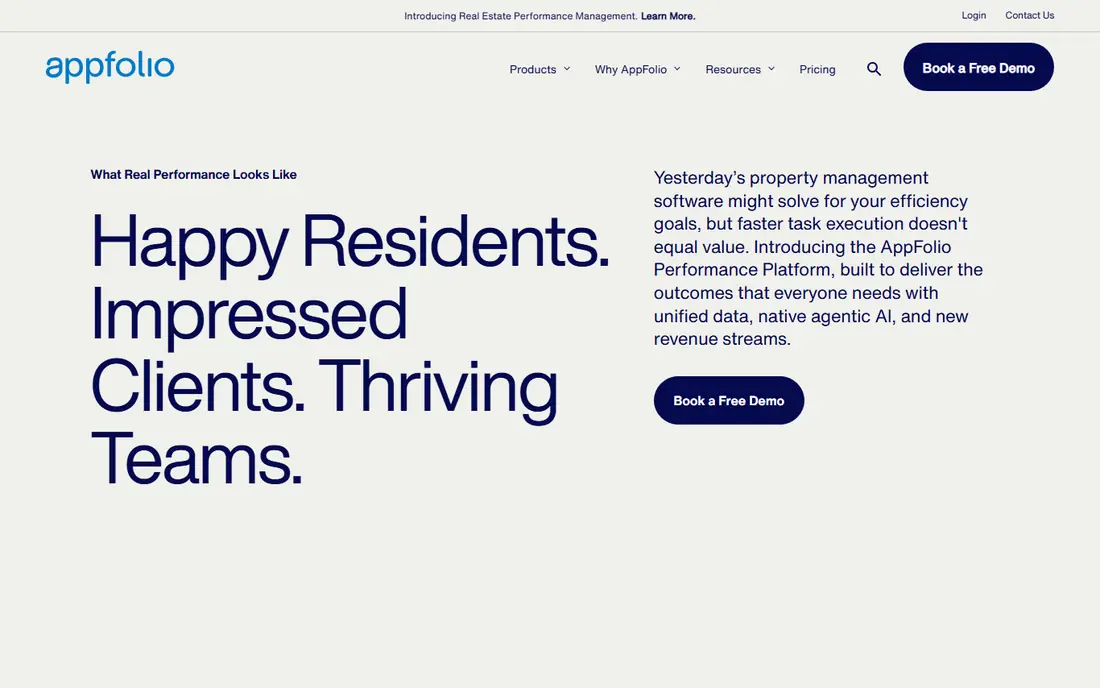
AppFolio is built for management companies rather than single landlords. It handles residential, commercial, student, and mixed portfolios in one cloud platform, with marketing, leasing, accounting, maintenance, and resident communication included. Its mobile experience is strong for both managers and residents, which helps when teams work in the field.
The main barrier is access and cost. Pricing is quote-based, and some plans have minimum unit counts or minimum spend, so a landlord with a few units will find it out of reach. Implementation also takes more planning than a small-landlord tool. For a company managing hundreds of units and planning to grow, AppFolio is a leading option to evaluate.
- Unified platform
- Marketing and leasing tools
- Mobile-first design
- Quote-only pricing
- Minimum unit requirements on some plans
Rent Manager appeals to operators who want to shape the software around their own processes, rather than fitting their processes to the software. It offers extensive customization for accounting, reporting, leasing, and maintenance, and it handles a wide range of property types, including residential, commercial, and affordable housing. Its support team is frequently praised by long-term users.
Customization has a cost in time. Setup and training take longer than on simpler platforms, and the interface is less modern than DoorLoop or AppFolio. For a mid-size or large operator with specific workflows, that trade-off is worth it. For a landlord who wants to be live this week, a simpler platform will feel faster.
- Highly customizable
- Strong accounting
- Good customer service reputation
- Interface feels dated to some users
- Setup takes time
Rentec Direct is a value-focused platform that includes full accounting, rent collection, tenant screening, maintenance tracking, and owner portals without forcing landlords into an enterprise price. It suits landlords and small managers who want a complete system at a fair monthly cost, and it has a long track record in the US market.
The interface is functional rather than polished, and some users will find it less modern than DoorLoop. Advanced features such as certain integrations or marketing tools may require higher tiers. If value and complete accounting matter more to you than a sleek design, Rentec Direct deserves a trial.
- Full accounting included
- Online payments
- Tenant and owner portals
- Design is functional rather than polished
- Some advanced features need higher tiers
TenantCloud is aimed at independent landlords, and its free tier makes it easy to test without a credit card commitment. The free and paid plans cover rent collection, online leases, maintenance requests, and tenant communication, which are the core jobs for a landlord with a few units. Paid plans add accounting depth, screening, and additional units.
The limits show up as a portfolio grows. Reporting and accounting depth are not as strong as Buildium, and some integrations are thinner. TenantCloud is best for a landlord starting out, or for someone who wants to manage a small portfolio at low cost. If you outgrow it, moving to Buildium or DoorLoop later is a normal path.
- Free tier for basic use
- Rent collection and leases
- Maintenance requests
- Advanced reporting is limited
- Some features require paid plans
Yardi Breeze is the small-portfolio product from Yardi, a major name in property technology. It offers accounting, rent collection, leasing, maintenance, and marketing in a single system, with the benefit of a vendor that also serves large portfolios. That matters if you expect to grow, since the upgrade path to larger Yardi products is clearer than with a standalone small tool.
Pricing is often quote-based, which makes quick comparison harder, and some features take time to learn. Yardi Breeze suits landlords and small managers who want a vendor with scale behind it, and who value accounting depth over the simplest possible setup. It is a solid alternative to Buildium for portfolios in the small to mid-size range.
- Backed by Yardi
- Solid accounting
- Marketing and leasing tools
- Pricing is quote-based for many users
- Learning curve for some features
Avail, owned by Realtor.com, is built for do-it-yourself landlords rather than management companies. Its free tier covers listings, applications, state-specific lease templates, and rent collection, which is enough for many landlords with one to five units. Paid plans add screening bundles, faster payments, and additional features.
Accounting and owner reporting are simpler than on Buildium or Rent Manager, so a landlord with multiple owners or complex books will outgrow Avail. For a landlord starting with a single rental, though, Avail is one of the easiest and lowest-cost ways to collect rent online, screen tenants, and use a proper lease. It is a practical first platform.
- Free tier for landlords
- State-specific leases
- Simple rent collection
- Limited accounting depth
- Fewer tools for larger portfolios
How we picked these
We compared official feature pages, pricing pages, and plan structures for property management platforms available in the United States in October 2026. We kept only platforms with rent collection, lease management, maintenance tracking, and tenant communication, and with a clear pricing or trial path. We left out platforms that only listed rentals, platforms with no US landlord offering, and platforms with no verifiable homepage.
How to choose the right platform
Start by counting your units and owners, then list the jobs you do every month. A landlord with three units needs reliable rent collection and a lease template. A manager with 100 units needs trust accounting, owner statements, maintenance workflows, and staff permissions. Choosing a platform built for your size avoids paying for enterprise features you will not use, or outgrowing a simple tool within a year.
Compare total cost, not just the headline price
Ask what is included in the base price and what costs extra. Tenant screening, online payment processing, website hosting, and additional units often carry separate fees. Run the total for your exact unit count across two or three platforms, and check whether annual billing saves enough to justify the commitment. A free trial is useful, but only if you test with a real property, a real lease, and a real payment flow.
Test the daily workflow before you commit
During a trial, collect a rent payment, create a maintenance request, send a tenant message, and generate an owner statement. Those four tasks reveal more than a feature list, because they show how many clicks each job takes and whether the interface makes sense to your team and your tenants. Also check data export options, since you should be able to leave a platform with your leases, ledgers, and tenant records intact.
FAQ
What does property management software do?
It brings rent collection, leases, tenant screening, maintenance requests, accounting, and owner reporting into one system. Instead of tracking rent in a spreadsheet, leases in email, and repairs in text messages, you manage them from a single dashboard that tenants and owners can also access.
How much does property management software cost?
Pricing varies by platform and unit count. Small-landlord tools may start free or at a modest monthly price, mid-size platforms often charge per month by tier, and larger platforms use quote-based pricing. Always get a quote for your exact unit count, and ask about screening and payment processing fees.
Can tenants pay rent online?
Yes, all platforms on this list offer online rent collection, usually by bank transfer and sometimes by card. Bank payments are typically cheaper than card payments, and some platforms charge tenants or landlords a processing fee. Check who pays the fee and how long payouts take.
Do I need property management software for one rental unit?
Not always, but it can still help. A free or low-cost tool such as Avail or TenantCloud gives you a proper lease, online rent collection, and a record of payments and maintenance, which is useful if a dispute arises. For one unit, keep it simple and avoid a platform built for hundreds of units.
Can I switch platforms later?
Yes, but switching takes planning. Export your leases, tenant ledgers, owner statements, and maintenance history before you cancel, and time the switch between tenancies or at month end where possible. Check that the new platform can import your data, or budget time to enter it manually.