Best Project Management Tools for Marketing Teams in 2026: 8 Tools Compared
Compare the best project management tools for marketing teams in 2026, with campaign planning, content calendars, approvals, and dashboards for agencies.

- Editor's choice
 Asana
Marketing teams that need structured workflows and portfolios
Starts atFrom $10.99 per user per monthVisit asana.comFull review - Great alternative
 monday.com
Visual marketing teams that want boards and dashboards
Starts atFrom $9 per seat per monthVisit monday.comFull review - Also consider
 ClickUp
Teams that want many features at a lower price
Starts atFrom $7 per user per monthVisit clickup.comFull review
TL;DR:
- Campaign visibility matters more than task count, so dashboards, calendars, and portfolios decide most choices.
- Approval and proofing workflows separate marketing tools from generic task lists, especially for creative teams.
- Per-seat pricing and minimum seat counts change team costs, so model your real team size before comparing headlines.
- Free plans suit very small teams, but timeline, automation, and portfolio views usually need paid plans.
Quick comparison
| Tool | Best for | Starts at | Free plan? | |
|---|---|---|---|---|
| Asana | Marketing teams that need structured workflows and portfolios | From $10.99 per user per month | Yes | Visit |
| monday.com | Visual marketing teams that want boards and dashboards | From $9 per seat per month | Free trial | Visit |
| ClickUp | Teams that want many features at a lower price | From $7 per user per month | Yes | Visit |
 Wrike | Creative and marketing operations teams with review cycles | From $10 per user per month | Yes | Visit |
 Trello | Small marketing teams that want simple Kanban boards | From $5 per user per month | Yes | Visit |
 Smartsheet | Marketing and operations teams that prefer spreadsheet planning | From $9 per user per month | Free trial | Visit |
 CoSchedule | Content and social teams that need one marketing calendar | From $19 per user per month | Free trial | Visit |
 Teamwork.com | Agencies managing multiple client marketing projects | From $10.99 per user per month | Free trial | Visit |
The best project management tools for marketing teams
We compared project management tools used by marketing teams, focusing on campaign planning, content calendars, approvals, workload views, and integrations with design, social, and CRM tools. Prices are from vendor and comparison pages checked in September and October 2026, and teams should confirm current pricing before signing, since plans change often.

Asana suits marketing teams that run many campaigns with dependencies, since timeline views, task dependencies, and portfolios show how work rolls up to goals. Starter costs 10.99 dollars per user per month billed annually, with unlimited automations from that tier, which helps teams that route work without manual triage.
The free Personal plan covers only up to two users, so most teams will pay from the start. Portfolios, goals, and advanced reporting sit on higher tiers, so check which tier includes the visibility your managers actually need before committing.
- Timeline and dependencies
- Portfolios and goals
- Unlimited automations from Starter
- Many marketing templates
- Free plan covers only up to two users
- Portfolios and advanced reporting need higher tiers
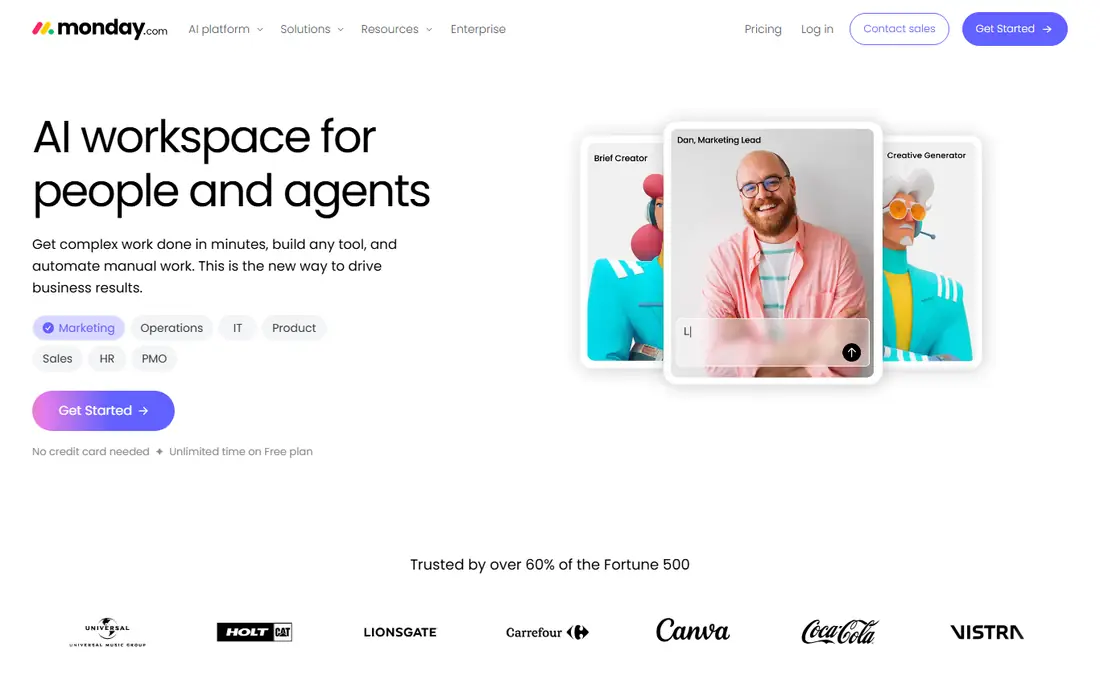
monday.com suits visual marketing teams that plan campaigns on boards and want dashboards for status, budgets, and workload. Basic starts at 9 dollars per seat per month billed annually, with Standard around 12 dollars per seat per month adding timeline and more automations.
The catch is automation limits. Basic has no automations, Standard allows 250 actions per month, and higher tiers add more, so teams that automate heavily need Pro. A three-seat minimum on many plans also affects very small teams, though the free plan covers up to two seats.
- Visual boards and dashboards
- Campaign and content templates
- Workload and resource views
- Basic plan has no automations
- Three-seat minimum on many plans
- Costs rise with dashboards and AI

ClickUp suits teams that want one login for tasks, docs, whiteboards, and chat, with Unlimited plans from about 7 dollars per user per month. Its free plan is generous, and custom statuses and views let marketing teams shape workflows for campaigns, content, and social work.
The breadth creates a learning curve, since teams can spend time configuring views before work starts. AI features cost extra at about 9 dollars per user per month, so budget for that if AI summaries and drafting matter. For value per feature, ClickUp is hard to beat.
- Many views including docs, whiteboards, and chat
- Custom statuses
- Generous free plan
- Strong value
- Learning curve can be steep
- AI features cost extra per user
Wrike suits marketing operations and creative teams that live on intake forms, review cycles, and approvals. Team plans start around 10 dollars per user per month, with configurable workflows, collaboration tools, and resource views that help managers balance creative workloads.
The free plan allows unlimited users with caps, so most serious teams will pay. Proofing and advanced resource features may need higher tiers, so test approval workflows with real design files before committing, since that is where Wrike should earn its price.
- Intake forms and request workflows
- Proofing and approvals
- Resource views for creative teams
- Free plan has caps
- Proofing depth may need higher tiers or add-ons
Trello suits small marketing teams that want a simple board for content planning, social posts, and campaign tasks. Standard starts around 5 dollars per user per month, with a free plan for up to 10 boards, and setup takes minutes rather than days.
The limit is scale. Complex campaigns with dependencies, portfolios, and workload planning outgrow Trello quickly, and teams often migrate to Asana or monday.com as they grow. For a small team with one or two campaigns at a time, that simplicity is a strength.
- Simple Kanban boards for content planning
- Easy setup
- Low learning curve for small teams
- Limited for complex campaigns
- Portfolios, workload, and advanced reporting need other tools
Smartsheet
Best for: Marketing and operations teams that prefer spreadsheet planning
Smartsheet suits teams that think in spreadsheets but need dashboards, Gantt charts, and portfolio reporting. Pro plans start around 9 dollars per user per month billed annually, with grid views that finance and operations managers often prefer over Kanban boards.
Creative teams that want visual boards and proofing may find it less appealing than Wrike or monday.com. It earns its place for marketing operations, event planning, and campaign portfolios where grid planning and reporting matter more than visual flair.
- Spreadsheet-style grid with dashboards and Gantt charts
- Portfolio reporting
- Familiar for PMO teams
- Less visual than monday.com for creative teams
- Learning curve for non-spreadsheet users
CoSchedule suits content and social teams that need one calendar for blogs, social posts, and campaigns, rather than separate tools for planning and scheduling. Plans start around 19 dollars per user per month, with a unified calendar that shows what publishes when across channels.
The trade-off is breadth. As a general project management tool, CoSchedule is narrower than Asana or monday.com, so teams with complex dependencies or portfolios may still need another tool. For content-led marketing, the calendar focus is the main draw.
- Unified marketing calendar for content and social
- Campaign planning
- Social scheduling links
- Narrower as a general project tool
- Pricing rises for larger teams
Teamwork.com is built for agencies that manage multiple client projects, with project templates, time tracking, and client reporting that help teams show progress and billable work. Starter plans start around 10.99 dollars per user per month.
In-house teams without client work may find agency features unnecessary, and portfolio features sit on higher tiers. Agencies should test client access, permissions, and reporting, since those features decide whether Teamwork fits better than Asana or monday.com for client delivery.
- Built for client delivery
- Project templates
- Time tracking and client reporting
- Less suited to in-house teams without client work
- Higher tiers add portfolio features
How we picked these
We compared official feature pages, pricing pages, and public reviews for each tool, and we checked that each product exists, works today, and truly fits the topic. Where a vendor quotes rather than publishes a price, we say so instead of guessing a number.
We also weighed fit for different team sizes, since the best choice for a solo operator is rarely the best choice for a larger team. That is why the list mixes well-known leaders with smaller options that suit narrower needs, and why each write-up names an honest weakness as well as a strength.
How to choose a project management tool for marketing
Start with how campaigns actually flow through your team. Map intake, briefing, creation, review, approval, and publishing, then check which tool handles each step without workarounds. A tool that looks good for tasks but fails on approvals will slow creative work.
Test the calendar and approval views
Ask for a marketing calendar that shows campaigns, content, and social posts together, plus proofing or approval workflows for design files. Creative teams waste time when approvals happen by email while tasks live in another system.
Check workload and capacity honestly
Workload views help managers spot overloaded designers and writers before deadlines slip. Test them with real team members and real hours, not demo data, and check whether capacity planning needs a higher tier.
Count seats and automation limits
Some plans charge per seat with a minimum, and some limit automations on lower tiers. Model your team size, plus freelancers and clients if they need access, and check automation limits against how many rules your campaigns will actually use.
Before you pay, run a short trial with your real work, not a demo dataset. Check setup time, support response, and the total monthly cost at your real user or volume level. A tool that passes that test is far more likely to still suit you in six months than a tool chosen from a feature list alone.
FAQ
What is the best project management tool for marketing teams?
Asana suits structured marketing teams that need dependencies and portfolios, while monday.com suits visual teams that want boards and dashboards. ClickUp suits teams that want many features at a lower price, and Wrike suits creative teams with heavy review cycles.
How much do marketing project management tools cost?
Entry paid plans range from about 4 dollars per user per month for Zoho Projects to about 12 dollars per user per month for monday.com Standard, with Asana Starter at 10.99 dollars per user per month. Free plans suit very small teams, but paid plans add timelines and automation.
Do marketing teams need a separate content calendar tool?
Not always. Tools such as CoSchedule combine a marketing calendar with project work, while Asana, monday.com, and ClickUp include calendar views. Teams with heavy social publishing may still add a social tool for scheduling and analytics.
What features matter most for marketing project management?
Campaign templates, content calendars, approval workflows, workload views, and integrations with design and CRM tools matter most. Reporting by campaign and channel helps managers show results, not just completed tasks.
Can clients and freelancers use these tools?
Yes, most tools allow guests or collaborators, but limits and pricing vary. Check guest access, permissions, and whether clients count toward paid seats before inviting external partners into your workspace.