Best Platforms for Influencers in 2026: 8 Platforms Compared
Compare the best platforms for influencers in 2026, from Aspire and Grin to Upfluence, CreatorIQ, and Heepsy, with discovery, campaigns, and pricing today.

- Editor's choice
 Aspire
Ambassador and creator programs
Starts atSee websiteVisit aspire.ioFull review - Great alternative
 Grin
Ecommerce creator management
Starts atSee websiteVisit grin.coFull review - Also consider
 Upfluence
Customer-to-creator discovery
Starts atSee websiteVisit upfluence.comFull review
TL;DR:
- The best influencer marketing platform depends on whether you are a brand, an agency, or a creator looking for work.
- Aspire, Grin, and Upfluence suit ecommerce brands that need discovery, gifting, and sales tracking.
- CreatorIQ and Traackr suit large enterprises that need compliance, measurement, and global scale.
- Heepsy and Modash suit smaller teams that need discovery and vetting without an enterprise contract.
Quick comparison
| Tool | Best for | Starts at | Free plan? | |
|---|---|---|---|---|
| Aspire | Ambassador and creator programs | See website | No | Visit |
| Grin | Ecommerce creator management | See website | Free trial | Visit |
| Upfluence | Customer-to-creator discovery | See website | No | Visit |
 CreatorIQ | Enterprise creator programs | See website | No | Visit |
 Traackr | Enterprise measurement | See website | No | Visit |
 Influencity | Mid-size brand campaigns | See website | Free trial | Visit |
 Modash | Creator discovery and vetting | $199 per month | Free trial | Visit |
 Heepsy | Affordable influencer search | See website | Yes | Visit |
The best platforms for influencers
We compared official feature pages, pricing pages, app store listings, privacy policies, and public reviews to find platforms that help brands find creators, run campaigns, track results, and pay creators, and that help creators find brand work.

Aspire suits ecommerce and consumer brands that run ongoing ambassador and creator programmes, not just one-off posts. The marketplace helps you find creators, manage briefs and content approvals, and track sales through affiliate links and codes. That end-to-end flow reduces the spreadsheet work that grows with a larger programme. Smaller brands may find the quote-based pricing and annual terms a barrier. Aspire works best when you have regular creator activity and a team to manage it. If you only need a few creators a year, a discovery tool such as Heepsy or Modash may be cheaper.
- Large creator marketplace
- Campaign workflow and briefs
- Affiliate and promo-code tracking
- Pricing is quote-based
- Best value for mid-market and larger brands

Grin is built as a creator management system for ecommerce brands, with a focus on Shopify. You can manage creator relationships like a CRM, send products, track affiliate sales, and handle payments in one place. That Shopify fit is the main reason many direct-to-consumer brands choose it. The platform is heavier than a simple search tool, so small teams should trial the workflow with a real campaign before committing. Pricing also depends on volume and features, so get a written quote for your expected creator count. For a growing ecommerce programme, Grin scales well.
- Strong Shopify integration
- Creator CRM and workflow
- Gifting, affiliate, and payment tools
- Pricing varies by plan and needs a quote or trial
- Setup takes time for large catalogues
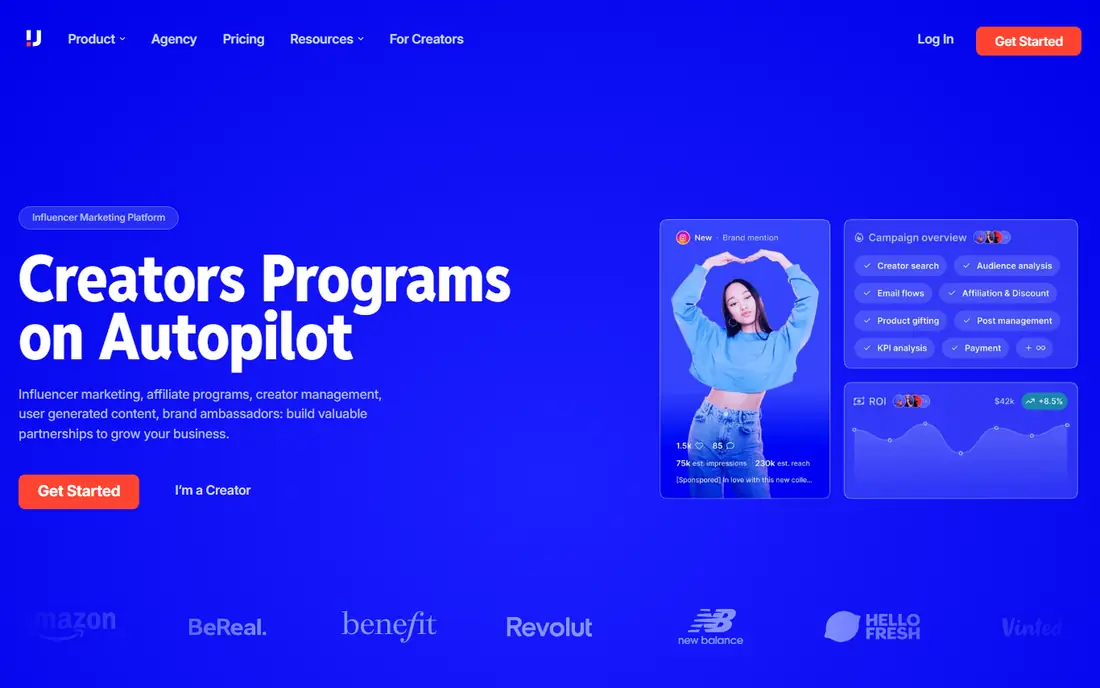
Upfluence stands out for finding creators inside your customer base, which suits brands that want authentic advocates rather than cold outreach. It also offers creator search, campaign management, and payment tools, with integrations for Shopify and WooCommerce. That customer-first angle can improve response rates and content fit. Pricing needs a demo and quote, and annual terms are common, so small brands should compare total yearly cost with self-serve options. For ecommerce brands with a large customer list, the ability to turn buyers into creators is a practical advantage.
- Finds creators among your own customers
- Strong ecommerce integrations
- Built-in creator payments
- Quote-based pricing
- Annual terms on many plans
CreatorIQ suits global brands and agencies that run large, complex creator programmes with strict compliance needs. Discovery, workflow, payments, and reporting sit in one enterprise system, with brand safety checks that matter for regulated or high-profile brands. Measurement tools help teams compare creators and campaigns across regions. The cost and setup put it out of reach for small brands. Implementation can take weeks, and pricing is custom. For an enterprise team that needs governance, scale, and consistent reporting, CreatorIQ is one of the strongest options in this list.
- Large creator database
- Strong compliance and brand safety tools
- Deep reporting and measurement
- Enterprise pricing only
- Implementation takes time
Traackr focuses on measurement, benchmarking, and audience quality, which suits brands that need to justify creator spend with data. You can compare creators, track campaign impact, and check audience authenticity before you commit budget. That focus helps teams that report results to senior leaders. It is not a low-cost self-serve tool, and smaller brands will find the pricing and setup heavy. For a large brand that runs many campaigns and needs consistent measurement across markets, Traackr gives a clearer picture than a simple search database.
- Strong audience quality and benchmarking
- Global creator data
- Clear campaign measurement
- Enterprise pricing
- Less suited to small, self-serve campaigns
Influencity suits mid-size brands and agencies that want visual campaign boards plus detailed creator data. Discovery filters, audience analysis, and campaign tracking sit together, so a team can move from search to outreach to reporting without many separate tools. The visual layout helps managers track many creators at once. Pricing depends on the modules you choose, so confirm which features sit in your plan during a trial. The depth can also feel large at first, so start with one campaign and learn the workflow before adding more. For a mid-size programme, the balance of data and usability is strong.
- Visual campaign management
- Deep creator data and audience analysis
- Influencer relationship tools
- Pricing varies by module
- Learning the full tool takes time
Modash is the clearest self-serve pick for teams that mainly need to find and vet creators. The database is large, pricing is published, and you can start without a long sales process. Affiliate-linked tracking helps ecommerce teams connect creator posts to sales, even without a full CRM suite. Campaign management is lighter than Aspire or Grin, so teams that need deep workflow, gifting, and payments may need another tool alongside it. For discovery-first work, such as building a shortlist, checking audience quality, and running outreach, Modash is efficient and transparent on price.
- Very large creator database
- Clear pricing for self-serve teams
- Affiliate-linked tracking
- Campaign workflow is lighter than full suites
- Payment tools are less central
Heepsy suits small brands, startups, and creators who need to search for influencers without an enterprise budget. The free plan lets you test searches and profile views, while paid plans add more filters, lists, and data. Fake-follower checks help you avoid creators with inflated audiences. It is a search tool first, not a full campaign suite, so larger programmes will need extra tools for contracts, payments, and reporting. For a first influencer campaign, or for finding a handful of creators in a niche, Heepsy gives a low-cost, practical start.
- Free plan for basic search
- Fake-follower detection
- Affordable paid plans for small teams
- Campaign tools are lighter than enterprise suites
- Data depth varies by network
How we picked these
We compared official feature pages, pricing pages, app store listings, privacy policies, and public reviews. We looked for platforms that are active in October 2026, offer creator discovery or campaign management, and serve a real team size, from a small brand to a global enterprise. We included ecommerce-focused suites, enterprise tools, and affordable discovery options, so readers can match a platform to budget and programme size.
How to choose an influencer platform
Start with your programme size, not with database size alone. A huge database helps only if you also have workflow, payment, and reporting tools to use it. Trial with a real campaign brief, and check audience data for creators in your niche.
Decide discovery, management, or both
If you only need to find creators, Modash or Heepsy may be enough. If you run regular campaigns with gifting, approvals, and payments, Aspire, Grin, or Upfluence fit better. Enterprise teams that need compliance and global reporting should shortlist CreatorIQ and Traackr, and budget for implementation time.
Check audience quality and sales tracking
Look for fake-follower detection, audience location, age, and interest data, and test it on creators you already know. For ecommerce, check gifting, affiliate codes, and sales attribution, since those links decide whether you can prove return on spend. Ask how payments and tax documents are handled for creators in your countries.
Price the full year, not the first month
Many enterprise platforms use annual contracts, while self-serve tools charge monthly. Compare the yearly total, seat counts, creator limits, and payment fees. A low monthly price that caps creators or charges high payout fees can cost more than a higher plan with clearer limits.
FAQ
What is the best influencer marketing platform for small businesses?
Heepsy and Modash suit most small businesses, since both offer discovery without enterprise contracts. Heepsy is cheapest to start, while Modash offers deeper data and published pricing. If you run regular ecommerce campaigns, Grin or Upfluence may be worth a trial once volume grows.
What is the best platform for influencer marketing for ecommerce?
Aspire, Grin, and Upfluence lead for ecommerce, thanks to Shopify integrations, gifting, affiliate tracking, and payments. Grin fits Shopify-first brands, Upfluence fits customer-to-creator programmes, and Aspire fits ambassador programmes. Trial the gifting and sales tracking workflow with a real product before you choose.
How do influencers find brand deals on these platforms?
Brands usually search creator databases, post campaign briefs, or invite creators from a marketplace. Creators can also apply to briefs, join marketplaces, or be found through customer data on tools such as Upfluence. A complete profile, clear niche, and recent work samples improve the chance of an invite.
How much does influencer marketing software cost?
Costs range from free search plans at Heepsy to $199 per month at Modash, and to thousands per month or tens of thousands per year for enterprise suites. Self-serve tools publish prices, while enterprise tools quote by programme size. Always get a written yearly quote that includes seats, creator limits, and payment fees.
What should brands check before paying an influencer?
Check audience authenticity, location, engagement quality, and past brand work, not just follower count. Review content style, disclosure practices, and contract terms for usage rights, exclusivity, and payment timing. A small test campaign with clear tracking often reveals more than a large first deal.
Is an influencer platform better than manual outreach?
A platform saves time on discovery, vetting, tracking, and payments once you run regular campaigns. Manual outreach can work for a handful of creators, especially through direct messages and email. If you manage more than ten creators, or need sales attribution, a platform usually pays for itself in time saved.