Best Online Learning Platforms for Kids in 2026: 9 Platforms Compared
Compare the best online learning platforms for kids in 2026. We reviewed 9 learning apps and sites for toddlers to grade schoolers by age, price and free options.

- Editor's choice
 Khan Academy Kids
Free early learning for ages 2 to 8
Starts atFreeVisit khanacademy.orgFull review - Great alternative
 ABCmouse
A full preschool curriculum in one app
Starts at$14.99 per monthVisit abcmouse.comFull review - Also consider
 HOMER
Personalized reading for ages 2 to 8
Starts at$9.99 per monthVisit learnwithhomer.comFull review
TL;DR:
- Khan Academy Kids is the best free starting point for ages 2 to 8: Khan Academy says it is 100% free with no ads and no subscriptions.
- For older kids, Khan Academy itself offers 840+ free courses for K-12 and early college, run by a 501(c)(3) nonprofit.
- ABCmouse and HOMER are the most complete paid programs for preschoolers, at $14.99 and $9.99 per month, and both offer a 30-day free trial.
- IXL is the cheapest structured skill practice for school-age kids, starting at $6 per month for one subject.
- Outschool is different from the rest: it sells live, small-group online classes for ages 3 to 18, with an average of four learners per teacher.
Quick comparison
| Tool | Best for | Starts at | Free plan? | |
|---|---|---|---|---|
| Khan Academy Kids | Free early learning for ages 2 to 8 | Free | Yes | Visit |
| ABCmouse | A full preschool curriculum in one app | $14.99 per month | Free trial (30 days) | Visit |
| HOMER | Personalized reading for ages 2 to 8 | $9.99 per month | Free trial (30 days) | Visit |
 Lingokids | Play-based learning for toddlers | Free | Yes | Visit |
 SplashLearn | Math and reading games, PreK to grade 5 | See website | Free trial | Visit |
 Reading Eggs | Structured learn-to-read lessons | See website | Free trial | Visit |
 IXL | Skill practice for school subjects | $6 per month | No | Visit |
 Khan Academy | Free courses for grade schoolers and up | Free | Yes | Visit |
 Outschool | Live small-group classes with teachers | See website | No | Visit |
The best online learning platforms for kids
We grouped these platforms by age, from toddler apps to resources that last into middle and high school. Prices are what each official site showed when we checked, and trial offers are noted as such.
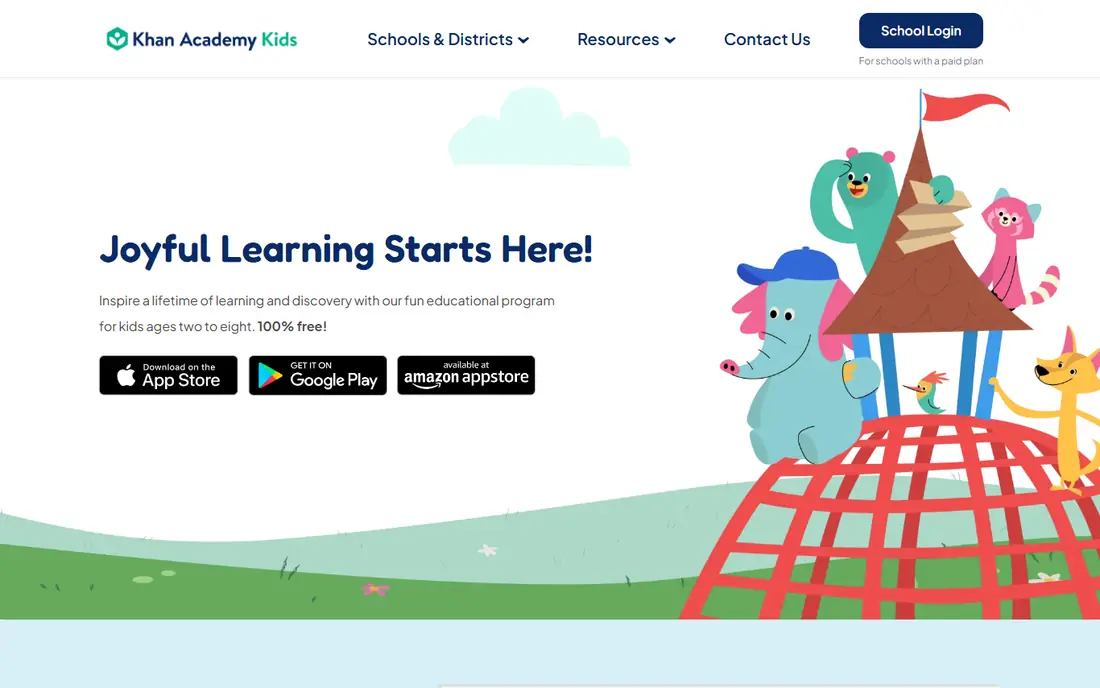
Khan Academy Kids is where we would start with any young child. Khan Academy says the app is 100% free, with no ads and no subscriptions, and is designed for ages 2 to 8. Lessons cover early literacy, reading, writing, language and math, along with social-emotional growth and creative play.
It works well as a daily routine for preschoolers and kindergarteners because activities are short and guided by friendly characters. It is available through the Apple, Google Play and Amazon app stores.
The limit is age. Once a child reads fluently and is working on grade-level math, they will outgrow it, and Khan Academy's main site is the natural next step.
- 100% free with no ads or subscriptions
- Covers early literacy, reading, writing, language and math
- Includes social-emotional learning and creative play
- Only for ages 2 to 8
- Content is app-based rather than a full website
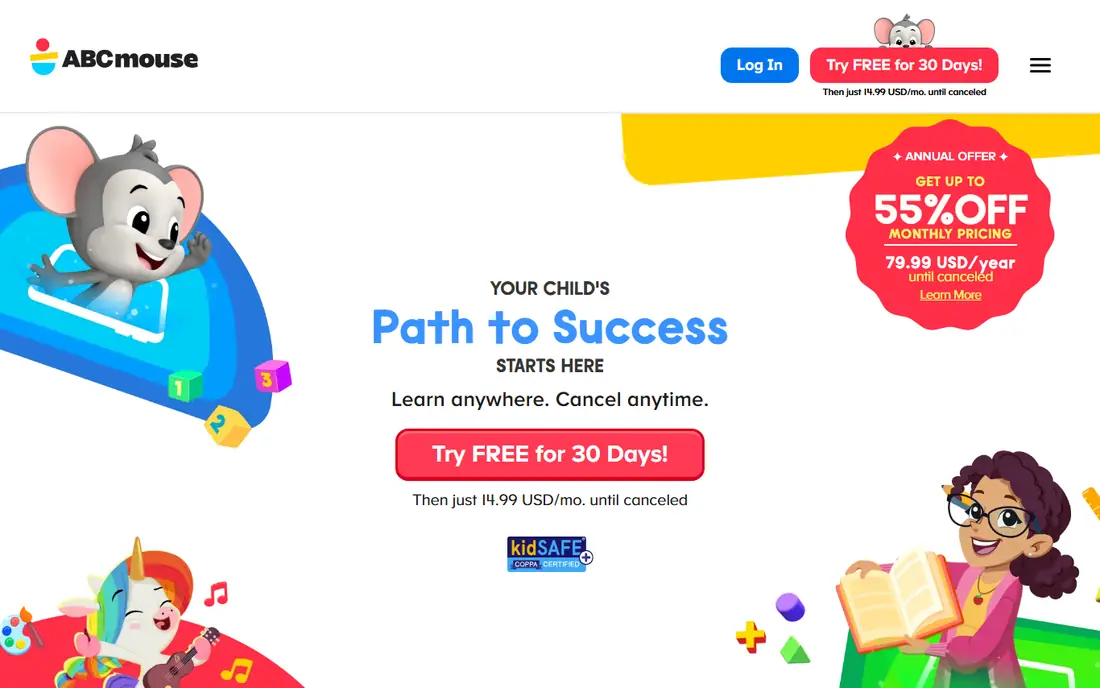
ABCmouse is the most complete paid early-learning program on this list. Its site advertises unlimited access to more than 13,000 activities, up to three child profiles, and subjects from reading and math to science, coding, art and music. Educator-designed learning paths guide kids through reading and math step by step.
Pricing is $14.99 per month after a 30-day free trial, and ABCmouse was showing an annual offer of $79.99 per year when we checked. For a family with two or three young kids, the annual plan with three profiles is solid value.
The honest catch is the ticket-and-rewards system. Some kids love earning tickets for Pet Town and the aquarium, but others spend more time decorating than learning. Check the parent progress view now and then.
- More than 13,000 activities across reading, math, science, art and music
- Up to three child profiles
- Reading and math learning paths
- Monthly price is high compared with free options
- Reward system can distract some kids

HOMER is built around early reading, with math, social-emotional learning, thinking skills and creativity added around it. You tell it your child's age and interests, such as dinosaurs, space or princesses, and it builds a learning path that matches their level.
It costs $9.99 per month or $59.99 per year (about $4.99 per month), with a 30-day free trial. Each plan includes up to 4 child profiles, more than 1,000 activities, and printables for offline practice. HOMER says the app is ad-free.
The trade-off is focus. HOMER is excellent for learning to read, but if your child needs broad math practice, pair it with Khan Academy Kids or SplashLearn.
- Personalized to age, level and interests
- Up to 4 child profiles
- Annual plan works out to $4.99 per month
- Strongest in reading, lighter in other subjects
- Paid after the trial
Lingokids is a playful app aimed at toddlers and young children, mixing learning games, shows, sing-alongs and podcasts. The company says it is designed by parents and educators to make play purposeful, and parent reviews on its site mention children as young as two.
Safety is a strong point. Lingokids says there are no ads, ever, and displays a kidSAFE COPPA Plus certification seal, which matters for an app children use on their own.
The weakness is the paywall. You can download it free, but much of the content sits behind a subscription, and the homepage does not show the price. Check the cost in the app store before your child gets attached.
- Free download
- No ads
- KidSAFE COPPA Plus certified
- Many activities require a subscription
- Pricing not shown on the homepage
SplashLearn covers math and English from preschool through grade 5 using story-based games. Its site says it offers over 8,000 learning games, activities and printable worksheets, plus live classes taught by certified teachers.
Parents get a personalized learning path that breaks practice into daily milestones and weekly progress reports by subject, topic and skill. SplashLearn also says it is used in 1 in 3 US schools, and it is free for teachers to use.
The catch is that it sticks to two subjects. For science, social studies or reading full books, you will want another resource. Parent pricing appears only after signup, so check it during the trial.
- More than 8,000 games, activities and worksheets
- Personalized daily learning path
- Weekly progress reports for parents
- Parent pricing not listed on the homepage
- Covers only math and English
Reading Eggs, from Blake eLearning and 3P Learning, is a structured reading program that moves children from letters and phonics to reading full texts. Kids earn golden eggs and rewards as they complete lessons, which keeps younger readers motivated.
The same company offers Mathseeds for math and Fast Phonics for focused phonics practice, so families can add subjects later. Reading Eggs also offers free downloadable learning resources for ages 2 to 13.
The honest drawback is pricing clarity. Plans and prices depend on your country and the programs you bundle, and trial terms can differ by country, so confirm the details at signup.
- Step-by-step phonics and reading program
- Sister programs for math (Mathseeds) and phonics
- Free printable resources for ages 2 to 13
- Prices vary by region and plan
- The US site may redirect outside the US
IXL is the platform for parents who want practice that lines up with school. It covers more than 20,000 skills in math, English language arts, science, social studies and Spanish, from Pre-K through 12th grade, and its diagnostic pinpoints what a child is ready to learn next.
Family memberships start at $6 per month for one subject (math or language arts), $8 per month for math plus language arts, and $9 per month for all four core subjects. IXL also includes more than 1,300 video tutorials and 120+ games, and it is popular with homeschooling families.
The weakness is the format. IXL is mostly question after question, which works for practice but can feel like homework. Short daily sessions work better than long ones.
- 20,000+ skills from Pre-K to 12th grade
- Diagnostic shows what your child is ready to learn next
- Combo and core plans for multiple subjects
- Repetitive question format
- Can feel like homework
Khan Academy is the best free online learning platform for elementary, middle and high school students. The nonprofit says it offers more than 840 free courses for K-12 and early college, including math, science, English, social studies, computing, life skills and test prep.
It is a strong fit for homework help and for kids who want to work ahead. Lessons pair short videos with practice exercises, and parents and teachers can follow progress.
The trade-off is style. It looks and feels like school rather than a game, so younger elementary kids may need a parent nearby. For ages 2 to 8, Khan Academy Kids is the better fit.
- 840+ free courses for K-12 and early college
- Run by a 501(c)(3) nonprofit
- Covers math, science, reading, computing and test prep
- Less game-like than kids apps
- Young children need help using it
Outschool is unlike the apps above because a real teacher leads each class live. It offers small-format online classes for ages 3 to 18 across academics and enrichment, with an average class size of 4 learners. Outschool says it has thousands of credentialed educators and is trusted by more than 1.5 million families.
It works well for kids who need a human to keep them engaged, for homeschool families filling gaps, and for interests schools rarely cover. Classes are priced individually, so you can try one before committing.
The honest caution is that classes are taught by independent teachers, so quality and style vary. Read reviews for each class, check the teacher's profile, and sit in on the first session with younger children.
- Live classes for ages 3 to 18
- Average class size of four learners
- Academics and enrichment topics
- Priced per class, so costs add up
- Quality varies by teacher
How we picked these
We looked at platforms parents use most for kids from toddler age through grade school, then checked each one on its official website: pricing pages, plan details, age ranges, ad and safety statements, and privacy certifications where listed. We noted exact prices where the company publishes them and wrote See website where prices only appear during signup. We did not run a classroom trial with children, so this comparison is based on documented features, published prices and the safety claims each company makes.
We also mixed free and paid options, since a free app plus one paid subscription covers most families.
How to choose a learning platform for your child
Match the platform to the age
Toddlers and preschoolers (ages 2 to 5) do best with short, playful activities, like Khan Academy Kids, HOMER, ABCmouse or Lingokids. Early elementary kids benefit from SplashLearn, Reading Eggs or IXL. Older kids can use Khan Academy and Outschool.
Try free options first
Khan Academy Kids and Khan Academy are completely free. Start there, see how your child responds, and only pay for a subscription if you need something more specific, such as a reading program or school-aligned practice.
Check privacy and ads
Look for apps that are ad-free and clear about children's data. Lingokids shows a kidSAFE COPPA Plus seal, and Khan Academy Kids and HOMER say they do not show ads. Read the privacy policy before creating a child profile.
Set limits and stay involved
Learning apps work best in short, regular sessions. Sit with younger children for the first few days, check progress reports weekly, and talk with your child about what they learned.
Cancel trials you will not keep
Many paid platforms start with a 30-day trial that renews automatically. Put a reminder on your calendar a few days before it ends.
FAQ
What is the best online learning platform for kids?
For most families, Khan Academy Kids (ages 2 to 8) and Khan Academy (older kids) are the best starting points because they are free and ad-free. If you want a structured paid program for a preschooler, ABCmouse or HOMER are strong choices. For school-aligned practice, IXL is the most affordable.
What are the best learning apps for toddlers and preschoolers?
Khan Academy Kids, HOMER, ABCmouse and Lingokids are all designed for young children. Khan Academy Kids is free, while HOMER and ABCmouse offer 30-day free trials before their subscriptions start. Keep sessions short at this age and stay close by.
What are the best educational apps for 4-year-olds?
At age 4, early reading and number skills matter most. HOMER personalizes reading practice to your child's interests, ABCmouse covers several subjects in one app, and Khan Academy Kids offers a free mix of reading, math and social-emotional learning.
What is the best online learning platform for elementary students?
IXL and SplashLearn cover elementary math and English with school-aligned practice, and Reading Eggs is a structured reading program. Khan Academy offers free courses across subjects. Outschool adds live classes with teachers if your child learns better with a person.
Are online learning platforms safe for kids?
Most well-known platforms are safe, but check the details. Look for apps without ads, read the privacy policy, and use parent controls. For live classes like Outschool, review the teacher's profile and supervise younger kids during sessions.
Are free learning apps as good as paid ones?
Free apps like Khan Academy Kids and Khan Academy are excellent and cover a lot of ground. Paid platforms usually add more personalization, extra subjects, or progress reports. Try a free app first, then pay only if your child needs something specific.