Best No-Code AI Agent Platforms in 2026: 8 Platforms Compared
Searching for the best no-code ai agent platforms? We compare 8 no-code tools for ai agents, from chat-built assistants to visual workflow builders. Learn more.

- Editor's choice
 Lindy
Chat-built agents in Slack and email
Starts at$29.99 per monthVisit lindy.aiFull review - Great alternative
 Zapier Agents
Teams already running Zaps
Starts at$50 per monthVisit zapier.comFull review - Also consider
 Gumloop
Visual agents on a shared canvas
Starts at$37 per monthVisit gumloop.comFull review
TL;DR:
- No-code agent tools split into two kinds: finished assistants you configure in chat, and visual builders where you design the workflow.
- Credits and activities are the real price, so estimate monthly runs before comparing headline plan prices.
- The best platform for you depends on where your work already lives, such as Slack, Gmail, Zapier, or Microsoft 365.
- Start with one narrow agent, such as inbox triage or meeting follow-up, and expand only after it runs reliably for two weeks.
- Guardrails matter: check approval steps, data access limits, and audit logs before giving an agent access to customer data.
Quick comparison
| Tool | Best for | Starts at | Free plan? | |
|---|---|---|---|---|
| Lindy | Chat-built agents in Slack and email | $29.99 per month | Free trial | Visit |
| Zapier Agents | Teams already running Zaps | $50 per month | Yes | Visit |
| Gumloop | Visual agents on a shared canvas | $37 per month | Yes | Visit |
 n8n | Technical teams wanting visual control | $24 per month | Yes | Visit |
 Make | Low-cost visual automation with agents | $12 per month | Yes | Visit |
 Relevance AI | Agents with evaluations and audit logs | $29 per month | No | Visit |
 Microsoft Copilot Studio | Microsoft 365 organizations | See website | Free trial | Visit |
 Dust | Knowledge agents for internal teams | $24 per month | No | Visit |
The best no-code ai agent platforms
An AI agent is more than a chatbot: it takes a goal, checks tools and data, and carries out steps on your behalf. No-code platforms let non-developers build that behavior with plain language, templates, or a visual canvas. The eight below cover the main approaches, from the simplest chat setup to the most flexible builder.

Lindy is the fastest path to a working agent for most business teams. You describe the job in chat, pick a template for tasks such as scheduling, inbox triage, or meeting follow-up, and the agent runs in Slack, email, or your CRM. The Plus plan starts at 29.99 dollars per user per month with 3,000 credits, which suits a small team delegating routine work.
The catch is the credit meter. Heavy research or multi-step work burns credits faster than simple tasks, and overage costs extra. Start with one agent, watch credit use for a month, and only then roll it out wider. For teams that live in Slack, Lindy still feels the most natural of the chat-first tools.
- Build agents by chatting, with strong templates
- Works inside Slack
- Credits pool across seats
- Per-user pricing adds up for large teams
- Credits can run out on heavy use
- Complex logic is harder to inspect than a visual flow
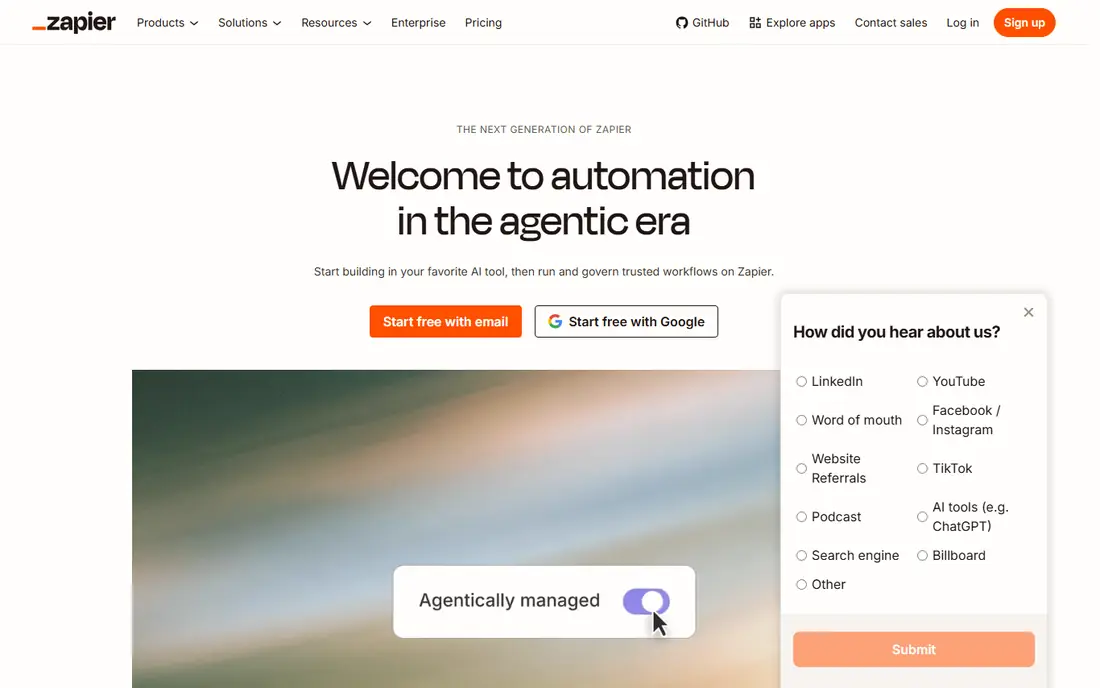
Zapier Agents suits teams that already automate with Zapier. Instead of learning a new platform, you add an agent that can reason over triggers, check apps, and act across thousands of connected tools. A free tier covers 400 activities per month, and the Pro plan starts at 50 dollars per month on monthly billing.
The honest limit is cost layering. If you already pay for Zapier, agent activities are an extra meter to watch, and a busy agent can climb tiers quickly. The payoff is connectivity: few platforms match Zapier for the sheer number of apps an agent can touch without custom code.
- Builds on the huge Zapier app catalog
- Plain-language setup
- Activities meter is easy to track
- Agent plans are separate from standard Zapier plans
- Complex agents can get expensive
- Less visual than canvas builders
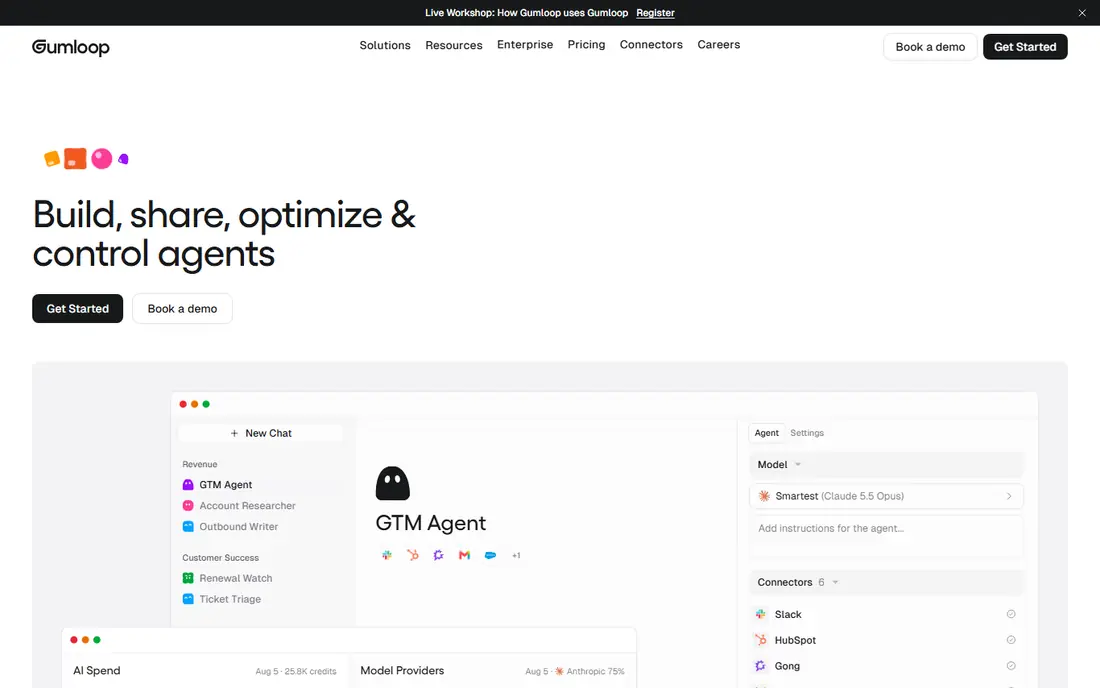
Gumloop blends two styles: describe an agent in chat, then inspect and adjust it on a shared visual canvas. That mix suits operations teams where more than one person needs to understand what the agent does. Plans start at 37 dollars per month, with a free tier for testing.
The trade-off is maturity. The community and template library are smaller than Zapier or n8n, so unusual use cases may need more manual setup. If your team values a canvas you can review together, Gumloop is a strong middle ground between chat-only tools and developer builders.
- Chat-built agents plus a visual canvas
- Good for ops teams working together
- Broad app connections
- Newer platform with a smaller community
- Pricing rises with use
- Advanced controls need learning
n8n is the most flexible tool on this list, and the least purely no-code. You build with visual nodes, add code nodes when a step needs custom logic, and choose cloud hosting from 24 dollars per month or a free self-hosted edition. That control appeals to technical teams that care about data residency and custom integrations.
For non-technical users, the learning curve is real. Simple agents are approachable, but multi-system agents with branching logic need someone comfortable with APIs and data formats. If your team has that person, n8n gives more power per dollar than any chat-first tool here.
- Visual nodes with code when you need it
- Free self-hosted option
- Strong control over data and hosting
- Truly no-code only for simpler flows
- Self-hosting needs maintenance
- AI features require model setup
Make is the budget pick for teams that want a visual builder without paying Lindy or Zapier prices. Plans start at 12 dollars per month, and the free tier covers 1,000 operations per month for testing. Its visual scenarios make multi-step logic easy to follow, and its AI toolkit adds agent behavior on top of that automation base.
Agent features here are less mature than the core automation engine, so expect more setup for reasoning-heavy agents. For teams whose agents mostly follow clear rules with some AI judgment in the middle, Make offers excellent value. Track credits closely on busy scenarios.
- Low entry price
- Strong visual scenario builder
- Generous free tier for testing
- AI agent features are newer than core automation
- Credit math needs care
- Support is less hands-on than Lindy
Relevance AI stands out for teams that need to prove what an agent did. Evaluations, audit logs, and structured tools help managers review agent decisions, which matters when agents touch leads, support tickets, or customer data. Plans start at 29 dollars per month, with usage on top.
The downside is trial friction. Without a free tier, you need a paid plan or a sales conversation to test seriously, and usage-based pricing rewards careful scoping. For regulated or quality-sensitive work, the audit features may justify that cost. For a first experiment, start with a free-tier tool instead.
- Agent evaluations and audit trails
- Large connector catalog
- Tools for sales and support teams
- No free tier for full testing
- Pricing is usage-based and can climb
- Interface takes time to learn
Microsoft Copilot Studio is the natural choice for organizations already standardized on Microsoft 365. Agents built with its guided builder can work in Teams, draw on SharePoint and Outlook data, and follow enterprise identity and governance controls. A free trial lets you build, though publishing options depend on licensing.
Outside the Microsoft world, much of that advantage fades, and licensing can confuse buyers, with per-user Copilot plans, credit licenses, and pay-as-you-go options. If your company already pays for Microsoft 365 Copilot, test Copilot Studio before buying a separate platform. If not, compare its total licensing cost carefully.
- Deep Microsoft 365 and Teams integration
- Guided builder
- Enterprise security and governance options
- Best value only inside Microsoft 365
- Licensing is complex
- Publishing outside Microsoft channels costs extra
Dust builds agents that answer from your internal knowledge: docs, wikis, tickets, and messages, with access controls that respect who can see what. That makes it a strong pick for HR, support, and operations teams drowning in internal questions. Plans start at 24 dollars per month per seat plus credits.
The limit is scope. Dust shines on knowledge work and less on agents that must act across many external sales or marketing tools. Teams that need both may pair Dust with a workflow tool. Check connector coverage for your core systems before committing, since knowledge agents are only as good as the sources they can read.
- Strong internal knowledge agents
- Many enterprise connectors
- Security and access controls
- No free plan
- Focused on internal knowledge more than external actions
- Per-seat pricing adds up
How we picked these
We compared vendor pricing pages, feature documentation, and recent no-code agent comparisons, focusing on how agents are built, what triggers them, how usage is metered, and which systems they connect with. We favored platforms a non-developer can genuinely set up, while including n8n for technical teams that want more control. We did not run production agents ourselves, and credit prices change often, so confirm the current meter on the vendor pricing page before buying.
How to choose a no-code ai agent platform
Start with the job, not the platform. Write down one task, its inputs, its tools, and what a good outcome looks like, then test that single agent on two platforms. Watch three things: how often it needs correction, how many credits or activities it uses, and whether a teammate can understand its steps from the builder view.
Then set guardrails before scaling. Require approval for external messages, payments, and data changes, limit which systems the agent can write to, and review logs weekly in the first month. A no-code agent that runs without review is a risk, not a productivity win. The best platform is the one your team will actually monitor, not just the one with the longest feature list.
FAQ
What are the best no-code platforms for ai agents?
Lindy and Zapier Agents lead for business teams that want a fast start, Gumloop and Make lead for visual builders on a budget, and n8n leads for technical teams. Microsoft Copilot Studio leads inside Microsoft 365, while Dust leads for internal knowledge agents. Match the platform to your existing tools and your team's technical comfort.
What is the best no-code ai agent tool for beginners?
Lindy is the easiest starting point, because you build by chatting and use templates for common jobs. Zapier Agents is also beginner-friendly if you already use Zapier. Start with one narrow task, use the free tier or trial, and expand only after the agent runs reliably.
How much do no-code ai agent platforms cost?
Entry prices in this list range from 12 dollars per month for Make to 50 dollars per month for Zapier Agents, with most tools metering usage through credits or activities. Self-hosted n8n has no license fee but adds hosting and model costs. Estimate monthly runs first, since usage often matters more than the base plan.
Do no-code ai agents need coding at all?
No, for the core use cases on Lindy, Zapier Agents, and Gumloop, where plain language and templates cover setup. Visual builders such as n8n and Make allow code for advanced steps, but do not require it for simple agents. Complex branching, custom APIs, and data transforms are where technical help becomes useful.
Are no-code ai agents safe for customer data?
They can be, with the right controls: limit data access, require approval for external actions, use audit logs, and check security certifications and data processing terms. Avoid giving a new agent write access to customer records or payment systems until it has run reliably on internal tasks. Review vendor privacy policies before connecting sensitive systems.
Can a no-code agent replace automation tools like Zapier or Make?
Not fully. Fixed, repeatable workflows are still cheaper and more reliable as plain automations, while agents suit ambiguous work such as triaging messages or drafting replies that need judgment. Most teams end up with both: automations for the predictable steps and agents for the judgment calls in between.