Best LLM Rank Tracker Software in 2026: 8 Tools Compared
Compare the best LLM rank tracker software in 2026, with prices, tracked models, free options and honest limits for AI search visibility teams. for teams.

- Editor's choice
 Otterly AI
Affordable AI visibility tracking
Starts at$29 per monthVisit otterly.aiFull review - Great alternative
 Peec AI
Mid-market SEO teams
Starts atSee websiteVisit peec.aiFull review - Also consider
 Profound
Enterprise answer engine insights
Starts at$99 per monthVisit profound.comFull review
TL;DR:
- Otterly AI is the cheapest useful starting point, at 29 dollars a month, while Peec AI and Profound suit larger teams.
- No LLM tracker gives exact rankings like classic Google rank tracking, so treat visibility scores as directional trends.
- Free LLM rank tracker tools exist, but they are usually one off reports or small free tiers, not full ongoing tracking.
- Pick a tool that tracks the models your customers actually use, and check prompt limits before you sign up.
Quick comparison
| Tool | Best for | Starts at | Free plan? | |
|---|---|---|---|---|
| Otterly AI | Affordable AI visibility tracking | $29 per month | Free trial | Visit |
| Peec AI | Mid-market SEO teams | See website | Free trial | Visit |
| Profound | Enterprise answer engine insights | $99 per month | No | Visit |
 Scrunch AI | Monitoring plus AI crawler analytics | See website | Free trial | Visit |
 Rankscale | Flexible tracking for startups | $20 per month | Free trial | Visit |
 AthenaHQ | Action focused AI visibility tracking | $295 per month | Yes | Visit |
 Goodie | Tracking tied to optimization actions | $399 per month | Free trial | Visit |
 SE Ranking | SEO teams that want AI visibility inside a full suite | See website | Free trial | Visit |
The best LLM rank tracker software
LLM rank trackers show how often your brand appears in answers from ChatGPT, Perplexity, Gemini, Claude, and other AI systems. They track prompts, mentions, citations, and sentiment over time, which helps SEO and content teams see whether AI search is sending them traffic, or sending it to a competitor.
Otterly AI is the easiest entry point in this list. The Lite plan starts at 29 dollars a month and tracks brand mentions, citations, and prompt level visibility across major AI surfaces. For a solo marketer or a small team, that is enough to answer the basic question, which is whether AI answers mention you at all.
The interface stays focused. You add prompts, add competitors, and watch mentions and citations change over time. That simplicity helps small teams that do not have time to learn an enterprise analytics platform. Otterly also offers a free trial, so you can test it with your real brand prompts before paying.
The limit is scale. Entry prompt allowances are modest, and the Standard and Premium tiers cost much more. If you need hundreds of prompts across many models, Otterly may still work, but the price gap to a mid-market tool narrows fast.
- Low starting price
- Tracks ChatGPT, Perplexity, and Google AI Overviews
- Simple prompt tracking
- Prompt allowances are small on the entry plan
- Higher tiers rise sharply in price
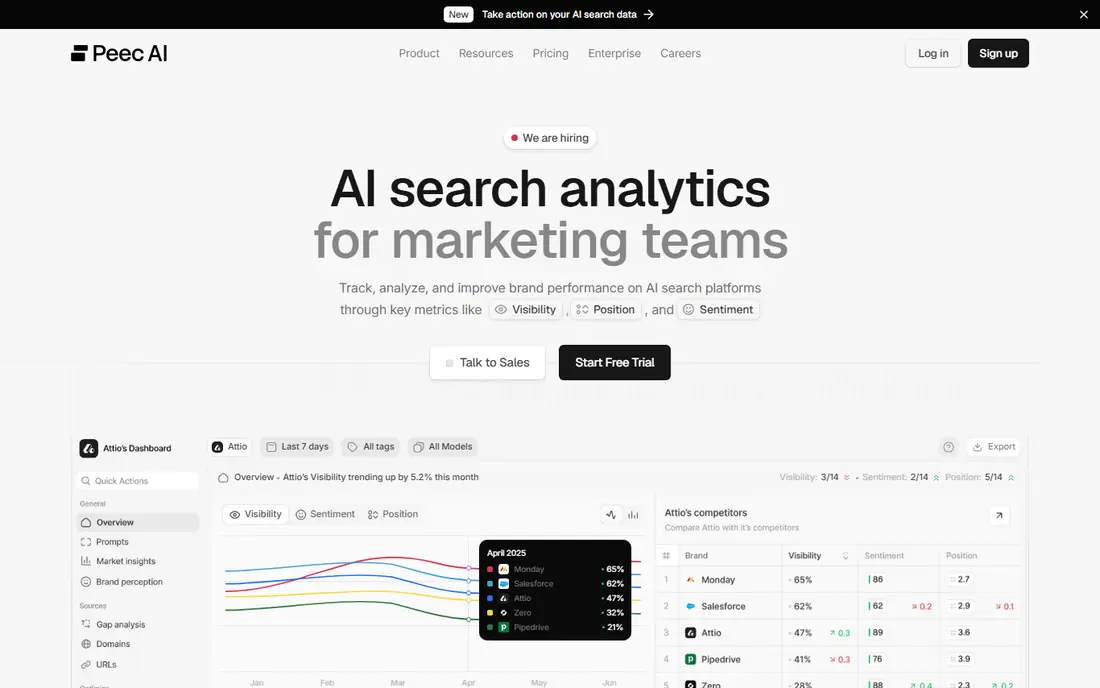
Peec AI is built for SEO teams that want clean, readable analytics rather than a wall of raw answers. It tracks how your brand appears in LLM answers, including visibility, position, and sentiment, and it compares you with competitors on the same prompts. That comparison is useful when a client asks why a rival keeps appearing in ChatGPT answers.
The platform supports several models, including ChatGPT, Google AI Mode, AI Overviews, and Gemini on many plans, with more models available as add-ons. Prompt tiers scale from a starter set to several hundred prompts, which suits agencies and mid-market brands with multiple sites or markets.
Pricing needs a careful read, because Peec lists prices in euros on some pages and the entry tier includes a limited model set. Check the current plan, the prompt count, and the models included before you compare it with a dollar priced rival.
- Clean analytics for visibility, position, and sentiment
- Competitor comparison
- Multiple models
- Pricing is in euros on some pages and varies by plan
- Model count is limited on entry tiers
Profound is one of the best known LLM tracking platforms, and it is built for enterprise brands with serious answer engine programs. It measures brand visibility across AI search and answer engines, with prompt level insights, share of voice, sentiment, and competitor benchmarking. Shopping analytics and conversation data add depth for ecommerce and large consumer brands.
The entry plan starts at 99 dollars a month on annual billing, but it tracks ChatGPT only, which is an important limit. Broader model coverage, including Perplexity and Google AI Overviews, sits on higher tiers, and enterprise plans are custom priced. That structure makes Profound a strong choice for large teams, and a less obvious one for small teams that need many models on a low budget.
There is no free plan, though Profound offers trials and demos depending on the tier. If you need deep data, compliance friendly reporting, and a platform built for scale, Profound earns its place. If you need cheap multi model tracking, start elsewhere.
- Deep prompt level insights and benchmarking
- Shopping and conversation analytics
- Enterprise grade data
- Entry plan tracks ChatGPT only
- No free plan, demos only for higher tiers
Scrunch AI combines brand monitoring with a useful extra, which is insight into how AI crawlers visit your site. It tracks prompts, citations, and brand presence across ChatGPT, Perplexity, Google AI Overviews, and Copilot on core plans, with more models on enterprise tiers. That gives content teams a link between what AI systems say and whether they can actually read your pages.
The platform also offers guidance on improving citations and content structure, which helps teams move from watching a score to fixing a problem. For SaaS and B2B companies, that action layer matters, because a dashboard alone rarely changes an outcome.
Scrunch pricing is higher than Otterly or Rankscale, with core plans reported around 250 to 300 dollars a month in recent comparisons, so confirm the current price directly. A seven day trial helps you test prompt coverage before committing.
- Prompt monitoring and citation tracking
- Insight into AI bot crawling
- Content optimization guidance
- Entry pricing is higher than budget tools
- Enterprise features need a custom plan
Rankscale is a newer LLM rank tracker aimed at startups and small teams that want flexible pricing. Its Essentials plan starts at 20 dollars a month, which makes it one of the cheapest paid options in this list. Setup is simple, and a free trial on the Pro plan lets you test it with real prompts.
The appeal is straightforward. You get prompt tracking, brand mentions, and visibility trends without an enterprise contract or a long onboarding process. For a small site that wants to know whether AI answers mention it, and how that changes month to month, Rankscale covers the basics well.
As a newer tool, it has fewer integrations and less depth than Profound or AthenaHQ. Teams that need advanced analytics, large prompt sets, or enterprise reporting will likely outgrow it. For a lean start, it is a sensible, low risk choice.
- Low entry price
- Pay per check style flexibility
- Simple setup
- Newer platform with a smaller feature set
- Fewer enterprise integrations
AthenaHQ is built for mid-market teams that want to act on AI visibility data, not just watch it. It tracks brands across a wide set of AI engines, including ChatGPT, Gemini, Perplexity, Claude, Copilot, and Google AI Mode, and it adds recommendations for improving mentions and citations. That action focus sets it apart from pure monitoring tools.
The platform also offers a free Essential plan with a small credit, which is rare in this category. That lets a team test the interface and run a first set of prompts before paying. Paid plans start at 295 dollars a month, which reflects the breadth of model coverage and the action features.
AthenaHQ is more than most small sites need, and the paid price puts it in the mid-market bracket. For a team with a real AI search program and a budget to fix what it finds, it is one of the strongest LLM rank trackers available.
- Wide model coverage
- Action layer for fixing visibility gaps
- Free Essential plan with credit
- High starting price for paid plans
- More than a small site needs
Goodie monitors how AI models describe and recommend a brand, across ChatGPT, Claude, Perplexity, Gemini, Copilot, Grok, and Meta AI. That breadth matters for brands that appear in many different AI systems, not just ChatGPT. The platform ties tracking to optimization actions, so teams can move from a visibility gap to a content or PR task.
Reporting is brand focused, with sentiment, positioning, and competitor context. That helps marketing leaders explain AI visibility to stakeholders who do not care about prompt level detail. A seven day free trial lets teams test the platform before committing.
The entry Explorer plan is reported at 399 dollars a month, which puts Goodie firmly in the mid-market and enterprise bracket. Small teams should start with Otterly or Rankscale, and consider Goodie when AI search becomes a core channel.
- Visibility monitoring across many models
- Optimization workflows
- Brand focused reporting
- High entry price
- No public free tier beyond a trial
SE Ranking is a full SEO platform that has added AI visibility tracking, including AI Overviews and LLM mention data, as part of its wider toolkit. For a team already using SE Ranking for keyword rankings, backlinks, and site audits, that integration is convenient. You can see classic search and AI search data in one place, without buying a separate tool.
The AI visibility features are an add-on rather than a standalone product, so depth varies by plan. Teams that need deep LLM analytics, large prompt sets, or enterprise reporting may still want a dedicated tracker such as Profound or AthenaHQ. For many SEO teams, though, SE Ranking covers the basics well enough.
Pricing depends on the base SEO plan and the AI add-on, so confirm the current total before comparing it with a standalone tracker. A 14 day free trial gives you time to test both the SEO suite and the AI features together.
- AI visibility tracking inside a full SEO platform
- Classic rank tracking included
- Good value for existing users
- AI tracking is an add-on, not the core product
- Pricing depends on your base plan
How we picked these
We compared official pricing pages, feature documentation, and recent third party comparisons for tools that track brand visibility across large language models in October 2026. We favored tools with public pricing or a clear trial, coverage of at least two major AI models, and prompt level tracking. We left out one off graders and tools that only track classic Google rankings.
How to choose an LLM rank tracker
Start with the models your customers use. If most of your audience asks ChatGPT, a ChatGPT focused plan may be enough. If they use Perplexity, Gemini, and Google AI Mode as well, you need a tool that covers those models on the plan you can afford.
Check prompt limits, not just the price
A low monthly price can hide a small prompt allowance. Count how many prompts you actually need, including brand prompts, product prompts, and competitor prompts, then check the tier that covers that count. Add a buffer, because prompt lists tend to grow.
Treat scores as trends, not exact ranks
LLM answers change with the prompt wording, the model version, and the time of day. A visibility score that moves a few points week to week may reflect model variation, not a real change in your content. Look for sustained trends over four to eight weeks before you act.
Pair tracking with content fixes
Tracking alone does not improve visibility. Use the citation data to find which pages AI systems cite, which pages they ignore, and which competitor pages they prefer. Then update those pages with clear facts, structured data, and direct answers to common questions.
FAQ
What is the best LLM rank tracker software?
Otterly AI is the best starting point for small teams, Peec AI suits mid-market SEO teams, and Profound suits enterprise brands. AthenaHQ is a strong pick if you want tracking tied to optimization actions, while SE Ranking suits teams that want AI data inside a full SEO suite.
What is the best free LLM rank tracker tool?
There is no fully free ongoing tracker that matches a paid tool. AthenaHQ offers a free Essential plan with a small credit, and several tools offer free trials. One off AI search graders can give a snapshot, but they do not track trends over time.
How is LLM rank tracking different from Google rank tracking?
Google rank tracking measures a position in a list of links. LLM tracking measures whether, and how, a brand appears inside a generated answer, including mentions, citations, sentiment, and recommendations. The two overlap, but they are not the same metric.
Which AI models should I track?
Track the models your customers actually use. For most US brands, that means ChatGPT, Google AI Overviews and AI Mode, Perplexity, and Gemini. Add Claude, Copilot, and Grok if your audience uses those systems, or if competitors appear there often.
How many prompts do I need to track?
Start with 20 to 50 core prompts covering your brand, your main products, and your top competitors. Add prompts for common customer questions and comparison searches. A small, focused prompt set gives clearer trends than hundreds of low value prompts.
Do LLM rank trackers improve my AI visibility?
Not on their own. They show where you appear and where you do not, and which sources AI systems cite. Improvement comes from the content, PR, and technical fixes you make after reading that data, such as clearer pages, better structured data, and stronger third party coverage.