Best Inbound Marketing Software in 2026: 9 Tools Compared
Find the best inbound marketing software for attracting, converting and nurturing leads, with HubSpot, ActiveCampaign and more compared on features and price.

- Editor's choice
 HubSpot Marketing Hub
Complete inbound marketing suites
Starts atSee websiteVisit hubspot.comFull review - Great alternative
 ActiveCampaign
Automation led inbound teams
Starts atSee websiteVisit activecampaign.comFull review - Also consider
 Adobe Marketo Engage
Large inbound and account based teams
Starts atSee websiteVisit business.adobe.comFull review
TL;DR:
- Inbound success depends on content, forms, lead capture and follow up working together, not on any single channel.
- HubSpot remains the most complete inbound suite, while ActiveCampaign and GetResponse suit teams that want strong automation at lower cost.
- A tool should prove it can capture leads, score them and hand them to sales cleanly before you commit to a yearly plan.
- Start with one content offer and one nurture path, measure conversion to qualified leads, then expand the program.
Quick comparison
| Tool | Best for | Starts at | Free plan? | |
|---|---|---|---|---|
| HubSpot Marketing Hub | Complete inbound marketing suites | See website | Free trial | Visit |
| ActiveCampaign | Automation led inbound teams | See website | Free trial | Visit |
| Adobe Marketo Engage | Large inbound and account based teams | See website | No | Visit |
 Salesforce Account Engagement | Salesforce based B2B inbound teams | See website | Free trial | Visit |
 Mailchimp | Small inbound teams and creators | See website | Free trial | Visit |
 GetResponse | Content and webinar led inbound teams | See website | Free trial | Visit |
 Keap | Small service businesses doing inbound | See website | Free trial | Visit |
 Zoho Marketing Automation | Zoho based inbound teams | See website | Free trial | Visit |
 SharpSpring | Agencies running inbound for clients | See website | Free trial | Visit |
The best inbound marketing tools
We compared inbound tools on content and landing page creation, forms and lead capture, automation, SEO and social tools, and reporting. The right choice depends on team size, budget and whether sales works from the same system.

HubSpot is the reference point for inbound marketing because it was built around attracting visitors, converting them with content and forms, and nurturing them to a sales conversation. Blogging, landing pages, forms, email automation and CRM timelines sit in one system, so a team can trace a lead from first search to closed deal without stitching reports together. That traceability is what inbound managers need when they defend budget.
The cost and setup are the real limits. Lower tiers cover the basics, but advanced automation, reporting and account tools need higher plans, and the system only shines when data stays clean. Small teams should start narrow, publish consistently, and add features as their content engine grows.
- Full inbound suite with CRM, content and automation
- Strong reporting and lead scoring
- Large integration library
- Paid tiers are costly
- Setup takes time and clean data
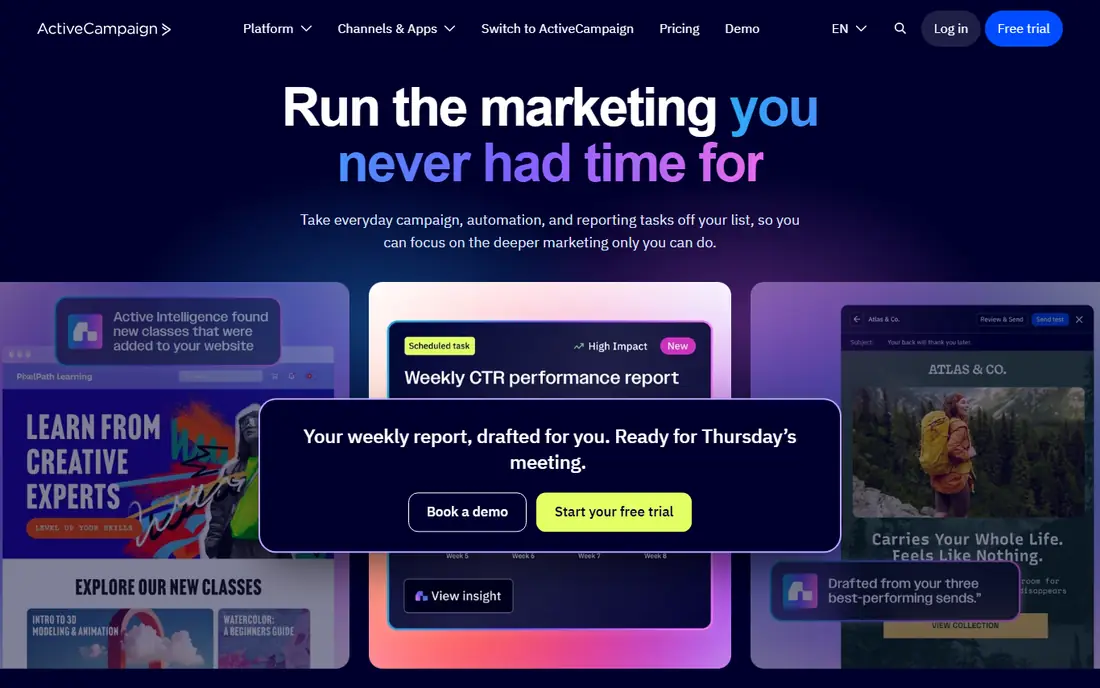
ActiveCampaign works best when inbound means capture, then nurture with smart automation. Its visual builder, site tracking and lead scoring let teams react to downloads, page visits and email replies with tailored follow ups. For firms that already create content elsewhere, this focus on conversion and nurture is often enough.
Content creation is not its strongest area. Blogging and SEO tools are thinner than HubSpot, so teams may pair it with a separate CMS. The automation maps also need clear naming and regular review, or they become hard to maintain. It is a strong pick for automation led inbound teams.
- Strong automation and segmentation
- CRM and site tracking
- Good value for mid sized teams
- Content tools are thinner than HubSpot
- Complex maps need care
Marketo suits large inbound programs where content attracts many leads and only some deserve sales time. Scoring, nurture streams and attribution help teams sort real buying intent from casual downloads, and account tools extend inbound thinking to buying groups. For firms with Salesforce and a large database, that depth matters.
The platform demands skill and budget. Implementation, data hygiene and scoring rules need owners, and small teams will find it heavy. It is best when inbound volume is high, sales alignment is formal, and reporting must link content to revenue, not just traffic.
- Deep scoring, nurture and attribution
- Strong CRM sync
- Scalable for large programs
- Costly and complex
- Needs skilled owners
Salesforce Account Engagement, formerly Pardot, fits B2B teams that already live in Salesforce. Leads, campaigns and scores sync natively, so sales sees the same engagement history that marketing used to qualify a prospect. Landing pages, forms and nurture programs support inbound capture without a separate database.
Outside Salesforce, the value drops sharply. Pricing and setup reflect an enterprise tool, and teams need Salesforce admin help to get the most from it. For Salesforce shops with formal sales alignment, it is a logical choice, but it is not a light starter tool.
- Native Salesforce sync
- Strong lead scoring and nurture
- Good for account based programs
- Costly
- Setup is complex outside Salesforce
Mailchimp helps small teams start inbound work fast. Landing pages, sign up forms, email and basic automation cover the core capture and nurture steps, and templates keep early campaigns looking professional. For a small firm testing content offers, that speed matters more than enterprise reporting.
As inbound volume and sales handoffs grow, limits appear. Lead scoring is basic, CRM depth is thinner than HubSpot, and pricing rises with list size. Teams should use Mailchimp to prove an offer converts, then move to a deeper suite when qualified lead volume justifies it.
- Easy landing pages, forms and email
- Useful audience tools
- Quick to launch
- Lead scoring and CRM depth are limited
- Costs rise with contacts
GetResponse combines several inbound pieces that small teams often buy separately. Landing pages capture leads, webinars educate them, and email automation nurtures them toward a demo or call. That single account setup reduces integration work and helps a lean team run a full funnel.
The trade off is focus. Reporting and scoring are useful but not as deep as HubSpot or Marketo, and the broad menu can distract new users. Teams should pick two funnels to master first. It suits content and webinar led teams that want one practical suite.
- Landing pages, webinars, funnels and email in one suite
- Solid automation
- Reporting depth varies by tier
- Interface can feel crowded
Keap targets small service firms that need inbound capture plus follow up and payment in one place. A prospect can fill a form, enter a nurture sequence, book a call and pay, without the firm juggling five tools. That all in one flow suits coaches, agencies and local service firms.
The limits are scale and polish. Reporting and design tools are less advanced than larger suites, and costs rise as contacts grow. It is best for small firms that want a simple inbound to sale path, not for large teams running complex content programs.
- CRM, email, landing pages and payments in one tool
- Simple automation
- Design and reporting are less advanced
- Pricing suits small lists best
Zoho Marketing Automation gives Zoho CRM users a coherent inbound path. Web forms, landing pages, lead scoring and customer journeys connect to CRM records, so sales can follow up with context. Pricing is friendly for small and mid sized firms, and the wider Zoho suite covers adjacent needs.
Content and SEO tools are more basic than HubSpot, and the third party ecosystem is smaller. Teams outside Zoho may prefer a vendor neutral suite. Inside Zoho, though, the sync and value make it a practical inbound choice that is easy to justify.
- Lead capture, scoring and journeys
- Strong Zoho CRM sync
- Good value
- Smaller third party ecosystem than HubSpot
- Content tools are basic
SharpSpring, now part of the Constant Contact group, appeals to agencies that run inbound for several clients. It bundles CRM, automation, landing pages, forms and tracking in one account, with agency tools for managing multiple clients. That structure helps small agencies offer inbound services without enterprise suite costs.
The integration marketplace is smaller than HubSpot, and some teams may need extra tools for advanced content or SEO work. It is still a solid agency pick when the core need is capture, nurture and client reporting in one system, at a more accessible price.
- CRM, automation and landing pages
- Agency friendly pricing and client tools
- Good tracking
- Smaller marketplace than HubSpot
- Brand is now part of Constant Contact group
How we picked these
We compared official product pages, pricing, integration lists and public documentation, with a focus on the full inbound path from visitor to qualified lead. We weighted lead capture, forms and landing pages, automation, scoring, CRM handoff and reporting above single channel tools. Tools that only handle one piece, such as a standalone SEO checker, were left out because they do not cover an inbound program on their own.
How to build an inbound stack that works
Inbound marketing only works when content, capture and follow up connect. A pretty blog with no form, or a form with no nurture, will waste the traffic you worked hard to earn.
Map one journey before you buy
Pick one buyer problem, one content offer and one next step, such as a demo or consultation. Test that path end to end in a trial, from search landing to sales alert. If the path breaks, fix the tool choice or the offer before adding more content.
Check scoring and sales handoff rules
Agree with sales on what makes a lead qualified, then encode those rules in scoring and lifecycle stages. Review passed leads weekly at first, and adjust scores based on real outcomes, not just downloads. A tool that cannot show this handoff clearly will create friction.
Measure leads, not just traffic
Traffic and opens are useful signals, but inbound success is qualified leads and closed deals. Build reports that link content and campaigns to those outcomes. Keep publishing what converts, and pause what only brings visits.
FAQ
What is the best inbound marketing platform?
HubSpot Marketing Hub is the most complete inbound platform for teams that want content, capture, automation and CRM reporting in one place. ActiveCampaign and GetResponse suit smaller teams that want strong automation at lower cost. The best platform is the one your team will use consistently.
What are the best inbound marketing tools for small businesses?
Mailchimp, GetResponse, Keap and Zoho Marketing Automation cover capture and nurture at prices small firms can manage. Start with one offer and one nurture path, and upgrade when lead volume and sales handoffs demand deeper scoring and reporting.
What is the best tool for inbound marketing automation?
ActiveCampaign and HubSpot offer the strongest automation for inbound journeys, with branching, scoring and sales tasks. Marketo and Salesforce Account Engagement suit larger B2B programs. Test your core journeys during a trial before committing.
Do I need a separate CMS for inbound marketing?
Not always. HubSpot includes blogging and landing pages, while other tools pair well with WordPress or a similar CMS. What matters is that forms, tracking and lead data flow into your marketing system without manual exports.
How long does inbound marketing take to work?
Inbound results usually build over months, not days, because search and content trust take time to grow. Teams should expect early leads from offers and referrals first, then steadier organic leads as content ranks. Measure progress monthly and keep publishing.
Sources
- https://www.hubspot.com/products/marketing
- https://www.activecampaign.com/
- https://business.adobe.com/products/marketo/adobe-marketo-engage.html
- https://www.salesforce.com/products/marketing-cloud/account-engagement/
- https://mailchimp.com/
- https://www.getresponse.com/
- https://keap.com/
- https://www.zoho.com/marketing-automation/
- https://www.sharpspring.com/