Best House Hunting Apps in 2026: 8 Apps Compared
Compare the best house hunting apps for 2026, with listings, price history, alerts, neighborhood data, and honest limits to help you find a home today.

- Editor's choice
 Zillow
Broad listing search for most buyers
Starts atFreeVisit zillow.comFull review - Great alternative
 Redfin
Buyers who want data plus agent services
Starts atFreeVisit redfin.comFull review - Also consider
 Realtor.com
Listings sourced from MLS data
Starts atFreeVisit realtor.comFull review
TL;DR:
- The best house hunting app for most buyers is Zillow for its listing breadth, while Redfin is our pick for buyers who also want agent services and price insights.
- No single app lists every home, so serious buyers should check at least two apps, plus local MLS listings through an agent.
- Saved searches and instant alerts matter more than any other feature in a fast market, because good homes can go pending quickly.
- Price history, tax history, and days on market help you judge whether an asking price is realistic, but they do not replace an appraisal or inspection.
- All apps on this list are free for buyers to browse, with revenue coming from agent advertising and services rather than buyer subscriptions.
Quick comparison
| Tool | Best for | Starts at | Free plan? | |
|---|---|---|---|---|
| Zillow | Broad listing search for most buyers | Free | Yes | Visit |
| Redfin | Buyers who want data plus agent services | Free | Yes | Visit |
| Realtor.com | Listings sourced from MLS data | Free | Yes | Visit |
 Homes.com | Neighborhood detail and listing information | Free | Yes | Visit |
 Trulia | Neighborhood maps and local insights | Free | Yes | Visit |
 Movoto | Simple search with helpful price history | Free | Yes | Visit |
 Rocket Homes | Buyers planning to use Rocket Mortgage | Free | Yes | Visit |
 Compass | Luxury homes and agent-connected search | Free | Yes | Visit |
The best house hunting apps
House hunting apps differ in listing coverage, search filters, and buyer tools, and the best choice depends on your market and how you plan to buy. We compared official app pages, listing features, and buyer tools to build this list.
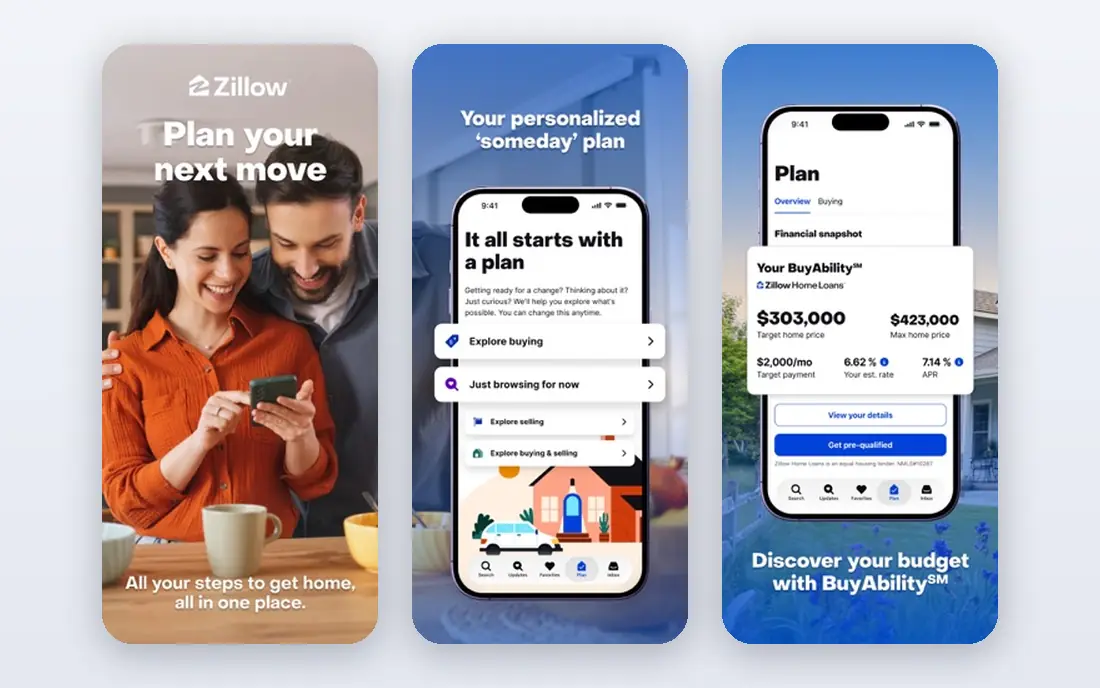
Zillow is the default starting point for most US home buyers, and its breadth is the reason. It lists homes for sale and rent across the country, with photos, price history, tax history, and neighborhood information in one place. Saved searches and alerts let you hear about new listings that match your criteria, which is essential in a competitive market.
The main cautions are listing freshness and the Zestimate. Some listings may already be pending or sold, especially if the source data lags, and the Zestimate is a computer estimate that can differ from a real appraisal. Use Zillow to discover homes and track the market, then confirm status and value with your agent and local MLS data before making an offer.
- Very large listing database
- Zestimate price estimates
- Saved searches and alerts
- Some listings may be outdated
- Zestimate is an estimate, not an appraisal

Redfin combines a home search app with a brokerage, which gives buyers a more integrated path from search to offer. Its listing pages show detailed sale and price history, comparable sales context, and market insights, and buyers in served markets can book tours and work with Redfin agents through the app. That integration appeals to buyers who want data and service in one place.
Agent availability and refund or commission programs vary by market, so check what Redfin offers in your area. Listing coverage is strong in major markets but may be thinner in some rural areas. For buyers in a Redfin-served market who value data-driven pricing, Redfin is a strong first or second app alongside Zillow.
- Detailed price and sale history
- Redfin Estimate
- Integrated agent booking
- Agent services vary by market
- Listing coverage is strong but not universal

Realtor.com draws listings from Multiple Listing Services, which often means faster updates and clearer listing status than aggregator-only sources. For buyers, that can mean seeing a new listing sooner and trusting its status more. The app also offers saved searches, alerts, mortgage calculators, and neighborhood information.
The interface can feel busy with agent promotions and related content, and some features work best after creating an account. Realtor.com is a smart second app to pair with Zillow, since comparing the two helps you catch listings that one app shows before the other, and confirm whether a home is still active.
- MLS-sourced listings
- Fast updates in many markets
- Clear listing status
- Interface can feel busy
- Some features require an account
Homes.com has invested in neighborhood content, with detailed pages on schools, commute times, local amenities, and market trends alongside listings. That context helps buyers compare areas, not just houses, which matters when you are relocating or choosing between two neighborhoods. Listing pages are clean and easy to read on mobile.
Listing volume can vary by market, so Homes.com works best as a complement to a larger listing app rather than your only search tool. If neighborhood research is a big part of your decision, Homes.com deserves a place on your phone, even if you discover most listings elsewhere first.
- Detailed neighborhood pages
- School and commute information
- Clean listing pages
- Listing volume varies by market
- Newer search experience than Zillow
Trulia, owned by Zillow, focuses on neighborhood understanding through maps that show schools, commute options, amenities, and local insights. That map-first approach helps buyers who think in terms of areas and commutes, rather than scrolling a list of houses. Saved searches and alerts work similarly to Zillow, which makes sense given the shared ownership.
The overlap with Zillow is also the limit. If you already use Zillow, Trulia will show many of the same listings, so its added value is mainly the neighborhood maps and local context. Use Trulia when you are still choosing a neighborhood, and use Zillow or Realtor.com when you are tracking specific homes.
- Map-based neighborhood insights
- Crime, school, and commute layers
- Saved searches
- Owned by Zillow, so listings overlap heavily
- Some data needs local checking
Movoto offers a straightforward search experience with clear listing pages, price history, and market context, without as much clutter as larger apps. That simplicity appeals to buyers who find Zillow busy and want a cleaner way to track homes and prices. Saved searches and alerts cover the basics well.
Listing coverage and local depth vary by market, so Movoto is best used alongside a larger app rather than alone. For buyers who value a clean interface and clear price history, it is a pleasant alternative, especially for tracking a shortlist of homes you already found.
- Clear listing pages
- Price history and market context
- Easy saved searches
- Smaller brand presence than Zillow
- Listing coverage varies by market
Rocket Homes connects home search with Rocket Mortgage, which helps buyers who plan to finance through Rocket. Affordability tools, pre-approval pathways, and agent connections are built into the experience, so the path from browsing to financing feels more connected than using separate apps. That integration can save time during pre-approval and offer preparation.
Outside the Rocket ecosystem, the app is less compelling than Zillow or Redfin for pure listing search, and listing breadth is smaller. If you are already considering Rocket Mortgage, Rocket Homes is a useful companion. If you have not chosen a lender, start with a broader search app and compare lenders separately.
- Integrates with Rocket Mortgage
- Affordability tools
- Agent connections
- Most useful inside the Rocket ecosystem
- Listing breadth is less than Zillow
Compass is a brokerage with a polished search app, and it is particularly strong for luxury and high-end homes in markets where Compass agents are active. Listing presentation is excellent, with high-quality photos and detailed property information, and the app connects buyers with Compass agents for tours and offers. That agent connection is the main benefit over a pure listing aggregator.
In markets where Compass has fewer agents, the app is less distinctive, and budget buyers may find broader coverage on Zillow or Realtor.com. Compass is best for buyers in a Compass-strong market, especially at higher price points, or for buyers who want to work with a Compass agent from the start.
- Strong luxury and high-end listings
- Agent tools
- Polished listing presentation
- Best in markets where Compass has a strong agent presence
- Less useful for budget search alone
How we picked these
We compared official app pages, listing features, and buyer tools for house hunting apps available in the United States in October 2026. We kept only apps with nationwide or broad listing search, saved searches, and alerts, and with a clear free browsing option. We left out apps that only served one city, apps with no verifiable homepage, and agent-only tools that buyers cannot use directly.
How to use house hunting apps well
Set up saved searches early, with your must-have filters such as price, beds, baths, and location, plus a slightly wider search for backup options. Turn on instant alerts for new listings, and check the app at least once a day in a fast market. When a home interests you, save it, check its price and tax history, and share it with your agent quickly, since waiting until the weekend can mean missing a showing window.
Judge price with data, not just the listing
Use price history, days on market, recent comparable sales, and tax history to judge whether an asking price is realistic. A home that has had several price cuts or a long time on market may have room for negotiation, while a new listing priced below comparable sales may attract multiple offers. These signals help you and your agent shape an offer, but they do not replace a professional appraisal, inspection, or local market knowledge.
Work with an agent alongside the apps
Apps are excellent for discovery, but an agent adds MLS access, showing coordination, negotiation, and local knowledge that apps cannot provide. Share your saved homes with your agent, ask about off-market or coming-soon listings in your area, and confirm listing status before visiting. The best results usually come from apps plus an agent, not apps alone.
FAQ
Which house hunting app has the most listings?
Zillow generally offers the broadest listing coverage for most US buyers, but no app lists every home. Checking Zillow alongside Realtor.com and working with an agent who has MLS access gives you the best coverage, especially for new and pending listings.
Are house hunting apps free for buyers?
Yes, browsing, saved searches, and alerts are free on all apps on this list. These companies earn revenue mainly from agent advertising and services, not from charging buyers to search. Be aware that contacting an agent through an app may connect you with a partner agent.
What is a Zestimate, and should I trust it?
A Zestimate is Zillow automated estimate of a home value, based on public data and comparable sales. It is useful as a rough guide and for tracking trends, but it is not an appraisal and can be inaccurate for unique homes or thin markets. Use it alongside comparable sales and your agent advice.
How do I get alerts for new listings?
Create a saved search with your price, location, beds, baths, and must-have filters, then turn on notifications for new listings and price changes. In a fast market, instant alerts work better than daily digests, since desirable homes can receive offers within days.
Should I use one app or several?
Use at least two apps, plus an agent, for a serious search. Different apps update at different speeds and show slightly different listings, so checking two sources helps you catch new homes sooner and confirm whether a listing is still active.