Best Futures Trading Platform in 2026: 8 Platforms Compared
Compare the best futures trading platform options in 2026, with commissions, margins, charting, automation and paper trading for active futures traders.

- Editor's choice
 NinjaTrader
Dedicated futures traders who want depth
Starts at$0.39 per micro contract per sideVisit ninjatrader.comFull review - Great alternative
 Interactive Brokers
Global traders with multi-asset accounts
Starts atSee websiteVisit interactivebrokers.comFull review - Also consider
 TradeStation
Systematic traders and backtesting
Starts atSee websiteVisit tradestation.comFull review
TL;DR:
- NinjaTrader is our pick for dedicated futures traders, thanks to futures-first charting, order flow tools, market replay and low micro contract commissions.
- Interactive Brokers suits global, multi-asset traders who want many futures markets in one account alongside stocks and options.
- AMP Futures and Tradovate suit cost-focused traders who want low micro contract costs and low day trading margins.
- Futures trading involves significant risk, including the potential to lose more than your initial deposit. This is not financial advice.
Quick comparison
| Tool | Best for | Starts at | Free plan? | |
|---|---|---|---|---|
| NinjaTrader | Dedicated futures traders who want depth | $0.39 per micro contract per side | Free trial | Visit |
| Interactive Brokers | Global traders with multi-asset accounts | See website | Free trial | Visit |
| TradeStation | Systematic traders and backtesting | See website | Free trial | Visit |
 thinkorswim | Traders who want research and education | $2.25 per contract per side | Free trial | Visit |
 AMP Futures | Low-cost futures trading with platform choice | See website | Free trial | Visit |
 Tradovate | Simple, cloud-based futures trading | See website | Free trial | Visit |
 tastytrade | Traders combining futures with options | See website | No | Visit |
 Optimus Futures | Traders who want broker support with low costs | See website | Free trial | Visit |
The best futures trading platforms
We compared published commission schedules, intraday and overnight margin examples, market data costs, charting and automation tools, and paper trading options. Futures costs are not just commissions: exchange, clearing and regulatory fees, plus market data subscriptions, also affect the total. Always check the broker's current rate card and margin schedule for the exact contracts you plan to trade before funding an account.
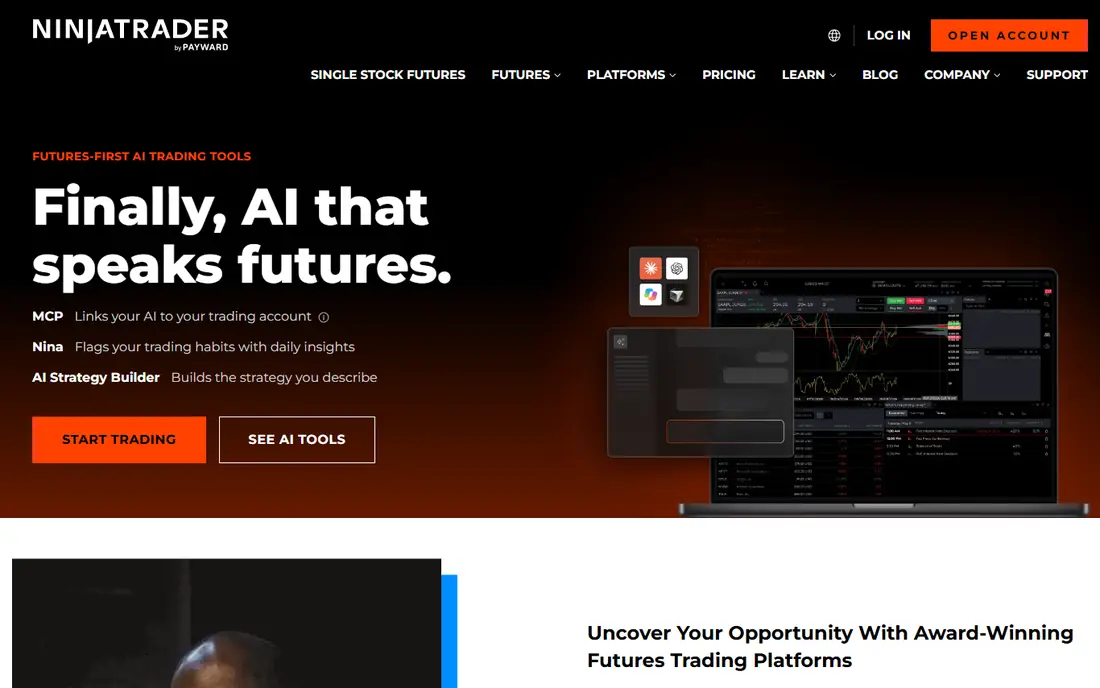
NinjaTrader is built for futures first, and that focus shows in the tools. Advanced charting, SuperDOM order entry, order flow tools, strategy automation with NinjaScript and market replay give active traders a deep toolkit for practising and refining a plan. Micro contract commissions start at $0.39 per side on the Free plan, with lower rates on Monthly and Lifetime plans, and intraday margins for micro contracts can be as low as $50 on some contracts. A free simulation account lets traders learn the platform without risking real money.
The learning curve is real, and total cost is more than the headline commission. Exchange, clearing and regulatory fees plus market data subscriptions add to each trade, so compare all-in round-trip costs, not just the per-side figure. Traders who only trade futures occasionally may find a simpler cloud platform easier. For dedicated futures traders, NinjaTrader offers the strongest combination of tools, automation and cost control here.
- Futures-first charting and SuperDOM
- Order flow tools and market replay
- Low micro margins and a free simulation account
- Platform depth has a learning curve
- Exchange and data fees sit on top of commissions
- Lifetime plan pricing needs comparison

Interactive Brokers suits traders who do not want futures isolated from the rest of a portfolio. One account can cover global futures markets, including CME, Eurex and ICE, alongside stocks, options and forex, with Trader Workstation, mobile apps and a full API for automation. That breadth helps traders who hedge equity exposure with futures, or who trade futures in several regions and want one clearing and reporting system. Paper trading lets you test strategies before committing capital.
The trade-off is margin and complexity. Interactive Brokers often uses higher, exchange-based day trading margins than specialist futures brokers, with examples around $1,200 for a micro Nasdaq contract in some comparisons, versus $50 at specialists. Trader Workstation is powerful but dense for beginners. If futures are your main activity and low intraday margin matters most, a specialist may be cheaper. If global multi-asset access matters most, Interactive Brokers is hard to beat.
- Widest futures market coverage in this list
- Stocks, options, forex and futures in one account
- Paper trading and API access
- Day trading margins are often higher than specialist futures brokers
- Trader Workstation has a steep learning curve

TradeStation appeals to traders who build, test and automate rules rather than trading only by hand. Decades of historical data, strong charting and EasyLanguage let systematic traders code a strategy, backtest it and run it with defined risk controls. Volume-based futures pricing can fall as low as $0.50 per standard contract for active traders, and intraday margins for micro contracts can be around $100 in published comparisons. That combination suits quants and disciplined systematic traders.
The complexity is the catch. The platform rewards time spent learning it, and pricing that depends on volume needs careful reading to know what you will actually pay at your trade frequency. Beginners who want a simple order ticket may prefer Tradovate or thinkorswim first. For traders who treat backtesting and automation as core work, TradeStation remains a strong, serious platform.
- Deep customisation and backtesting
- EasyLanguage automation
- Volume-based futures pricing for active traders
- Pricing varies by volume and plan
- Platform depth can overwhelm beginners
- Data and exchange fees apply on top
Thinkorswim, from Charles Schwab, is the best choice here for traders who value analysis and learning alongside execution. Charting is deep, thinkScript allows custom studies and strategies, paperMoney offers a realistic simulation environment, and Schwab coaching and education support traders who are still building skill. Futures sit alongside stocks, options and forex in one account, which suits investors who trade futures as one part of a broader portfolio rather than as a sole activity.
The clear drawback is cost for futures-only traders. At $2.25 per futures contract per side, thinkorswim costs materially more per trade than NinjaTrader, AMP Futures or Tradovate for the same contract. That premium may be acceptable if you already hold most assets at Schwab and value keeping everything together. If futures execution is your main activity, a specialist platform will usually save a meaningful amount over many trades.
- Powerful charting and paperMoney simulation
- ThinkScript custom studies
- Strong education and Schwab support
- Futures commission of $2.25 per contract per side is higher than specialists
- Futures are one part of a wider platform
AMP Futures is a cost-focused choice for traders who want low fees without being locked to one platform. Published comparisons put all-in round-trip costs for micro contracts around $1.02 to $1.42 and for E-mini contracts around $3.79 to $4.49, with intraday margins around $50 for micro contracts and $500 for E-mini contracts on popular contracts. Access to platforms such as NinjaTrader, Tradovate, Rithmic and CQG lets traders pick the front end they already know. A free simulation account helps new users learn before funding.
The model needs understanding. AMP Futures is an introducing broker that clears through a third party, so account, clearing and support arrangements should be confirmed before funding. Platform, data feed and routing choices also affect the final experience, and a beginner may need help choosing among them. For cost-aware traders who know which platform they want, AMP Futures offers strong value.
- Low all-in micro and E-mini costs in published comparisons
- Low intraday margins
- Access to NinjaTrader, Tradovate and other platforms
- Introducing broker model clears through a third party
- Platform and data choices need careful setup
- Support varies by platform
Tradovate, now part of the NinjaTrader group, suits traders who want futures trading without a heavy desktop install. The cloud platform runs on web and mobile, order entry is straightforward, and published all-in micro round-trip costs sit around $1.02 to $1.29, with E-mini costs around $3.79 to $4.19 and intraday margins around $50 for micro contracts. That combination of simplicity and low cost makes Tradovate a good entry point for newer futures traders, or for experienced traders who want a clean second platform.
The limit is depth. Automation and order flow tools are more basic than at NinjaTrader or TradeStation, so systematic traders may outgrow Tradovate. Traders who rely on advanced custom indicators or complex automated strategies should check platform limits before switching. For straightforward futures execution with low margins and a modern interface, Tradovate is easy to recommend.
- Cloud-based platform on web and mobile
- Low micro contract costs in published comparisons
- Low intraday margins and free simulation
- Automation is more basic than NinjaTrader or TradeStation
- Platform depth is thinner for advanced order flow traders
Tastytrade appeals to traders who move between options, options on futures and futures themselves. The platform is designed around that combination, with education and content that explain how options on futures can hedge or express a view differently from an outright futures position. That breadth helps traders who do not want separate accounts for options and futures, and who value a platform built for active, short-term trading styles.
The trade-off is pure futures cost. For a trader who only trades futures, specialist brokers such as AMP Futures, Tradovate or NinjaTrader often offer lower all-in costs and lower intraday margins. Tastytrade is best judged as a multi-asset active trading account, not as the cheapest futures-only ticket. If options on futures are a core part of your plan, that breadth may outweigh a small commission difference.
- Strong options and options on futures coverage
- Clear platform for multi-asset traders
- Education focused on options and futures
- Futures costs are higher than the lowest-cost specialists
- Platform is geared to options traders as well as futures traders
Optimus Futures combines competitive pricing with a support-led approach that many independent traders value. Published comparisons put all-in micro round-trip costs around $1.10 to $1.60 and E-mini costs around $3.99 to $4.79, with intraday margins around $100 for micro contracts and $600 for E-mini contracts on popular contracts. Platform choice includes Rithmic, NinjaTrader, TradingView and CQG, and a free simulation account lets traders test routing before funding. Broker support for platform setup is a real differentiator for traders who want help, not just a login.
As with AMP Futures, Optimus is an introducing broker, so clearing arrangements and platform fees should be confirmed in writing. Costs also vary by the platform and data feed you choose, so the headline comparison is a starting point, not a final quote. For traders who want low costs plus a person to call when routing or platform setup gets tricky, Optimus Futures is a strong shortlist option.
- Competitive commissions and low day trading margins
- Access to Rithmic, NinjaTrader, TradingView and CQG
- Hands-on broker support
- Introducing broker model clears through third parties
- Costs vary by platform and data feed
- Smaller brand than Schwab or Interactive Brokers
How we picked these
We compared published commission and margin schedules, exchange and data fee notes, platform features, automation tools and paper trading availability from official broker pages and recent broker comparisons. We kept only platforms that are live in October 2026, that serve US futures traders, and that offer real futures brokerage, not just simulation or prop challenges. Where all-in costs vary by platform, data feed or volume, we described the range and advised readers to confirm the exact rate card.
What to check before you fund a futures account
Start with the contract you will actually trade. A micro E-mini Nasdaq contract has different margin, commission and data costs than a standard crude oil or Treasury contract, so a broker that looks cheapest for one product may not be cheapest for another. Check intraday margin, overnight margin, exchange fees, clearing fees and market data subscriptions together, and calculate an all-in round-trip cost for your typical trade size and frequency.
Margin, risk and paper trading
Futures trading uses margin borrowing, which means a small price move can produce a large gain or loss relative to margin posted, and losses can exceed your initial deposit. Set a maximum risk per trade, use stop orders where appropriate, and understand that stop orders do not guarantee a fill price in fast markets. Practise in a simulation account until order entry, margin calls and position sizing feel automatic, and start with micro contracts before moving to standard contracts. This is general information, not financial advice, and past simulation results do not guarantee live results.
Platform, data and support
Test the platform during market hours, not just in a demo video. Check chart speed, order entry, bracket orders, position flattening and mobile access, since a slow or confusing order ticket can cost more than a small commission saving. Confirm which data feeds are included, which cost extra, and how support works during trading hours. A broker with fast support during a platform outage or margin call is worth more than a slightly lower commission when something goes wrong.
FAQ
What is the best futures trading platform for beginners?
NinjaTrader and Tradovate are strong beginner-friendly starting points, thanks to free simulation accounts, micro contracts and low intraday margins. Thinkorswim suits beginners who want education and paperMoney simulation within a broader Schwab account. Start with micro contracts and paper trading before risking real capital.
How much does futures trading cost?
Costs include per-side commissions, exchange and clearing fees, regulatory fees and market data subscriptions. Published all-in round-trip costs for micro contracts at low-cost specialists are often around $1 to $1.60, while standard E-mini round trips are often around $3.80 to $4.90. Thinkorswim charges $2.25 per contract per side before exchange and other fees, so compare all-in costs for your contracts.
What is intraday margin in futures trading?
Intraday margin is the lower margin a broker may require for positions opened and closed within the same trading day, compared with overnight margin for positions held past the close. Specialist brokers may offer $50 intraday margin for micro contracts, while larger multi-asset brokers may require much more. Check both intraday and overnight margins for your contracts, since holding overnight changes the requirement.
Can I practise futures trading without real money?
Yes, most platforms here offer a free simulation or paper trading account, including NinjaTrader, TradeStation, thinkorswim paperMoney, AMP Futures, Tradovate and Optimus Futures. Simulation helps you learn order entry and platform tools, but it does not reproduce the emotions or slippage of live trading, so move to small live size gradually.
Is futures trading risky?
Yes, futures trading involves significant risk because of margin borrowing, and you can lose more than your initial deposit. Price moves, margin calls and gaps can produce large losses quickly. Only trade with money you can afford to lose, use risk controls, and consider speaking to a qualified financial adviser before trading futures with substantial capital.