Best Direct Mail Marketing Companies in 2026: 8 Companies Compared
Compare the best direct mail marketing companies for postcards, letters, and automated campaigns, with pricing, features, and honest trade-offs for 2026.
- Editor's choice
 PostcardMania
Local businesses wanting managed campaigns
Starts atSee websiteVisit postcardmania.comFull review - Great alternative
 Lob
Automated and API-driven mail
Starts atSee websiteVisit lob.comFull review - Also consider
 PostPilot
Ecommerce postcard campaigns
Starts at$0.49 per cardVisit postpilot.comFull review
TL;DR:
- Lob is the strongest choice for teams that want direct mail triggered from a CRM or app, with tracking and address checks built in.
- PostcardMania suits local service businesses that want design help, a mailing list, and a managed campaign in one place.
- PostPilot is built for online stores, especially Shopify brands, that want postcards tied to purchases, carts, and lapsed buyers.
- Per-piece cost depends heavily on format, volume, and mail class, so compare all-in prices, not postage alone.
- A small test mailing to a few hundred homes usually teaches more than a large first campaign based on guesses.
Quick comparison
| Tool | Best for | Starts at | Free plan? | |
|---|---|---|---|---|
| PostcardMania | Local businesses wanting managed campaigns | See website | No | Visit |
| Lob | Automated and API-driven mail | See website | No | Visit |
| PostPilot | Ecommerce postcard campaigns | $0.49 per card | No | Visit |
 Poplar | Triggered direct mail for brands | See website | No | Visit |
 Postalytics | Automated mail with tracking | See website | No | Visit |
 Click2Mail | Self-service letters and postcards | See website | No | Visit |
 Inkit | Enterprise direct mail automation | See website | No | Visit |
 Amazingmail | Simple postcard and greeting mail | See website | No | Visit |
The best direct mail marketing companies
Direct mail still works because a physical piece is harder to ignore than another email, but the right company depends on whether you want a managed service, a self-service tool, or an automated system. We compared official pricing pages, features, and service models to find companies that cover those three needs without hiding the basics.

PostcardMania is a full-service option for owners who do not want to manage design, lists, printing, and mailing separately. Its consultants help build a mailing list for a service area, design a postcard around a clear offer, and handle the mailing itself. That hand-holding matters for a first campaign, when targeting and creative choices matter more than saving a few cents per piece.
The downside is transparency. Prices depend on campaign size and format, so you will need a quote to compare it fairly with a self-service tool. For local businesses that value a managed result over a do-it-yourself dashboard, that trade is often worth it, especially for repeat mailings to the same neighborhoods.
- Managed design and mailing lists
- Small minimum mailings from 250 pieces
- Long track record with local businesses
- Pricing is quote-based, so comparison takes a call
- Less suited to developer-led automation

Lob turns direct mail into a programmable channel. A team can trigger a postcard when a customer signs up, buys, or goes quiet, and Lob handles printing and delivery through its printer network. Address verification before printing cuts waste from bad addresses, and tracking shows where each piece sits in delivery, which helps tie mail to later orders.
Lob is not the simplest tool for a one-off local mailing. Most plans add a platform subscription on top of per-piece print and postage, and getting the most from the API takes developer time. For companies that already run email and paid ads from a central system, though, Lob is the most flexible way to add mail without adding a separate manual workflow.
- API and CRM triggers
- Address verification
- Real-time tracking
- Flat per-piece rates
- Platform subscription on most plans
- Best value requires some technical setup
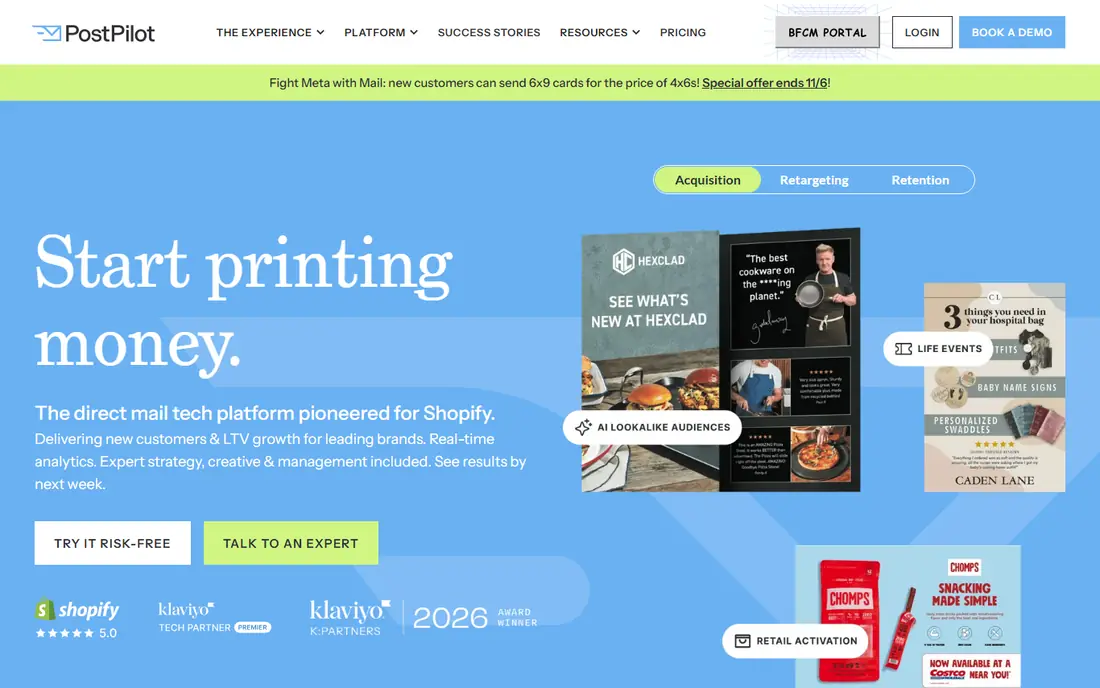
PostPilot describes itself as a postcard tool for online stores, and that focus shows in its features. It connects to Shopify, applies coupon codes automatically, and sends cards after a purchase, an abandoned cart, or a long gap since the last order. Typical sends start around 49 cents per card for smaller segments, with larger programs priced by volume and plan.
Stores that already know their repeat buyers and lapsed buyers will get the most from it, because the targeting is based on purchase behavior rather than broad demographics. Brands outside ecommerce can still use postcards, but they will find less of the ready-made automation here. For Shopify stores, PostPilot is our pick for most people.
- Shopify integration
- Post-purchase and winback flows
- Real-time tracking
- Dedicated account support on larger plans
- Ecommerce focus limits use for other industries
- Volume pricing varies by plan
Poplar sits between a managed agency and a pure API tool. Brands upload customer data, build triggered flows, and send mail when a customer hits a set condition, such as a first purchase or a birthday. The platform handles design, printing, and delivery, and tracking helps teams see which flows drive repeat orders.
Custom pricing means you will need a conversation before you can budget precisely, which can slow down a small test. For mid-size and larger brands that want mail as an always-on retention channel, rather than a one-time blast, Poplar offers a cleaner setup than stitching together separate print and data vendors.
- Triggered campaigns from customer data
- Design tools
- Delivery tracking
- Pricing is custom
- Smaller businesses may find it more than they need
Postalytics is built for marketers who already live in a CRM. It connects to tools such as HubSpot, lets teams build postcard and letter templates, and triggers sends from contact activity. Tracking and response data flow back into the CRM, which makes it easier to judge whether a mailing actually produced leads or sales.
The subscription model means it suits ongoing programs better than a single mailing. Teams that only send mail twice a year may prefer a pay-per-piece tool instead. For marketers who want mail to behave like email, with triggers, templates, and reporting in one place, Postalytics is a practical middle ground.
- HubSpot and CRM integrations
- Templates and tracking
- Direct mail automation for marketers
- Plans are subscription-based
- Design flexibility is lower than a full agency
Click2Mail is a straightforward self-service option: upload a design and a list, choose a format, and have it printed and mailed. That simplicity suits accountants, lawyers, nonprofits, and other senders who need letters or postcards without a marketing agency attached. There is no long onboarding, and you pay for what you send.
What you give up is guidance. Click2Mail will not design your campaign, pick your audience, or coach you on offers, so the quality of the result depends on what you upload. For senders who already have a list and a finished design, it is one of the fastest and least complicated routes to the mailbox.
- Upload and mail without a contract
- Letter and postcard formats
- Address handling
- Less campaign strategy help
- Interface feels utilitarian
Inkit targets larger organizations that send mail at scale and need it to fit into existing systems. It offers integrations, workflow automation, and controls that matter when mail contains sensitive information or must meet compliance rules. Healthcare and financial senders, in particular, benefit from a platform built around secure, repeatable sends.
Small businesses will likely find Inkit more platform than they need, and custom pricing makes a quick comparison hard. For enterprises that treat direct mail as a regular, high-volume channel, Inkit provides the structure and reporting that a simple print vendor cannot.
- Enterprise automation and integrations
- Secure handling for regulated senders
- Scalable print network
- Custom pricing
- Overkill for small local campaigns
Amazingmail keeps direct mail simple, with postcards and greeting cards that can be ordered in small batches. It suits real estate agents, small retailers, and anyone who wants a personal-feeling card without building a full campaign system. Ordering is quick, and the formats cover birthdays, thank-yous, and local promotions well.
Automation is limited compared with Lob, PostPilot, or Postalytics, so it is not the pick for triggered, data-driven programs. For a human, low-volume use of mail, that simplicity is a plus rather than a drawback. Use it when the goal is a thoughtful card to a known list, not a large automated funnel.
- Easy postcard ordering
- Greeting card options
- Good for small batches
- Fewer automation features
- Limited CRM triggers
How we picked these
We looked for companies that actually print and mail in the United States in 2026, with a working website, a clear service model, and a track record in direct mail. We compared official pricing and feature pages, and we favored a mix of managed services, self-service tools, and automation platforms, since different buyers need different levels of help. We did not claim hands-on testing, and we used vendor pricing where it was published, writing See website where pricing is quote-based.
We also weighed tracking and address quality, because undeliverable mail wastes postage and hides results. Companies that verify addresses and report delivery scored higher, even when their per-piece price was not the lowest. A cheap mailing that never arrives is not a bargain.
How to run a first campaign without wasting money
Start with a clear offer and a single call to action, such as a QR code to a landing page or a coupon code that only appears on the card. That code is how you will know whether mail worked, since mail alone does not report clicks. Keep the design simple: one headline, one benefit, one next step, and contact details that are easy to read.
Test small, then scale what works. A mailing of 500 to 1,000 pieces to a well-chosen list gives a usable signal without risking a large budget. Compare the response rate and cost per response across lists and offers before committing to a bigger run. Finally, clean your list before every send, since bad addresses are one of the largest hidden costs in direct mail.
FAQ
How much does direct mail cost per piece?
Typical all-in costs run from about 30 cents to 3 dollars per piece, depending on format, quantity, and mail class. A standard postcard at Marketing Mail rates often lands around 55 to 90 cents all in, while First-Class letters cost more. Postage usually makes up the largest share, followed by printing and list costs.
What is the best direct mail marketing company for small businesses?
PostcardMania is a strong fit for small local businesses that want design and list help, while Click2Mail suits owners who already have a design and list. If you run an online store, PostPilot is usually the better pick, because its triggers are built around purchases.
Is direct mail still effective in 2026?
Yes, for the right audience and offer, because physical mail stands out in a crowded inbox and reaches people who ignore digital ads. Results depend on targeting, creative, and follow-up, so treat the first mailing as a test and measure response with a unique code or landing page.
What is the minimum for a direct mail campaign?
Minimums vary by company and format. PostcardMania notes mailings from as few as 250 pieces, while Every Door Direct Mail through USPS requires at least 200 pieces and a full carrier route. Automated platforms often work best with segments of 500 to 1,000 for a readable result.
Should I use EDDM or a targeted mailing list?
Every Door Direct Mail suits broad local offers, such as a new restaurant or a neighborhood service, because it reaches every address on a route. A targeted list suits offers aimed at a specific group, such as homeowners of a certain age or past customers, and usually gives a higher response rate.
How do I track direct mail results?
Use a unique coupon code, a QR code to a dedicated landing page, or a tracking phone number on each campaign. Platforms such as Lob and Postalytics add delivery tracking, but response tracking still depends on the offer code or page you put on the piece.