Best Competitor Analysis Software for AI Products in 2026: 9 Tools Compared
We compared the best competitor analysis software for ai products, covering ai search tracking, pricing changes, feature maps and sales tools for growing teams.

- Editor's choice
 Crayon
Enterprise competitor monitoring
Starts atSee websiteVisit crayon.coFull review - Great alternative
 Klue
Competitive intelligence plus win loss
Starts atSee websiteVisit klue.comFull review - Also consider
 Semrush
Search and marketing intelligence
Starts at$139.95 per monthVisit semrush.comFull review
TL;DR:
- AI products need a new kind of tracking: how chatbots and AI search describe you compared with rivals, not just website traffic.
- Classic tools such as Semrush, Ahrefs and Similarweb still matter for search, backlinks and traffic benchmarking.
- Dedicated platforms such as Crayon and Klue turn competitor changes into battlecards and sales updates, which is where enterprise teams get value.
- For a small AI team, a low cost tool plus manual checks often beats an enterprise contract you will not fully use.
Quick comparison
| Tool | Best for | Starts at | Free plan? | |
|---|---|---|---|---|
| Crayon | Enterprise competitor monitoring | See website | No | Visit |
| Klue | Competitive intelligence plus win loss | See website | No | Visit |
| Semrush | Search and marketing intelligence | $139.95 per month | Free trial | Visit |
 Ahrefs | Backlinks and content gaps | $29 per month | Yes | Visit |
 Similarweb | Traffic and audience benchmarking | $199 per month | Free trial | Visit |
 Competely | Fast visual competitor maps | $39 per month | Free trial | Visit |
 Kompyte | Automated tracking and battlecards | See website | No | Visit |
 Brandwatch | Share of voice and social listening | See website | No | Visit |
 AIclicks | AI search visibility tracking | $59 per month | No | Visit |
The best competitor analysis software for AI products
AI products compete on model quality, pricing, integrations and how AI assistants describe them, so competitor tracking now spans websites, search, social chatter and AI answers. The tools below cover each of those angles.
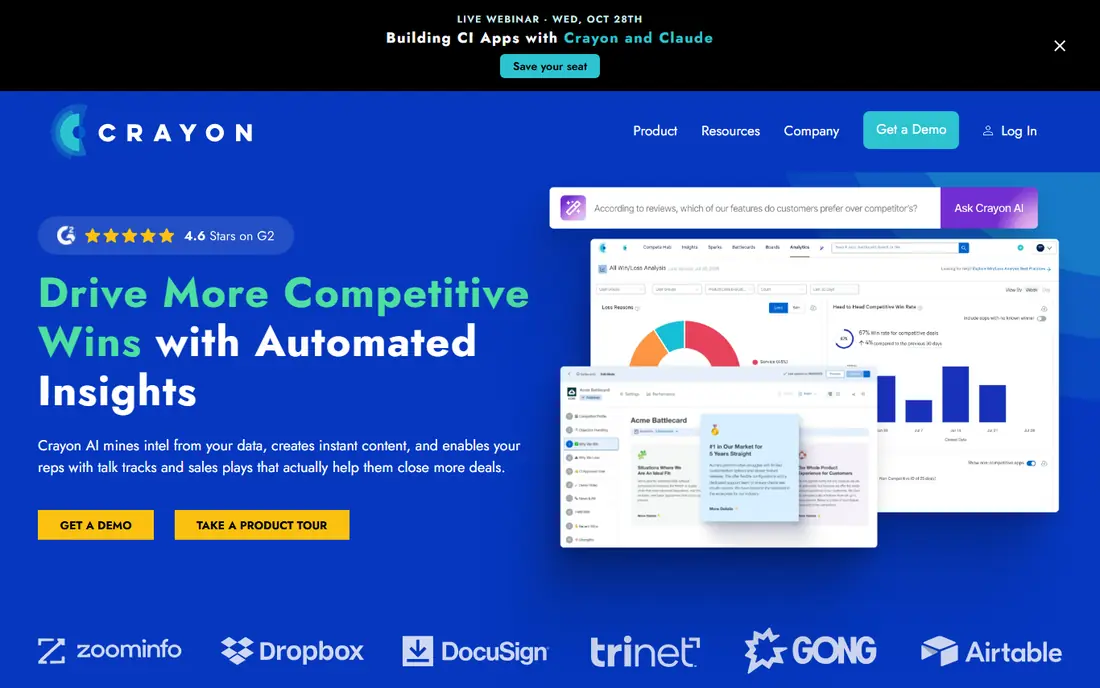
Crayon is built for companies with a formal competitive intelligence program. It tracks competitor websites, pricing pages, news, reviews and job posts, then turns changes into alerts, newsletters and battlecards that sales teams can actually use. For an AI product team facing fast moving rivals, that distribution matters as much as the data itself.
The trade off is size and cost. Pricing is by quote, and setup works best with a dedicated owner who curates what matters. A small startup will find it heavy and costly. For a mid market or enterprise AI company that needs sales enablement as well as monitoring, Crayon is a strong and established choice.
- Live tracking of competitor sites and news
- Battlecards for sales
- Slack and Salesforce links
- Quote only pricing
- Heavy for a small team

Klue pairs competitor tracking with win loss research, so a team learns not just what a rival changed, but why deals were won or lost against them. That pairing is valuable for AI products, where buyers often compare several similar tools and price, integrations or trust decide the deal. Klue also distributes insights into sales workflows, so the research reaches the people talking to buyers.
Like Crayon, Klue is enterprise priced and needs a team that will feed it deal data and use its outputs. Without that buy in, it becomes an expensive news feed. For companies ready to run a real intelligence program, with win loss as part of it, Klue is a thoughtful pick.
- Win loss interviews alongside tracking
- Curated intelligence feeds
- Sales enablement
- Quote only pricing
- Needs team buy in to work well

Semrush remains a core tool for understanding how AI rivals win search traffic. Its keyword gap analysis shows which terms a competitor ranks for that you do not, and its traffic and backlink tools reveal which pages and links drive their growth. For an AI product with a content led growth plan, those insights guide both product pages and blog topics.
The starting price is higher than simpler tools, and the sheer number of features can overwhelm a new user. Semrush fits best for marketing and growth teams that will use it weekly, not once a quarter. For search focused competitor work, it is still one of the most complete options.
- Broad keyword and traffic tools
- Keyword gap analysis
- Backlink audits
- Higher starting price
- Depth can overwhelm beginners
Ahrefs is the pick when backlinks and content explain a rival's growth. Its site explorer shows which pages earn links, which keywords bring traffic, and where content gaps exist, which helps an AI team plan pages that can actually compete. The lower entry price also makes it accessible to smaller teams than Semrush.
Traffic figures are estimates, not exact counts, so treat them as directional, and Ahrefs does not focus on AI search answers in the way newer tools do. Pair it with an AI visibility tool if AI search matters to you. For classic search and link intelligence, Ahrefs is clear and capable.
- Strong backlink database
- Top pages and content gaps
- Lower entry price
- Traffic figures are estimates
- AI search tracking is limited
Similarweb answers a different question: how big is a rival, and who visits it. Its traffic estimates, audience demographics and referral sources help an AI team size a market, spot a rival's growth channel, and benchmark its own traffic against a set of competitors. Market segment views also help when a product spans several categories.
Data is thinner for small sites, and the price is high for a small team. Similarweb fits best for growth and strategy teams that need market context, not just keyword lists. Used alongside Semrush or Ahrefs, it gives a fuller picture of where rivals actually get users.
- Traffic and audience estimates
- Market segment views
- Referral source data
- Higher price
- Small sites have thinner data
Competely is built for speed: enter a product and its rivals, and it builds a visual map of features, pricing and positioning in minutes. For a small AI team preparing a launch or a pricing review, that fast overview is often enough, and the low price makes it easy to justify. It is also useful for pitch decks and internal briefings where a clear map beats a long report.
Depth is the limit. Competely does not replace continuous monitoring or win loss research, and its tracking is lighter than Crayon or Klue. Use it for quick comparisons and positioning work, and add a monitoring tool if you need ongoing alerts. For fast, affordable competitor maps, it is a good pick.
- Quick visual maps of features and pricing
- Low price
- Fast setup
- Less depth than enterprise tools
- Tracking is lighter
Kompyte automates much of the monitoring work that teams otherwise do by hand, tracking competitor websites, product pages, reviews, pricing and news, then surfacing changes that matter. Its battlecards help sales teams answer rival claims without digging through notes. For an AI team with several fast moving rivals, that automation saves hours each week.
Pricing is by quote, and the interface takes some learning before alerts feel well tuned. Kompyte sits between a quick map tool and a full enterprise program, which suits mid market teams that need steady monitoring without a large intelligence team. For that middle ground, it is a capable option.
- Automated site and review tracking
- Battlecards
- Prioritized alerts
- Pricing by quote
- Interface takes learning
Brandwatch tracks how people talk about AI products across social and web sources, which reveals sentiment, complaints and trending topics that website tracking misses. Its share of voice view shows whether your product or a rival dominates conversation in a category, and its AI summaries help teams read large volumes of mentions quickly. For brand and product marketing teams, that social layer is essential.
Enterprise pricing puts it out of reach for many small teams, and setting up good queries takes care. Brandwatch fits best for companies where public perception and social buzz shape buying decisions. For AI products in crowded categories, it adds a view no traffic tool provides.
- Broad social listening
- Share of voice tracking
- AI summaries of conversation
- Enterprise pricing
- Setup needs care
AIclicks focuses on the newest battleground: how AI search and chat systems describe and cite your product compared with rivals. It tracks prompts, measures visibility in AI answers, and shows which sources get cited, which helps an AI team understand why a chatbot recommends a rival. That insight is hard to get from classic SEO tools alone.
The category is still new, so benchmarks are less settled than in search, and AIclicks does not replace Semrush or Ahrefs for classic traffic work. Pair it with a search tool for a full view. For AI product teams that care about being recommended by AI assistants, AIclicks is a timely and focused choice.
- Tracks prompts across AI systems
- Competitor benchmarking in AI answers
- Citation tracking
- Newer category
- Does not replace classic search tools
How we picked these
We compared official pricing pages, feature pages and public reviews for tools that track competitors in ways relevant to AI products, including classic search, traffic, social and AI search. We favored tools still sold in 2026, with clear tracking or enablement features, and we noted quote only pricing where it applies. Where a price could not be verified on the vendor site, we listed it as See website.
What to check before you buy
Start with the question you need answered. If you need pricing changes, a monitoring tool fits. If you need search growth, Semrush or Ahrefs fit. If you need AI assistant visibility, a tool such as AIclicks fits. Buying an enterprise platform to answer a single question wastes money, while a quick map tool will disappoint if you need daily alerts.
Also check data coverage for your specific rivals. Small or new AI products may have thin traffic or social data, so trial the tool on your actual competitor set before paying. Finally, decide who will act on the insights. A tool that sends alerts no one reads is worse than a simple monthly review that the team actually uses.
FAQ
What is the best competitor analysis tool for AI products?
The best competitor analysis tool for AI products depends on the job. For ongoing monitoring and sales enablement, Crayon or Klue lead. For search, Semrush or Ahrefs lead. For AI search visibility, AIclicks is a focused pick. Many AI teams use two tools: one for search and one for AI answers.
What are the best competitor analysis tools for AI products on a budget?
On a budget, Competely for visual maps and Ahrefs at its entry tier give good value, and both offer trials. A small team can also pair those with manual checks of rival pricing pages and AI chatbot answers. Avoid an enterprise contract until you have a clear weekly use for it.
How do AI products track competitors in AI search?
Tools such as AIclicks run a set of prompts across AI systems, record which products are mentioned, and track citations and sentiment. This shows whether an AI assistant recommends your product or a rival for a given question. Results vary by prompt wording, so track a consistent prompt set over time.
Can competitor analysis software track pricing changes?
Yes, monitoring tools such as Crayon and Kompyte track pricing pages and alert you to changes, though some pricing is hidden behind sales calls. For AI products with public pricing, tracking works well. For quote based rivals, combine tool alerts with manual checks and sales feedback.
Is competitor tracking legal?
Tracking public websites, pricing pages, reviews and social mentions is generally lawful, but scraping private data, bypassing logins or copying copyrighted content is not. Use tools that rely on public sources, respect terms of service, and do not collect personal data without a lawful basis. When in doubt, ask legal counsel.
How often should a team review competitor data?
A small team should review a short competitor update weekly and a deeper positioning review monthly. Enterprise teams with dedicated intelligence staff may review daily alerts. The key is action: each review should end with a decision, such as a pricing check, a content topic or a sales message update.