Best Backlink Indexing Tool in 2026: 8 Tools Compared
We compared the best backlink indexing tool options for 2026, from pay-per-index services to free consoles, so you can pick one that fits your budget.

- Editor's choice
 IndexMeNow
High-value links that need a second push
Starts atSee websiteVisit indexmenow.comFull review - Great alternative
 SpeedyIndex
Bulk backlinks on a budget
Starts at$5 packVisit speedyindex.comFull review - Also consider
 Omega Indexer
Drip-fed campaigns
Starts at$19 per monthVisit omegaindexer.comFull review
TL;DR:
- Indexing tools cannot force Google to index a page, and no vendor can honestly guarantee it, so treat refund terms as part of the price.
- Pay-per-indexed-link services suit bulk backlink work, while premium per-URL services suit a small set of high-value links.
- For pages on sites you own, Google Search Console is free and should be your first step before you pay anyone.
- Credit expiry, refund windows, and drip-feed controls matter more than headline rates, because those terms decide what a failed submission costs you.
- Our pick for most people is SpeedyIndex for bulk work and IndexMeNow for a small batch of important links, with Search Console running alongside both.
Quick comparison
| Tool | Best for | Starts at | Free plan? | |
|---|---|---|---|---|
| IndexMeNow | High-value links that need a second push | See website | No | Visit |
| SpeedyIndex | Bulk backlinks on a budget | $5 pack | Yes | Visit |
| Omega Indexer | Drip-fed campaigns | $19 per month | No | Visit |
 Rapid URL Indexer | Pay only for indexed links | See website | No | Visit |
 GigaIndexer | Small batches of valuable links | See website | No | Visit |
 Indexification | Low-cost bulk submissions | See website | No | Visit |
 OneHourIndexing | Simple, fast submissions | See website | No | Visit |
 Google Search Console | Free indexing for your own sites | Free | Yes | Visit |
The best backlink indexing tools
Backlink indexing tools submit URLs to search engines or use other methods to prompt a crawl, then report whether the page appears in the index. We compared official feature pages, pricing pages, and public reviews for each service below, and we checked that each one is still operating in October 2026.

IndexMeNow is the premium pick in this list, and its pricing reflects that. Published packs start at about 59 euros for 60 credits and fall to about 0.47 euros per URL on the largest pack, which makes it a poor fit for thousands of low-value links. It fits a different job: a money page, a strong editorial link, or a link that other tools failed to get indexed. For that job, paying more per URL can be rational, because one indexed link on an important page is worth more than hundreds of indexed links on throwaway pages.
The catch is the refund model. Credits for URLs not indexed within 10 days go back to your credit balance, not to your bank account, so the money stays inside the service. That is still better than paying for nothing, but it is not the same as a cash refund. Check the current pack prices on the vendor site before you buy, because this market reprices often.
- Credit refunds for URLs not indexed within 10 days
- API access
- Index checking included
- High per-URL cost
- Credit packs are priced in euros
- No free tier
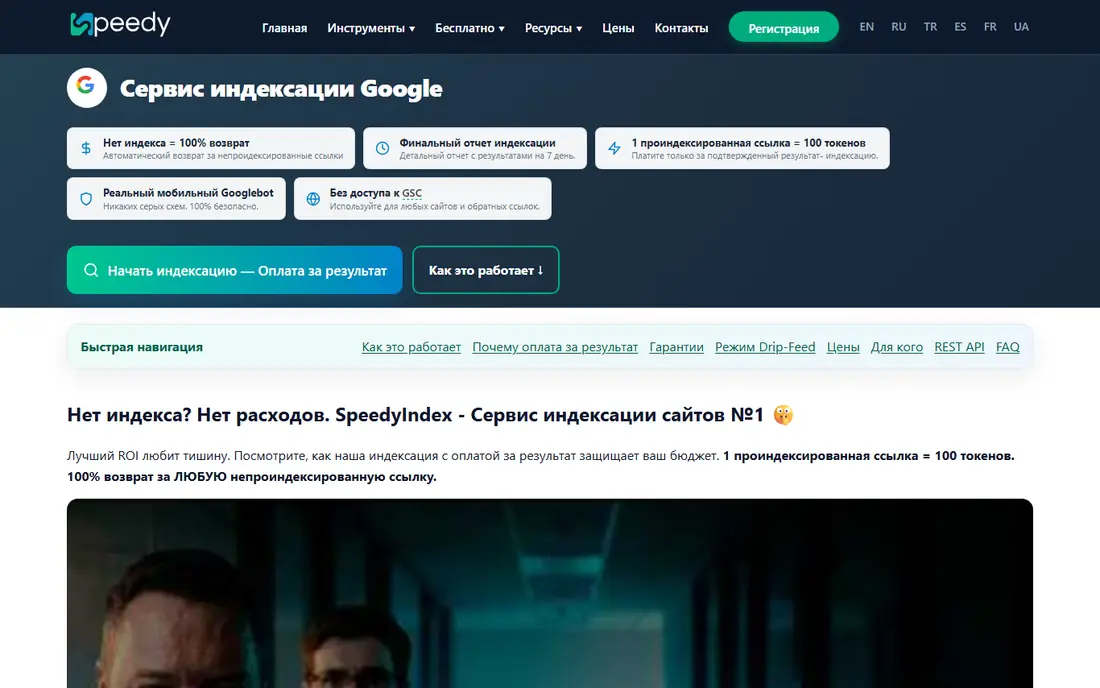
SpeedyIndex sells token packs starting at $5, and one indexed link costs 100 tokens, so the smallest pack covers roughly 50 indexed links. Tokens for links that do not index are returned after the reporting window, and tokens do not expire, which makes the real cost easier to predict than a monthly subscription you forget to cancel. New accounts get a small free token allowance to test the service, and a Telegram bot makes it usable without opening a dashboard.
The honest weakness is trust. SpeedyIndex went dark in late 2025 after a Google-side change and relaunched in early 2026 as pay-per-result only, and its effective prices are several times higher than its old advertised rates. That history does not make it useless, but it does mean you should start with a small pack, verify results in Search Console or a third-party index checker, and never treat it as your only indexing route.
- Pay-per-indexed-link model
- Tokens do not expire
- Telegram bot and API
- Method is not disclosed
- Service has shut down before
- Per-link cost rose after its 2026 relaunch

Omega Indexer is one of the longest-running services in this niche, and its main selling point is control over timing. Drip-feed scheduling lets you spread submissions over up to 30 days, which suits link builders who want new links to appear gradually rather than all at once. The starter plan is listed at $19 per month for 190 credits, with top-ups available, and credits are returned for links that cannot be indexed or are not indexed within the stated window.
The downside is the subscription shape. Monthly credits reset, so a quiet month wastes money, and the per-credit cost sits above the cheapest token packs. Omega Indexer makes sense for a team running steady monthly campaigns that value drip-feeding, and less sense for someone with one batch of links and no ongoing need.
- Drip-feed scheduling over many days
- Refunds for non-indexed links
- Long track record
- Monthly credits reset
- Higher per-credit cost than token services
- Pricing has changed several times
Rapid URL Indexer charges per indexed link, with published rates around $0.04 to $0.05 per credit, and refunds credits automatically for URLs not indexed within about 14 days. That refund window is the core appeal: you are not paying full price for submissions that go nowhere. A WordPress plugin also makes it practical for site owners who want to submit new posts without copying URLs into a separate dashboard.
The gap is verification. The service has no built-in independent checker, so its own reports are the main evidence, and you should still spot-check results yourself. It also offers a faster mode with different pricing, so read the plan page carefully and compare the standard timeline against the faster option before you commit a large batch.
- Automatic credit refunds for unindexed URLs
- Detailed reports
- WordPress plugin
- No built-in independent index checker
- Pricing varies by mode
- No free tier
GigaIndexer is a credit-based service aimed at smaller, higher-value batches rather than mass submission. Its published pricing has sat around $0.48 per URL in third-party comparisons, with a refund window for links that do not index, which puts it closer to IndexMeNow than to SpeedyIndex on cost. If you have a short list of links that matter, that price may be acceptable, and the simple submission flow keeps the work quick.
The trade-off is speed and transparency. Reported timelines run longer than the fastest services, and public detail on exactly how it prompts crawls is thin. That is common in this market, where vendors guard their methods, but it means you should test with a small batch and measure the result before scaling up.
- Credit-based pricing
- Refund window for unindexed links
- Simple submission flow
- Higher per-URL cost than budget tools
- Slower reported timelines
- Limited public detail on methods
Indexification has been around for years and remains one of the cheaper ways to submit a large list of URLs. It offers drip-feed controls and an API, which makes it workable for agencies that submit links in bulk and want to pace the work. For low-value links where you would not pay a premium per URL, a low-cost bulk tool is often the rational choice, and Indexification fits that slot.
The honest catch is that its refund terms and reporting are less clear than the pay-per-indexed leaders, so a failed batch can be harder to account for. Its interface also feels dated next to newer services. Use it for volume where cost per URL is the priority, and keep your own spreadsheet of what was submitted and what actually appeared in the index.
- Low entry cost
- Drip-feed options
- API access
- Older interface
- Refund terms are less clear than rivals
- Results vary by link quality
OneHourIndexing pitches speed and simplicity: upload a list, submit it, and get on with other work. Credit-based plans keep the cost tied to how many URLs you submit, and the dashboard is straightforward enough that a beginner can use it without a tutorial. For a small agency or a solo site owner with occasional batches, that simplicity has real value.
The limits are familiar for this category. Public pricing detail is thin, so you need to check the current plans page before buying, and no tool in this list can guarantee that Google will index a given page. OneHourIndexing is best treated as a prompt to crawl, not as a guarantee of ranking, and it works best alongside good content on the linked page itself.
- Fast submission process
- Credit-based plans
- Straightforward dashboard
- Limited public pricing detail
- No free tier
- Indexing is never guaranteed
Google Search Console is the baseline every other tool in this list should be measured against, and it costs nothing. If you own or manage the site, you can request indexing for individual URLs, submit sitemaps, and see coverage, crawl errors, and which pages Google has actually indexed. That data is first-party and more trustworthy than any vendor report, and it is the first place to look when a page is missing from search results.
The limit is scope. Search Console only works for properties you verify, so it cannot submit backlinks on other people's sites, which is exactly the job the paid tools claim to do. It also gives you no control over when Google acts on a request. Our advice is simple: use Search Console for everything you own, and only pay a third-party indexer for links you do not control.
- Free
- Official Google tool
- Shows crawl and coverage data
- Only works for sites you verify
- No bulk third-party backlink submission
- No control over timing
How we picked these
We compared official pricing pages, feature pages, and public reviews for services that were still operating in October 2026, and we favored tools with clear refund terms, an API or bulk upload, and a track record longer than a few months. We excluded services with no working homepage and tools that promise guaranteed indexing, because that promise cannot be kept by any third party. Prices in this market change often, so we marked anything we could not verify on a vendor page as See website and we recommend checking the plan page before you buy.
What to check before you pay for indexing
Start with the linked page itself. A thin page, a page blocked by robots rules, or a page on a low-quality site may never index no matter which tool you use, and paying to submit it is wasted money. Fix crawl blocks, thin content, and broken links first, then submit. This check costs nothing and saves more than any tool choice.
Next, read the refund terms as carefully as the price. A service that charges only for indexed links is cheaper in practice than a cheaper-looking service that charges for every submission, because failed submissions are common. Ask three questions: how long is the refund window, is the refund cash or credit, and do credits expire. Those answers decide the true cost of a batch.
Finally, verify results yourself. Check a sample of URLs in Search Console for your own pages, and use an independent index checker for third-party links. Vendor dashboards report what they submitted, not always what Google indexed, and the gap between those two numbers is where most disappointment lives. Keep a simple log of submissions, dates, and outcomes, and drop any service whose verified rate stays low after two batches.
FAQ
What is the best backlink indexing tool?
For bulk work, SpeedyIndex offers the lowest pay-per-indexed cost we found, while IndexMeNow suits a small set of high-value links. For your own pages, Google Search Console is free and should come first. The right pick depends on how many links you have and how much each one is worth to you.
What is the best backlink indexing software for agencies?
Agencies usually need bulk upload, an API, drip-feed scheduling, and clear reporting, which points to Omega Indexer or SpeedyIndex. Indexification can also work for low-cost volume. Whichever you pick, keep your own verification log, because client reporting should rest on indexed pages, not submitted ones.
Can a backlink indexing tool guarantee indexing?
No. Google decides what to index, and no third-party service can force that decision. Services can prompt a crawl and report the outcome, and the honest ones refund credits for links that do not index. Treat any guarantee of indexing or ranking as a warning sign.
How long does backlink indexing take?
It varies widely, from hours for some URLs to weeks for others, and some URLs never index. Link quality, the authority of the linking site, and the content of the target page all matter more than the tool. Give a batch at least two weeks before judging it, and re-check after 30 days.
Is backlink indexing safe?
Prompting a crawl of a legitimate link is a normal part of SEO, but mass-submitting spammy links can draw attention you do not want. Avoid services that promise thousands of indexed links overnight, and focus on links from real pages with real content. If a service will not explain its method at all, start small or skip it.
Should I index links I do not own?
That is the main use case for paid indexers, since Search Console only covers your own sites. It is fine for legitimate editorial links, press mentions, and citations. It is not a fix for low-quality links, and it will not turn a weak link into a strong one.
Sources
- https://www.indexmenow.com
- https://speedyindex.com
- https://www.omegaindexer.com
- https://rapidurlindexer.com
- https://gigaindexer.com
- https://indexification.com
- https://www.onehourindexing.com
- https://search.google.com/search-console
- https://www.charlesfloate.com/best-backlink-indexing-tools
- https://indexmachine.co/speedyindex-vs-omega-indexer