Best Automated Marketing Software in 2026: 8 Tools Compared
We compared the best automated marketing software for email, SMS, and journeys, with prices and honest notes on where costs rise as lists grow in 2026.

- Editor's choice
 HubSpot Marketing Hub
All-in-one CRM marketing
Starts at$15 per seat per monthVisit hubspot.comFull review - Great alternative
 ActiveCampaign
Deep automation
Starts at$15 per monthVisit activecampaign.comFull review - Also consider
 Brevo
Large lists on a budget
Starts at$9 per monthVisit brevo.comFull review
TL;DR:
- HubSpot Marketing Hub is the best all-in-one choice, with a free CRM and Marketing Hub Starter from 15 dollars per seat per month.
- ActiveCampaign at 15 dollars per month offers the deepest automation for the money for small and mid-sized teams.
- Brevo at 9 dollars per month is the best value for large lists, since it prices by email volume rather than contacts.
- Klaviyo leads for ecommerce brands that earn most revenue from email and SMS, starting at 20 dollars per month.
- Enterprise tools such as Marketo and Salesforce Account Engagement start at four figures per month and suit large B2B teams only.
Quick comparison
| Tool | Best for | Starts at | Free plan? | |
|---|---|---|---|---|
| HubSpot Marketing Hub | All-in-one CRM marketing | $15 per seat per month | Yes | Visit |
| ActiveCampaign | Deep automation | $15 per month | No | Visit |
| Brevo | Large lists on a budget | $9 per month | Yes | Visit |
 Mailchimp | Beginner email marketing | $13 per month | Yes | Visit |
 Klaviyo | Ecommerce email and SMS | $20 per month | Yes | Visit |
 Customer.io | Event-driven journeys | $100 per month | No | Visit |
 Adobe Marketo Engage | Enterprise B2B demand generation | See website | No | Visit |
 Salesforce Account Engagement | Salesforce-native B2B | $1,250 per month | No | Visit |
The best automated marketing software
We compared tools on automation depth, channels, CRM fit, and pricing model, and we kept only tools that are currently sold with working homepages. Prices scale with contacts, sends, or seats, so model your list at twice its current size before comparing.

HubSpot is our pick for teams that want marketing and sales in one system. The free CRM covers contacts, deals, tickets, and basic email, and Marketing Hub Starter at 15 dollars per seat per month adds email automation, landing pages, and lead scoring. That low entry point makes it easy to start, and the integration marketplace covers almost any tool a team already uses.
The bills arrive later. Marketing Hub Professional costs around 890 dollars per month, contact-tier pricing grows with your list, and onboarding fees run into four figures on Pro plans. HubSpot is right when marketing and sales must share one system and the budget allows growth, and wrong when you only need email.
- Free CRM with contacts, deals, and basic email
- Starter adds automation and landing pages
- Very wide integration marketplace
- Professional jumps to around 890 dollars per month
- Contact-based pricing punishes list growth
- Onboarding fees apply on higher plans

ActiveCampaign wins on automation depth for the price. Its visual builder handles complex journeys with conditions, splits, goals, and site tracking, and its built-in CRM keeps sales follow-up in the same place. Starter plans begin at 15 dollars per month for 1,000 contacts, which is strong value for teams that send behavior-based campaigns.
The trade-offs are the lack of a free plan and a steeper learning curve. Teams that only send a monthly newsletter will not use its power, and growing lists raise the monthly bill. For marketers who live in automations, it is the best value here.
- Visual automation builder with conditions and goals
- Built-in CRM
- Strong deliverability reputation
- No free plan
- Price rises with contact count
- Learning curve is steeper than Mailchimp
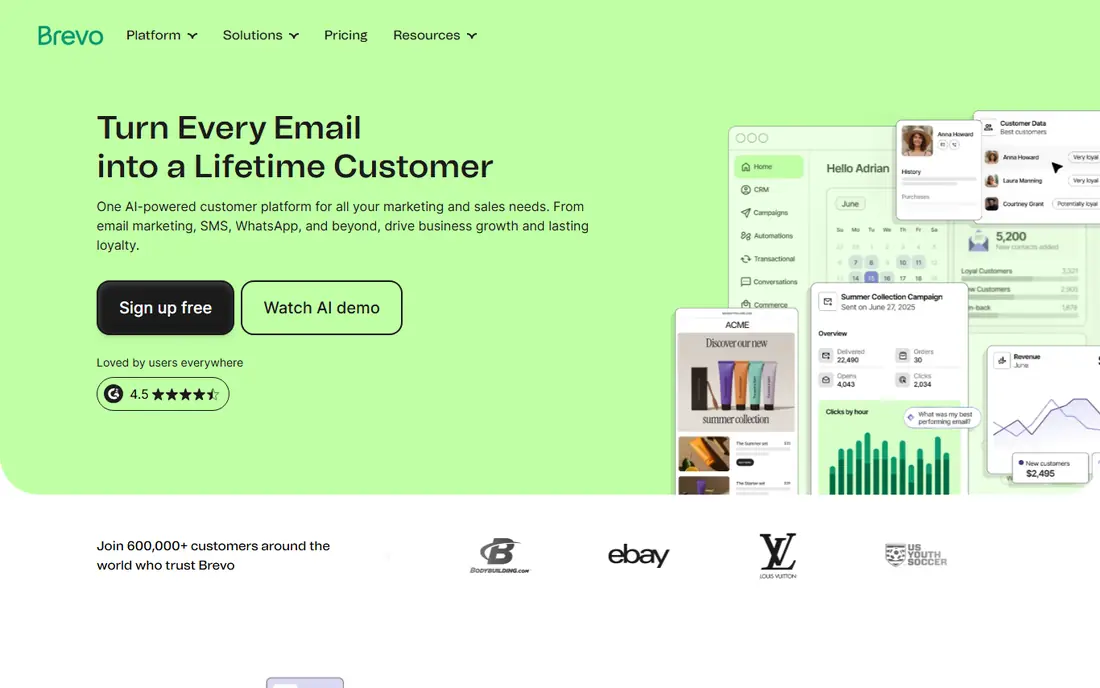
Brevo, formerly Sendinblue, is the best choice for businesses with large lists and small budgets. Its free plan covers basic sending, and Starter at 9 dollars per month adds higher send limits and removes daily caps. Because Brevo prices by email volume rather than contact count, a list of 50,000 contacts that rarely emails can cost far less than on contact-priced rivals.
Automation and CRM depth trail ActiveCampaign and HubSpot, so teams that need complex journeys or deep sales pipelines should look elsewhere. For newsletters, transactional email, and simple automations at scale, Brevo is hard to beat on price.
- Free plan available
- Starter at 9 dollars per month
- Pricing by email volume, not contacts
- Automation is less deep than ActiveCampaign
- CRM features are lighter
- SMS costs are extra
Mailchimp remains the easiest starting point. Its free plan covers up to 500 contacts, and Essentials starts at 13 dollars per month, with a drag-and-drop builder, templates, and landing pages that a beginner can use in an afternoon. For a small business sending regular newsletters, that simplicity matters more than advanced journey logic.
The limit is depth. Automation has improved but still feels lighter than ActiveCampaign, and contact-based pricing means costs climb as lists grow. Mailchimp suits beginners and small audiences, while growing teams usually move to ActiveCampaign or HubSpot within a year or two.
- Free plan for up to 500 contacts
- Easiest builder for beginners
- Wide template and integration range
- Automation is lighter than ActiveCampaign
- Price rises with contacts
- Long-time users often outgrow it
Klaviyo is the leader for ecommerce brands that earn revenue from email and SMS. Starting at 20 dollars per month for 250 to 500 active profiles, it unifies email, SMS, and automation with deep store integrations, so abandoned cart, post-purchase, and win-back flows can use real purchase data. Segmentation and predictive features help stores send fewer, better-targeted messages.
The pricing model needs care. Active profiles, not just subscribers, drive cost, and SMS adds separate charges, so a growing store should model costs at higher volumes. For stores where email drives a large share of revenue, Klaviyo usually pays for itself, but it is not a budget tool for non-ecommerce senders.
- Deep Shopify and WooCommerce integrations
- Email and SMS in one platform
- Strong segmentation and predictive features
- Price is based on active profiles, so costs rise fast
- SMS credits are extra
- Learning curve for advanced flows
Customer.io suits product-led companies that trigger messages from user behavior, not just list membership. Starting at 100 dollars per month, it builds journeys from events such as signups, feature use, and purchases, and sends across email, push, SMS, and in-app channels. SaaS teams that need precise, data-driven onboarding and retention flows get the most from it.
The tool needs developer help to send events cleanly, and its price is high for a simple newsletter sender. Teams without product data to drive journeys should pick a simpler email tool instead.
- Event and behavior-driven journeys
- Strong for product-led SaaS
- Email, push, SMS, and in-app messages
- Starting price of 100 dollars per month
- Needs developer setup for events
- Less suited to simple newsletters
Marketo Engage is the enterprise B2B standard for demand generation and account-based marketing. It handles lead scoring, nurturing, multi-touch programs, and account targeting at a scale that small tools cannot match, and it integrates deeply with Salesforce and other CRMs. Large B2B teams with long sales cycles rely on it for pipeline work.
The cost and complexity rule it out for small teams. Pricing is quote-based and typically starts above 1,200 dollars per month, implementation takes weeks, and it needs staff who run it full time. It earns its place only when B2B pipeline, not just email sends, is the goal.
- Deep B2B lead scoring and nurturing
- Account-based marketing tools
- Strong CRM integrations
- Quote-based pricing, often above 1,200 dollars per month
- Implementation is a project
- Needs dedicated operators
Salesforce Account Engagement, formerly Pardot, is the natural pick for companies already running Salesforce. Starting at 1,250 dollars per month per org, it shares data directly with Sales Cloud, so lead scores, campaign influence, and sales alerts stay in one system without fragile syncs. Its journey tools suit B2B teams with account-based sales.
Outside Salesforce, the price is hard to justify, and setup still needs expertise. Companies not committed to Salesforce should compare Marketo or HubSpot Professional instead, since both offer strong B2B features without requiring a Salesforce org.
- Native Salesforce CRM integration
- Strong B2B journey and scoring tools
- Agentforce AI features
- Starting price of 1,250 dollars per month per org
- Only makes sense inside Salesforce
- Setup needs expertise
How we picked these
We compared official pricing pages, automation features, channel coverage, and public reviews, and we required each tool to offer real automation, not just bulk sending. We favored published prices and clear pricing models, and we noted where pricing is quote-based. We weighted automation depth, CRM fit, and total cost at realistic list sizes, not just entry prices.
How to choose without overpaying
Start with your channels and your data. Ecommerce stores should shortlist Klaviyo, B2B teams should compare HubSpot, Marketo, and Account Engagement, and product-led SaaS teams should test Customer.io. Next, model cost at twice your current list size, since contact-based pricing punishes growth and is the most common surprise bill.
Run a small pilot with one journey, such as a welcome series or abandoned cart flow, and measure opens, clicks, and revenue before migrating your whole list. Check deliverability, support hours, and how easily you can export contacts, since switching later is painful if your data is locked in.
FAQ
What is the best automated marketing software for small businesses?
ActiveCampaign is the best automated marketing software for most small businesses, starting at 15 dollars per month with deep automation and a built-in CRM. HubSpot suits teams that want a free CRM and an all-in-one system, while Brevo at 9 dollars per month suits large lists on tight budgets. The best pick depends on list size, channels, and how complex your journeys are.
What are the best automated marketing tools for ecommerce?
Klaviyo is the leading ecommerce automation tool, with email and SMS flows driven by real purchase data, starting at 20 dollars per month. Mailchimp and Omnisend suit smaller stores, while Customer.io suits product-led brands with event data. Compare total cost at your real active profile count, not just the entry price.
How much does marketing automation software cost?
Prices range from free plans at HubSpot, Brevo, Mailchimp, and Klaviyo to 9 dollars per month at Brevo, 15 dollars at ActiveCampaign and HubSpot Starter, and 100 dollars at Customer.io. Enterprise tools cost far more, with Account Engagement at 1,250 dollars per month and Marketo by quote. Contact and profile counts drive most price increases.
Is HubSpot or ActiveCampaign better for automation?
ActiveCampaign offers deeper automation for the money, with a stronger visual builder for complex journeys at a lower price. HubSpot offers a better all-in-one system, with CRM, sales, and service tools sharing one database, but its powerful marketing features cost far more. Pick ActiveCampaign for automation depth and HubSpot for a shared company-wide system.
Can I automate marketing without a large budget?
Yes, Brevo, Mailchimp, and HubSpot all offer free plans, and Brevo Starter at 9 dollars per month covers larger lists cheaply. Start with one or two journeys, such as welcome and abandoned cart emails, and add complexity only when those flows earn their keep. Avoid enterprise tools until your list and revenue justify their cost.