Best Apps to Learn Korean in 2026: 8 Apps Compared
Compare the best apps to learn Korean in 2026, from Duolingo and LingoDeer to Talk To Me In Korean, italki and HelloTalk, with prices and levels for beginners.
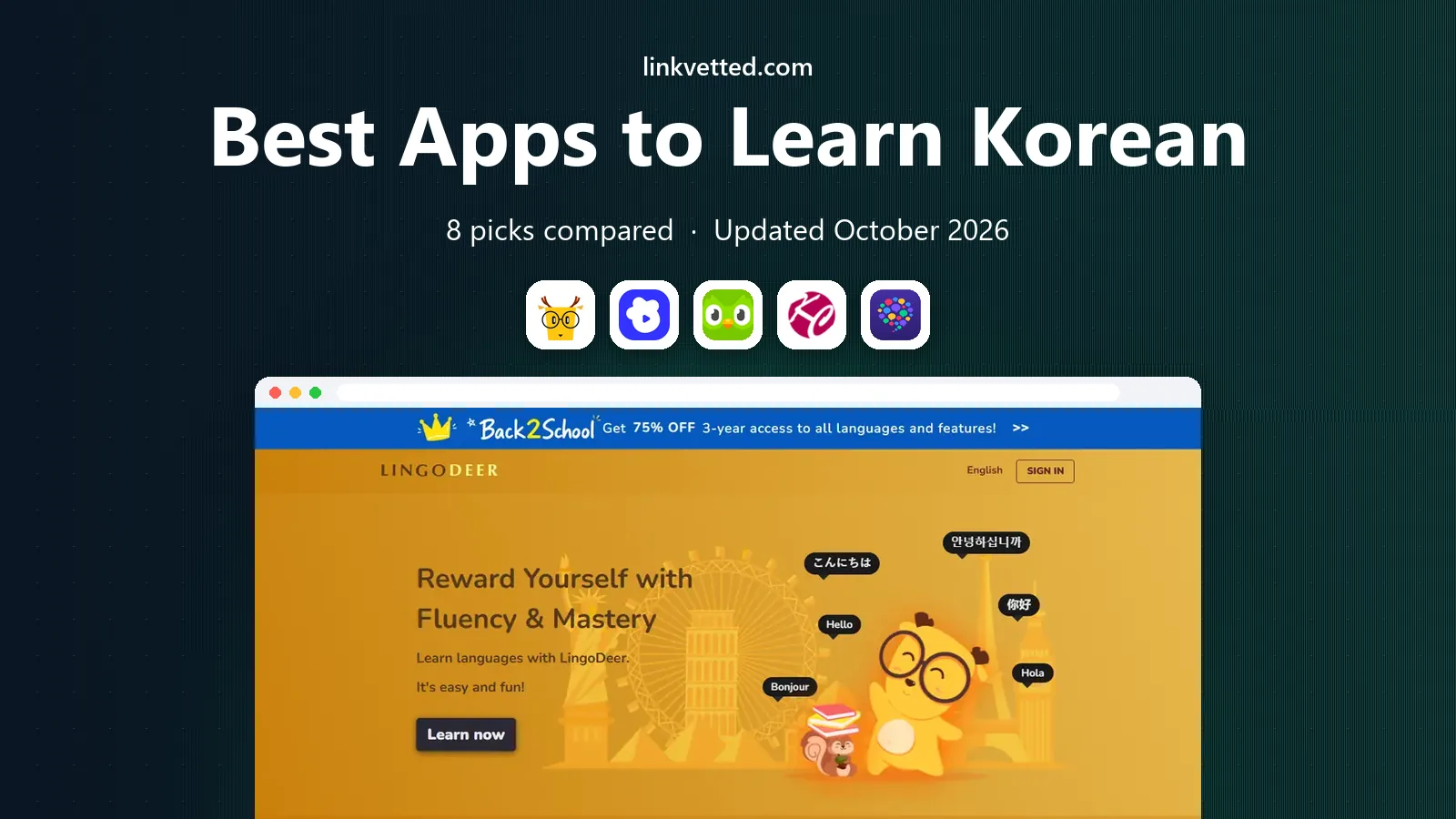
- Editor's choice
 LingoDeer
Structured grammar lessons
Starts at$14.99 per monthVisit lingodeer.comFull review - Great alternative
 Talk To Me In Korean
Grammar from beginner to advanced
Starts atFreeVisit talktomeinkorean.comFull review - Also consider
 Duolingo
Daily habit building
Starts atFreeVisit duolingo.comFull review
TL;DR:
- No single app covers everything. Pair a structured course app with a speaking app for the best results.
- LingoDeer and Talk To Me In Korean give the clearest grammar explanations for English speakers learning Korean.
- Duolingo is best for building a daily habit, while italki and HelloTalk are best for real conversation practice.
- Learn Hangul first. Reading the Korean alphabet makes every other app far more useful, and it takes only a few days of focused practice.
Quick comparison
| Tool | Best for | Starts at | Free plan? | |
|---|---|---|---|---|
| LingoDeer | Structured grammar lessons | $14.99 per month | Yes | Visit |
| Talk To Me In Korean | Grammar from beginner to advanced | Free | Yes | Visit |
| Duolingo | Daily habit building | Free | Yes | Visit |
 KoreanClass101 | Large audio and video library | Free | Yes | Visit |
 HelloTalk | Language exchange with native speakers | Free | Yes | Visit |
 italki | One to one tutoring | See website | No | Visit |
 Memrise | Vocabulary that sticks | Free | Yes | Visit |
 Drops | Short visual vocabulary sessions | Free | Yes | Visit |
The best apps to learn Korean
Korean has a clear learning path, and the apps below fit different stages of it. Start with Hangul, then build grammar and vocabulary, then practice speaking with real people. An app that feels fun but skips grammar will leave you stuck at simple phrases. An app that only teaches grammar will leave you shy about speaking. Use two apps together and you cover both gaps.

LingoDeer is our pick for most people who want a structured Korean course in an app. It was built for languages such as Korean, Japanese and Chinese, so it treats particles, honorifics and sentence structure with the care those topics need. Each lesson opens with a grammar note, then tests reading, listening and writing in a logical order.
The main weakness is conversation. LingoDeer will teach you how a sentence works, but it will not give you much live speaking practice. Plan to pair it with HelloTalk or italki once you can form basic sentences. The course also tops out around intermediate level, so advanced learners will need other resources. For beginners through lower intermediate learners, it is the strongest single course app here.
- Built for Asian languages
- Clear grammar notes before each lesson
- Native speaker audio
- Speaking practice is limited
- Free content is limited
- Course ends around intermediate level

Talk To Me In Korean, often called TTMIK, has taught Korean since 2009, and its lessons are still a benchmark for clarity. The free podcast and video lessons explain particles such as topic and subject markers in plain language, with examples that show how Koreans actually use them. Paid courses add structure, workbooks and review material for learners who want a set path.
The app itself is less polished than newer apps, and the sheer size of the library can feel overwhelming at first. Start with the level one lessons in order, rather than jumping between topics. TTMIK is best for learners who want depth and are happy to study in a more traditional way, with audio lessons and notes rather than streaks and points.
- Huge free audio library
- Clear grammar explanations
- Levels from beginner to advanced
- App interface feels dated
- Full course access is paid
- Less gamified than Duolingo

Duolingo is the easiest app to open every day, and that counts for a lot in language learning. Short lessons, streaks and reminders help you build a habit, and the Korean course covers Hangul, basic vocabulary and simple sentences. For a complete beginner who is not sure whether they will stick with Korean, it is a low risk starting point.
The limits show up quickly. Grammar is taught mostly through examples, not explanations, so particles and verb endings can stay confusing. The course also feels shallow compared with LingoDeer or TTMIK once you pass the beginner stage. Use Duolingo as a daily habit app alongside a grammar app, not as your only course.
- Free to start
- Strong habit features
- Good for Hangul and basic vocabulary
- Grammar explanations are thin
- Korean course is weaker than its European language courses
- Ads on the free plan
KoreanClass101 is a library more than a single course. It offers thousands of audio and video lessons, from absolute beginner phrases to news and culture topics, plus vocabulary lists and study tools. That breadth makes it a good supplement, especially for listening practice on a commute or a walk. You can pick lessons by level, theme or series, which suits learners who like to choose their own path.
The downside is structure. With so many lessons, it is easy to drift between topics without building a solid base. KoreanClass101 works best when you already have a main course and use it to add listening and vocabulary. Check the current plan price before you subscribe, since sales change the monthly cost often.
- Very large lesson library
- Audio lessons suit commutes
- Lessons by level and topic
- Website and app can feel cluttered
- Paid plans vary with sales
- Less structured than LingoDeer
HelloTalk connects you with native Korean speakers who want to learn your language, so you help each other. The app includes translation, pronunciation help and correction tools that make early conversations less stressful. You can start with text messages, then move to voice messages and calls as your confidence grows.
It is not a course, and it works best once you can write basic sentences. Complete beginners may struggle to hold a conversation, even with translation tools. Partner quality also varies, so be patient and look for partners who correct your Korean and reply regularly. Used well, HelloTalk turns textbook Korean into real communication faster than any solo app.
- Free language exchange
- Built-in translation and correction tools
- Text, voice and calls
- Best after the beginner stage
- Partner quality varies
- VIP features are paid
italki is the fastest way to improve speaking, because you talk with a real tutor who can correct you in the moment. You can choose a professional teacher for structured lessons or a community tutor for conversation practice, and you can book lessons around your schedule. Prices vary by tutor, so you can start with lower cost community tutors and move to professional teachers later.
The cost adds up if you take several lessons a week, so set a weekly budget and a clear goal for each lesson, such as practicing past tense or preparing for a trip. Read tutor reviews and try a trial lesson before you commit. For learners preparing for the TOPIK exam or a move to Korea, italki is worth the spend.
- Real tutors for your level and goals
- Flexible scheduling
- Lessons from community tutors and professional teachers
- Pay per lesson
- Tutor quality varies
- No free plan for lessons
Memrise is a vocabulary machine, and that is exactly what it should be. Spaced repetition schedules reviews at the right time, and short clips of native speakers help you hear how words sound in real speech. It is a strong supplement when your main course has given you grammar but your vocabulary is lagging behind.
It will not teach you how to build a sentence on its own. Use Memrise for ten to fifteen minutes a day to learn and review words, then use those words in your main course or in HelloTalk conversations. That pairing is more effective than spending an hour only on flashcards.
- Spaced repetition for vocabulary
- Native speaker video clips
- Useful as a supplement
- Does not teach full grammar
- Some content is user created
- Pro features are paid
Drops is built for five minute sessions with pictures, audio and quick matching games. That format suits busy days, when a full lesson feels like too much, and it is a pleasant way to learn Hangul and everyday words. The visual style makes new words easier to remember than a plain word list.
The free plan limits you to a short session each day, and Drops does not teach grammar in depth. Treat it as a snack, not a main meal. Use it to keep a streak alive on busy days, or to warm up before a longer study session with LingoDeer or TTMIK.
- Five minute visual sessions
- Good for Hangul and basic words
- Attractive design
- Free sessions are short each day
- Not a full course
- Limited grammar
How we picked these
We compared official app pages, pricing pages, app store listings and public reviews for apps with a working Korean course in October 2026. We favored apps with native speaker audio, a clear level path or a real speaking option, and we kept a mix of course apps, vocabulary apps and conversation apps. We left out apps that do not offer Korean, apps with only a few lessons, and apps with no clear pricing.
How to build a Korean study routine that lasts
Start with Hangul for a few days. Learn the letters, practice reading simple words, and stop using romanization as soon as you can. Romanization feels easier at first, but it hides the sounds and spelling patterns you need later. Most learners can read Hangul slowly within a week of short daily practice.
Next, pick one main course and stick with it for at least a month. LingoDeer or TTMIK are good choices, because they explain grammar in order. Add ten minutes of vocabulary with Memrise or Drops, and add one speaking session a week with HelloTalk or italki once you can make simple sentences. That routine covers reading, grammar, words and speaking without asking for hours each day.
Finally, add Korean media when you are ready. Short dramas, songs and webtoons give you real language, but they help most after the beginner stage. Use subtitles in Korean, not English, when you can, and note down phrases you hear often. A routine you enjoy will beat a perfect routine you quit after two weeks.
FAQ
What is the best app to learn Korean for beginners?
LingoDeer is the best structured course app for beginners, and Talk To Me In Korean is the best free grammar resource. Duolingo is a good habit app to use alongside either one, especially for Hangul and basic words.
How long does it take to learn Hangul?
Most learners can read Hangul slowly after a few days of focused practice, and read it with more speed within a few weeks. Apps such as Duolingo, Drops and LingoDeer all include Hangul lessons to help you start.
Is Duolingo good for Korean?
Duolingo is good for building a daily habit and learning basic vocabulary, but its Korean grammar explanations are thin. Pair it with LingoDeer or Talk To Me In Korean if you want to move past the beginner stage.
Can I learn Korean for free?
Yes. Talk To Me In Korean offers a large free audio library, Duolingo and Memrise have free plans, and HelloTalk offers free language exchange. Paid plans add structure, remove limits and open full courses, but you can start for free.
What is the best app for speaking Korean?
italki is best for structured one to one tutoring, while HelloTalk is best for free language exchange with native speakers. Both work best once you can form basic sentences, so start with a course app first.
Do I need to learn Korean grammar, or can I just memorize phrases?
Grammar matters in Korean, because particles and verb endings change meaning. Memorizing phrases helps for travel, but a course app that explains grammar will help you build your own sentences and understand new ones.