Best Apps for Mindfulness in 2026: 8 Apps Compared
Looking for the best apps for mindfulness? We compared eight meditation apps on price, free content, sleep tools, and beginner courses to help you start calmly.

- Editor's choice
 Headspace
Structured beginner courses
Starts at$12.99 per monthVisit headspace.comFull review - Great alternative
 Calm
Sleep stories and soundscapes
Starts at$14.99 per monthVisit calm.comFull review - Also consider
 Insight Timer
Huge free meditation library
Starts atFreeVisit insighttimer.comFull review
TL;DR:
- Headspace is the best app for mindfulness beginners who want a structured course, while Calm is best for sleep stories and soundscapes.
- Insight Timer and Medito offer the strongest free content, with Insight Timer offering a huge library and Medito offering everything free.
- Waking Up and Happier suit readers who want deeper teaching, while Aura and Balance suit readers who want short, personalized sessions.
- Meditation apps support a daily habit, but they are not a substitute for professional care for anxiety, depression, or sleep disorders.
Quick comparison
| Tool | Best for | Starts at | Free plan? | |
|---|---|---|---|---|
| Headspace | Structured beginner courses | $12.99 per month | No | Visit |
| Calm | Sleep stories and soundscapes | $14.99 per month | Yes | Visit |
| Insight Timer | Huge free meditation library | Free | Yes | Visit |
 Happier | Practical, teacher-led sessions | $14.99 per month | No | Visit |
 Waking Up | Depth and theory | See website | No | Visit |
 Aura | Short personalized sessions | $11.99 per month | Yes | Visit |
 Balance | Personalized daily plans | $11.99 per month | Yes | Visit |
 Medito | Completely free meditation | Free | Yes | Visit |
The best apps for mindfulness
Mindfulness apps differ in tone as much as in price. Some teach one skill at a time, some offer a library to browse, and some focus on sleep. The list below covers that range, with clear notes on free content, because the best meditation app is the one you will use for five or ten minutes most days.

Headspace is the safest choice for a complete beginner. Its courses teach one skill at a time, tell you what to do next, and build from short sessions to longer practice. The Basics course is a gentle introduction, and later courses cover stress, focus, sleep, and everyday mindfulness. The voice and pacing feel calm without being dull, which helps when you are learning to sit still.
The catch is price and free access. Headspace offers a trial, listed at 14 days in recent checks, but little remains free after that. The plan is listed at $12.99 per month or $69.99 per year. If you want structure and you are willing to pay, Headspace is our pick for beginners. If budget matters, start with Insight Timer or Medito first.
- Clear step-by-step courses
- Basics course for beginners
- Sleep and focus content included
- Little to use after the trial without paying
- Less free content than Insight Timer or Medito

Calm is best known for sleep, and that reputation is fair. Sleep Stories, read by familiar voices, plus soundscapes and sleep music, make the Sleep tab a strong reason to subscribe for many people. The Daily Calm offers a ten minute ritual each morning, and there are series on anxiety, stress, and focus for daytime use.
The free tier covers only a few sessions, so Calm is mainly a paid app. The plan is listed at $14.99 per month or $69.99 per year in recent checks, with a lifetime option also listed. If sleep is your main goal, Calm is the strongest pick here. If you mainly want meditation teaching, Headspace or Happier may suit you better.
- Large Sleep Stories library
- Daily Calm ritual
- Soundscapes and music for sleep and focus
- Free tier is limited
- Meditation can feel buried among sleep and music content
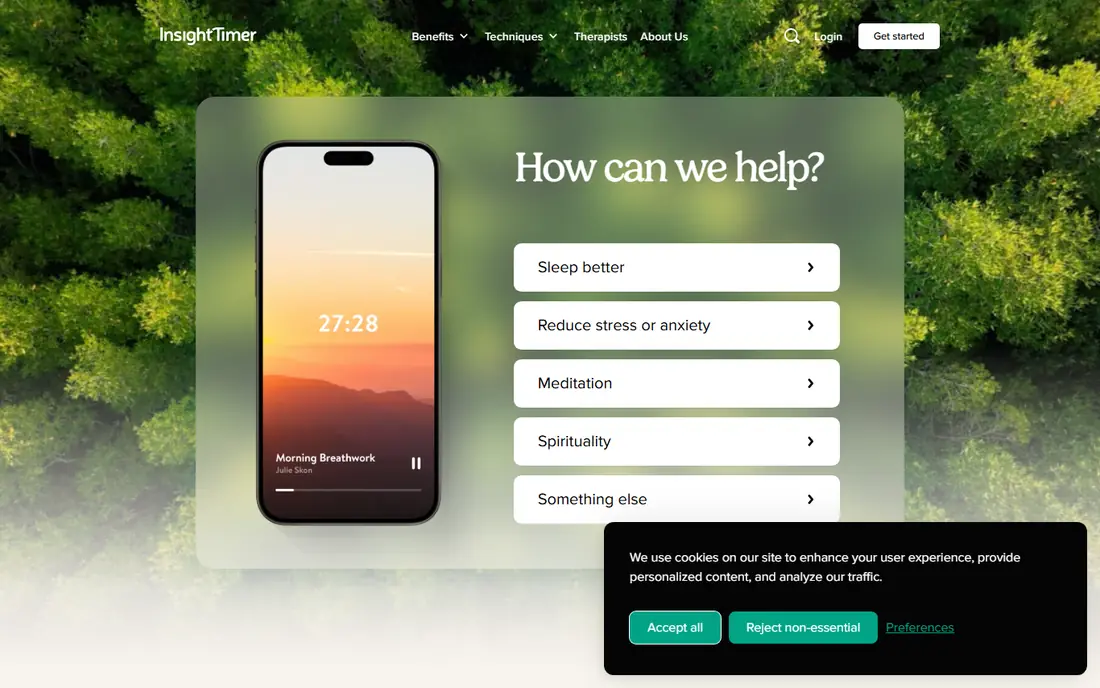
Insight Timer offers the best free library on this list. Thousands of guided meditations, talks, and music tracks are free, covering sleep, stress, focus, and many traditions. You can follow teachers you like, join live sessions, and use a simple timer for silent practice. For readers who want variety without a subscription, it is hard to beat.
Quality varies, because many teachers contribute, so you will need to try a few voices and styles before you find favorites. Member Plus, listed at $9.99 per month or $59.99 per year, adds full courses, offline listening, and extra features. If you want to explore mindfulness without paying, start here and pay only if you want structured courses.
- Very large free library
- Many teachers and styles
- Timer and courses included
- Quality varies between teachers
- Full courses and offline listening need Member Plus
Happier, formerly Ten Percent Happier, suits readers who feel skeptical about meditation or who want plain language instead of mystical talk. Teachers explain what to do, why it helps, and how to fit practice into a busy day. Sessions feel like a conversation, not a lecture, and courses build skills step by step.
The full library needs a subscription, listed at $14.99 per month or $99.99 per year in recent checks, with a trial on the annual plan. Sleep content is thinner than Calm, so Happier is best as a daytime practice app. If Headspace feels too structured and you want a more human, practical voice, Happier is a strong alternative.
- Conversational, practical teaching style
- Well-known teachers
- Courses for skeptics and busy people
- Full library needs a subscription
- Sleep content is limited compared with Calm
Waking Up is the deepest app on this list. It pairs daily meditations with lessons on how attention, thought, and awareness work, drawing on philosophy and contemplative teaching as well as practice. The introductory course is thorough, and later content goes further than most apps into theory. For readers who want to understand meditation, not just follow a voice, that depth is the point.
The price reflects that depth, with recent checks listing $19.99 per month or $149.99 per year in some sources and lower annual figures in others, so we list the starting price as See website. Waking Up also offers free access if you cannot afford it, by request, which is a genuine and generous policy. If you are new and want simple guidance, start with Headspace. If you want depth, Waking Up rewards patience.
- Deep theory alongside practice
- Introductory course is thorough
- Free access if you cannot afford it
- Most expensive in recent checks
- Theory-heavy style suits fewer beginners
Aura suits busy readers who want a short session that fits their mood. You answer a few questions about how you feel, and Aura suggests a meditation, story, or sound for that moment. Sessions are often short, which helps on days when ten minutes feels like a lot. Sleep stories, breathing exercises, and life coaching content sit alongside meditation.
The free tier covers basic features, while fuller personalization needs a subscription, listed at $11.99 per month in recent checks. Aura is less suited to long, structured courses than Headspace or Happier. If you want a quick, personalized pause during the day, Aura is a pleasant, low-pressure choice.
- Personalized daily sessions
- Short meditations for busy days
- Sleep and stress content included
- Library feels smaller than Insight Timer
- Fuller personalization needs a subscription
Balance builds a personal meditation plan that adapts as you practice. It asks about your experience, goals, and time, then creates a daily session that changes over days and weeks. That personal plan helps beginners who feel lost in a huge library, because the next session is already chosen. The design is clean, and sessions feel well paced.
Pricing needs care, because Balance has often offered a free first year in promotions, with a standard plan listed at $11.99 per month or $69.99 per year in recent checks. Check the current offer in the app before you subscribe, since promotions change. If you want a plan that adapts to you, Balance is a strong pick, especially during a free first year offer.
- Daily plan adapts to your experience and goals
- First year often offered free in promotions
- Clean design
- Promotional pricing varies
- Library is smaller than Insight Timer or Calm
Medito is the best completely free meditation app on this list. There are no ads, no subscriptions, and no paywalled courses. You get beginner courses, daily sessions, sleep content, and a timer, all free, funded by donations. That simplicity makes Medito an easy recommendation for students, families, and anyone who wants to try mindfulness without a bill.
The library is smaller than Insight Timer or Calm, and content is mainly in English, so advanced practitioners may outgrow it. For most beginners, though, Medito covers the essentials well. If cost is your main barrier, start with Medito for a month, then move to a paid app only if you want a larger library or a specific teacher.
- Everything free with no ads or subscriptions
- Structured courses for beginners
- Sleep and daily sessions
- Smaller library than paid rivals
- Content is mainly in English
How we picked these
We compared official pricing pages, app store listings, and recent October 2026 pricing checks for meditation apps. We kept only apps that are live, that focus on mindfulness and meditation, and that offer a clear path for beginners. We favored a mix of structured courses, large libraries, sleep tools, and free options, and we noted where pricing varies by promotion or region.
A short health note matters here. Meditation can support stress management and sleep habits, but it is not a treatment for anxiety, depression, trauma, or sleep disorders. If you are struggling, talk to a clinician or a trusted health professional, and use these apps as a complement to care, not a replacement.
How to start a mindfulness habit that lasts
Start with five minutes, not thirty
Five or ten minutes most days is easier to keep than a long session you dread. Pick a regular time, such as after waking or before bed, and put the app on your home screen. If you miss a day, return the next day without trying to make up the time.
Match the app to your main goal
Beginners should start with Headspace or Medito, sleep seekers with Calm, explorers with Insight Timer, and depth seekers with Waking Up. Busy readers who want short sessions should try Aura or Balance. Trial one app for two weeks before trying another, so you can judge the habit, not just the first session.
Check the trial and renewal terms
Most paid apps offer a 7 to 14 day trial, and annual plans are cheaper per month than monthly plans. Check the renewal date, cancel in the place you subscribed, and set a reminder before renewal. Free apps such as Medito and Insight Timer are enough for many readers, so pay only when a paid feature clearly helps your practice.
FAQ
What are the best apps for mindfulness?
The best apps for mindfulness in our list are Headspace for structured courses, Calm for sleep, Insight Timer for a huge free library, and Medito for completely free practice. Happier suits practical learners, Waking Up suits deeper study, and Aura and Balance suit short, personalized sessions.
What is the best meditation app?
The best meditation app depends on your goal. Headspace is the best meditation app for beginners who want a course, Calm is best for sleep stories, Insight Timer is best for free variety, and Waking Up is best for depth. Try a free tier or trial for two weeks before you pay.
Are there best mindfulness apps that are free?
Yes. Medito is completely free, and Insight Timer offers a very large free library. Aura and Balance offer free tiers, while Calm offers limited free sessions. Headspace, Happier, and Waking Up are mainly paid, though Waking Up offers free access on request if you cannot afford it.
What is the best app for meditation and sleep?
Calm is the best app for meditation and sleep in our list, thanks to its Sleep Stories library and soundscapes. Insight Timer and Medito also offer sleep content free, while Headspace includes sleep sessions in its paid plan. If sleep is your main goal, trial Calm first.
How long should I meditate each day as a beginner?
Five to ten minutes a day is a good start for most beginners. Short, regular sessions build the habit better than occasional long sessions. Increase the length only when the shorter session feels easy, and keep the time consistent so practice becomes part of your routine.
Can mindfulness apps help with anxiety?
Mindfulness apps can support a daily calming habit and teach breathing and attention skills, but they are not a substitute for professional care. If anxiety affects your work, sleep, or relationships, talk to a clinician. Use apps alongside professional support, and stop a practice that makes you feel worse.