Best App to Learn Japanese in 2026: 8 Apps Compared
Compare the best app to learn japanese for grammar, kanji, speaking, and JLPT prep, with free and paid options for beginners, and how to build a routine.

- Editor's choice
 Duolingo
Daily beginner habit
Starts atFreeVisit duolingo.comFull review - Great alternative
 WaniKani
Structured kanji learning
Starts atSee websiteVisit wanikani.comFull review - Also consider
 Bunpro
Grammar with spaced repetition
Starts atSee websiteVisit bunpro.jpFull review
TL;DR:
- No single app covers everything, so most learners pair a general course app with a kanji or grammar specialist.
- Duolingo builds a daily habit, WaniKani builds kanji, Bunpro builds grammar, and italki builds speaking confidence.
- Spaced repetition matters more than lesson count, because regular review is what turns new words into lasting memory.
- Free tiers are useful for testing a method, but serious learners usually pay for at least one specialist app.
Quick comparison
| Tool | Best for | Starts at | Free plan? | |
|---|---|---|---|---|
| Duolingo | Daily beginner habit | Free | Yes | Visit |
| WaniKani | Structured kanji learning | See website | Free trial | Visit |
| Bunpro | Grammar with spaced repetition | See website | Free trial | Visit |
 LingoDeer | Structured grammar courses | See website | Free trial | Visit |
 Busuu | Speaking with community feedback | Free | Yes | Visit |
 Pimsleur | Audio and speaking practice | See website | Free trial | Visit |
 JapanesePod101 | Audio lessons and listening | See website | Free trial | Visit |
 italki | Live lessons with tutors | See website | No | Visit |
The best apps to learn Japanese
We compared official feature and pricing pages, lesson structure, spaced repetition systems, and JLPT alignment, with a focus on what each app teaches best rather than which one claims the most content.

Duolingo is the easiest way to start Japanese, because lessons take a few minutes, the app rewards daily streaks, and the early course covers hiragana, katakana, basic vocabulary, and simple sentences. For a complete beginner who has never studied Japanese, that low barrier matters more than advanced grammar, since the first goal is simply to show up every day.
The limits appear after a few months. Grammar explanations are brief, kanji depth is limited, and speaking practice is lighter than a tutor or audio course. Use Duolingo as a habit builder and vocabulary primer, then add WaniKani or Bunpro when you want deeper kanji and grammar study.
- Free core course
- Short gamified lessons
- Strong habit-building streaks
- Grammar explanations are thin
- Advanced content is limited
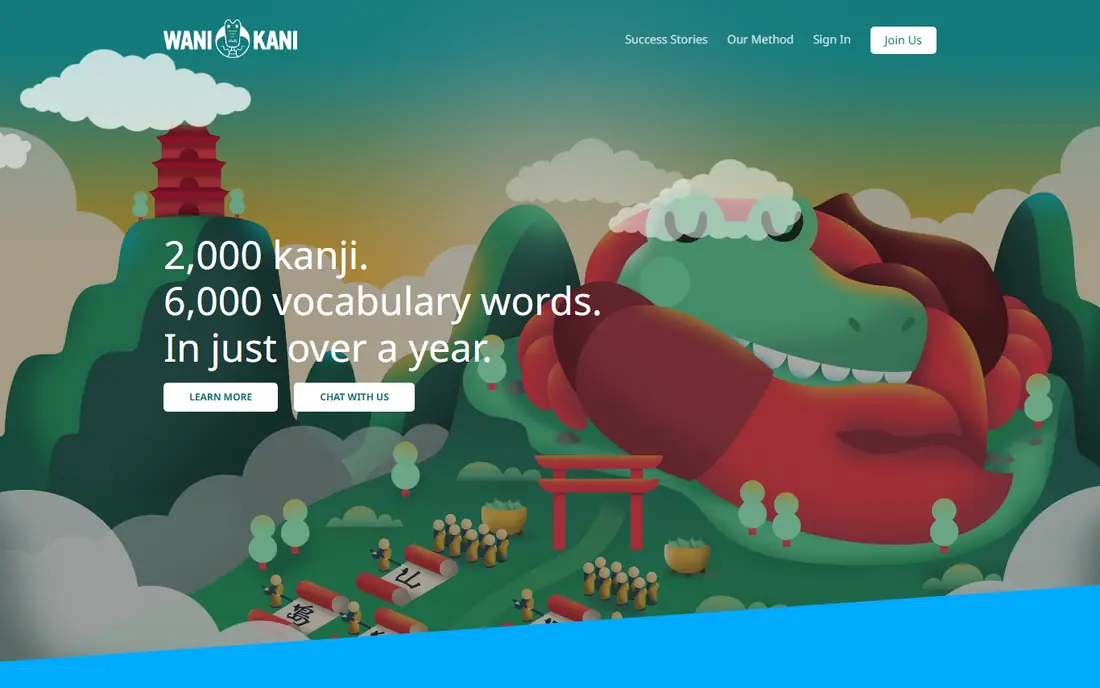
WaniKani tackles the part of Japanese that intimidates most learners: kanji. It teaches radicals first, then builds kanji from those parts, then vocabulary from those kanji, with mnemonics and spaced repetition reviews that bring items back just before you forget them. That structure removes the common problem of studying random kanji with no clear order.
The fixed pace can frustrate learners who already know some kanji, since you must work through early levels before reaching new material. Vocabulary also follows kanji rather than everyday usefulness, so some common spoken words arrive late. For learners committed to reading Japanese, WaniKani remains the most structured kanji path we found.
- Radicals-first kanji order
- Memorable mnemonics
- Built-in spaced repetition
- Vocabulary is tied to kanji progression
- Pace is fixed by the level system

Bunpro fills the grammar gap that general apps leave open. Each grammar point includes explanations, example sentences, and review prompts, organised from JLPT N5 through N1, so learners can follow a clear path or study the points they meet in other materials. Spaced repetition keeps older grammar fresh, which matters because grammar fades quickly without review.
Bunpro is a study tool, not a conversation app, so speaking and listening need a separate resource. The interface is plain compared with Duolingo, which suits serious learners but may bore casual users. If grammar is your weak point, Bunpro is the specialist pick we would add first.
- Grammar organised by JLPT level
- Spaced repetition reviews
- Links to external explanations
- Less speaking practice
- The interface is study-focused rather than playful
LingoDeer suits learners who want a course that actually explains grammar as it goes. Lessons introduce sentence patterns with notes on particles and verb forms, rather than asking you to guess rules from examples alone. Native audio supports listening and pronunciation, and the course path gives beginners a clear sequence from basics to intermediate material.
Higher-level content is thinner than the beginner path, so advanced learners may outgrow it sooner. Community and tutor features are also limited compared with Busuu or italki. For a structured start with real grammar teaching, LingoDeer is a strong alternative to Duolingo.
- Clear grammar notes in lessons
- Native audio
- Structured course path
- Content depth drops at higher levels
- Fewer community features than some rivals
Busuu combines structured lessons with a community feature that lets native speakers correct your written and spoken exercises. That feedback loop helps learners catch unnatural phrasing early, and the course structure gives a clearer path than purely gamified apps. A free tier lets you test the method before paying.
Japanese is not Busuu's deepest language, so advanced learners will find less content than in its Spanish or French courses. Grammar depth also lags behind Bunpro. Use Busuu for structured practice and community feedback, and pair it with a kanji or grammar specialist for deeper study.
- Community corrections from native speakers
- Structured courses
- Offline lessons on paid plans
- Japanese content is less deep than its major European languages
- Advanced grammar is limited
Pimsleur is built for learners who want to speak, not just recognise words on a screen. Thirty-minute audio lessons prompt you to respond out loud, build sentences gradually, and revisit material through spaced recall. That format suits commutes, walks, and other times when you cannot look at a phone, and it builds pronunciation habits early.
Reading, writing, and kanji are not Pimsleur's strengths, so you will still need a reading app. The subscription also costs more than many app-only options, which makes it harder to justify as a sole resource. For learners who prioritise speaking, Pimsleur is worth a trial, ideally alongside WaniKani or Bunpro.
- Strong audio-first speaking method
- Hands-free lessons
- Good pronunciation focus
- Reading and kanji coverage is minimal
- Subscription cost is high for audio alone
JapanesePod101 offers one of the largest audio libraries for Japanese learners, with lessons from absolute beginner to advanced, plus vocabulary lists, lesson notes, and listening practice. The dialogue-based lessons help with natural phrasing and listening speed, and the range means you can keep using it as you progress.
The sheer volume is also a drawback, since lesson quality and structure vary, and the site promotes upgrades often. Learners who prefer a strict course path may find LingoDeer clearer. For listening practice and supplementary audio, JapanesePod101 remains a useful addition to a study stack.
- Huge audio lesson library
- Lessons across levels
- Useful vocabulary and culture notes
- Lesson quality varies across levels
- The site can feel busy with upsells
italki is the fastest route to real speaking ability, because live lessons force you to produce Japanese, ask questions, and get corrections in real time. You can choose professional teachers or community tutors, set goals such as JLPT preparation or conversation practice, and schedule lessons around your week. For learners stuck at passive understanding, a weekly tutor session often breaks the plateau.
Costs add up with regular lessons, and tutor quality varies, so use trial lessons to find a teacher whose style fits you. italki works best as a complement to self-study apps, not a replacement for daily vocabulary and grammar review. Pair it with Bunpro or WaniKani for a balanced routine.
- One-to-one lessons with native tutors
- Flexible scheduling
- Lessons tailored to your goals
- Cost per lesson adds up
- Tutor quality varies, so trial lessons matter
How we picked these
We compared official feature and pricing pages, lesson structure, spaced repetition design, JLPT alignment, and speaking options for apps that remain actively updated in 2026. We favoured apps with a clear teaching strength, rather than apps that claim to cover everything thinly. We did not claim hands-on testing, and prices change, so check the vendor pricing page before subscribing.
How to build a study routine that lasts
Start with two apps, not six. A general course app plus one specialist gives daily variety without decision fatigue, and you can add a tutor or audio resource once the habit is steady. Aim for short daily sessions, such as 20 minutes of new material plus reviews, rather than long weekend cramming that fades by Monday.
Match the app to the skill you need now
Beginners should focus on kana, basic grammar, and core vocabulary, which Duolingo or LingoDeer handle well. Intermediate learners usually need kanji and grammar depth, which points to WaniKani and Bunpro. Learners who understand a lot but cannot speak should prioritise Pimsleur or italki, since speaking only improves through speaking.
Review, reading, and real Japanese
Spaced repetition reviews are not optional extras, since they protect the vocabulary you already studied. Once you can read basic sentences, add real reading such as graded readers or simple news, and use a dictionary app for unknown words. Real material keeps motivation high and shows how textbook grammar appears in everyday Japanese.
FAQ
What is the best app to learn Japanese for beginners?
Duolingo is the easiest first app for building a daily habit, while LingoDeer offers clearer grammar explanations for beginners who want structure. Start with one of those, learn hiragana and katakana early, and add WaniKani for kanji once basic sentences feel comfortable.
Can I learn Japanese with only one app?
You can make good progress with one app, but most learners hit a gap in kanji, grammar, or speaking that a single app does not fill well. A common stack pairs Duolingo or LingoDeer with WaniKani for kanji and Bunpro for grammar, plus italki or Pimsleur for speaking.
How long does it take to learn Japanese with an app?
Progress depends on daily time, prior language experience, and whether you practise speaking and reading outside the app. Basic conversation can take many months of steady study, while reading fluency and JLPT N1 level take years. Consistent daily review matters more than any single app choice.
Is Duolingo good for learning Japanese?
Duolingo is good for starting Japanese and building a habit, especially for kana and basic vocabulary. It is weaker on grammar explanations, kanji depth, and speaking practice, so treat it as a starting point rather than a complete course. Add a grammar or kanji specialist when you are ready for more depth.
What is the best app for learning kanji?
WaniKani is our pick for structured kanji learning, thanks to its radicals-first order, mnemonics, and spaced repetition. Learners who prefer free flashcards can build custom decks in a spaced repetition app, but that needs more setup and self-discipline. WaniKani trades flexibility for a clear path.
Do I need a tutor to learn Japanese?
A tutor is not required to start, but live lessons help greatly with speaking, pronunciation, and natural phrasing. italki lets you book single lessons to test the format, and even a weekly session can improve confidence. Self-study apps cover vocabulary and grammar, while tutors turn that knowledge into conversation.