Best App Marketing Companies in 2026: 8 Companies Compared
We compared the best app marketing companies for 2026, covering ASO, paid user acquisition, creative, and retention, to help you find the right growth partner.
- Editor's choice
 Moburst
Full-service mobile growth
Starts atSee websiteVisit moburst.comFull review - Great alternative
 Phiture
Growth strategy and retention
Starts atSee websiteVisit phiture.comFull review - Also consider
 Yodel Mobile
Boutique ASO and paid growth
Starts atSee websiteVisit yodelmobile.comFull review
TL;DR:
- The best app marketing companies pair paid user acquisition with app store optimization and retention work, not installs alone.
- Full-service agencies suit apps with real budgets and several channels, while ASO or paid specialists suit apps with one clear bottleneck.
- Ask every agency how it reports results: cost per install means little without retention, subscription starts, and revenue per user.
- Creative quality now drives much of paid performance, so check who actually designs ads, not just who buys media.
Quick comparison
| Tool | Best for | Starts at | Free plan? | |
|---|---|---|---|---|
| Moburst | Full-service mobile growth | See website | No | Visit |
| Phiture | Growth strategy and retention | See website | No | Visit |
| Yodel Mobile | Boutique ASO and paid growth | See website | No | Visit |
 Udonis | Mobile game marketing | See website | No | Visit |
 PreApps | App launch marketing | See website | No | Visit |
 App Radar | ASO software and services | See website | Free trial | Visit |
 SEM Nexus | Paid mobile advertising | See website | No | Visit |
 Naked Development | Strategy-led app marketing | See website | No | Visit |
The best app marketing companies
We compared agency service pages, published case material, and public client reviews for firms that market mobile apps as a core service. These eight cover full-service growth, ASO, paid acquisition, and game marketing, so a small startup and a large brand can both find a fit.
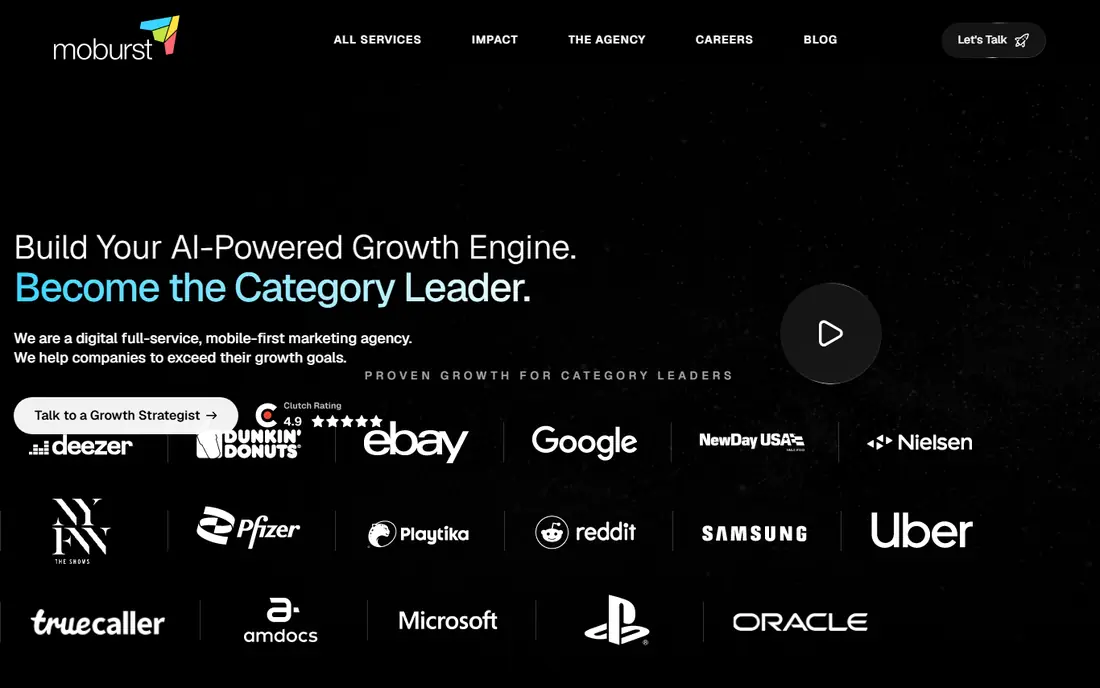
Moburst is the default shortlist pick for an app team that wants one partner to handle the whole growth job. The agency covers app store optimization, paid user acquisition, creative production, and product consulting, which helps because app growth problems rarely sit in one channel. A weak store listing hurts paid campaigns, and weak onboarding hurts retention, so a team that sees all three can fix the real bottleneck instead of selling more ads into a leaky funnel.
The catch is fit and budget. A full-service engagement makes sense when an app has funding or revenue to support several workstreams at once. A pre-launch indie app may be better served by a narrower project, such as an ASO overhaul or a launch campaign. Ask Moburst for a phased plan and for the metrics it will report each week, including retention and paywall conversion, not just installs.
- Covers ASO, paid, creative, and product strategy
- Works with startups and large brands
- Strong app launch record
- Full-service scope likely costs more than a specialist
- Smaller apps may not need every service

Phiture is the pick for an app that already has users but struggles to keep them or turn them into paying subscribers. The agency is known for growth strategy, lifecycle marketing, customer relationship work, experimentation, and app store optimization, with an emphasis on the full user journey rather than the install count. That matters because the cheapest install is worthless if the user never opens the app a second time.
This is less of a fit for a brand-new app with no data to analyze. Phiture does its best work when there is an existing funnel to measure: activation rates, trial starts, churn points, and subscription renewals. If your app is at that stage, ask for examples of retention or subscription work in your category, and for a clear testing roadmap for the first quarter.
- Analytical, retention-focused approach
- Strong lifecycle and CRM work
- Respected in mobile growth circles
- Consultative style suits established apps more than raw launch hype
- Pricing is quote-based
Yodel Mobile suits consumer app brands that want a boutique agency rather than a large holding-company team. Its work spans app store optimization, paid user acquisition, and organic growth strategy, with coordinated campaigns across channels. For a mid-size app, that coordination is the point: store keywords, screenshots, and ad creative should tell the same story, and a small senior team can keep them aligned.
The limit is scale. A boutique agency gives closer attention, but it may not staff a launch across ten markets at once the way a larger firm can. Ask who will work on the account day to day, how often creative is refreshed, and what happens if a campaign needs to scale fast. If those answers are solid, Yodel Mobile is a strong choice for apps that value craft over sheer size.
- Mobile-first boutique team
- ASO plus paid under one roof
- Hands-on senior attention
- Smaller team than global full-service agencies
- May lack capacity for very large multi-market launches
Udonis is the specialist pick for mobile games. Game marketing differs from other app marketing in important ways: creative testing volume is higher, monetization events matter more than simple installs, and genre audiences behave very differently. An agency that has run campaigns across many game genres understands those patterns, from hyper-casual volume plays to mid-core titles that live on long-term player value.
Non-game apps should look elsewhere, since the playbooks do not transfer cleanly. Game developers, by contrast, should ask Udonis about creative testing cadence, return on ad spend targets by genre, and how it handles platform privacy changes that limit tracking. A good game agency talks about player value and retention curves in the first meeting, not just cost per install.
- Deep mobile game experience
- Data-driven acquisition
- Monetization-aware strategy
- Game focus makes it a weaker fit for non-game apps
- Creative and media needs vary widely by genre
PreApps has marketed apps since the early app store era, with a focus on helping new apps acquire, engage, and retain users. Its platform and services cover pre-launch buzz, store listing work, and post-launch promotion, which suits a startup that needs a structured launch rather than scattered tactics. A first launch benefits from a checklist: store keywords, screenshots, press outreach, influencer seeding, and paid tests, all timed around release day.
The honest warning is that launch marketing is only the first chapter. Many apps spike at launch and fade within weeks because onboarding or retention was never fixed. Use PreApps for the launch push, but insist on a retention plan for weeks two through twelve, with clear owners for onboarding tweaks, push messaging, and store review responses. That second plan decides whether the launch was worth it.
- Launch-focused process
- Long track record with startups
- Pre-launch and post-launch services
- Launch hype does not guarantee long-term retention
- Verify recent results in your category
App Radar sits between software and agency, offering app store optimization tools backed by ASO expertise. For an app team that wants to own its store presence, keyword tracking, competitor monitoring, and listing experiments provide a steady way to improve organic downloads without paying for every install. Organic store traffic compounds over time, which makes ASO one of the highest-value investments a small app team can make.
The catch is effort. Tools surface opportunities, but someone still has to rewrite listings, test screenshots, and respond to reviews. If the team has no owner for ASO, a managed service or a full agency may work better. Ask App Radar what a typical monthly workflow looks like, how often keywords are reviewed, and what reporting shows movement in rankings and conversion, not just keyword lists.
- ASO tools plus agency expertise
- Keyword tracking and competitor insight
- Good for ongoing optimization
- A tool-led approach needs internal time to act on insights
- Full managed service costs more than software alone
SEM Nexus fits an app team that already has a solid store listing and product, and now needs paid campaigns run well. Paid mobile advertising rewards tight audience work, fast creative testing, and honest reporting on which campaigns produce paying users rather than cheap installs. A specialist paid team can often outperform a generalist agency on media buying alone, because it lives inside ad platforms every day.
The risk is tunnel vision. If the store listing converts poorly or onboarding leaks users, paid spend will look expensive no matter how good the media buying is. Before signing, ask SEM Nexus to audit the listing and onboarding, or pair the engagement with ASO work elsewhere. Also confirm fee structure: flat fee, percentage of spend, or a mix, and who owns the ad accounts and data if the engagement ends.
- Paid media focus for mobile apps
- New York based team
- Performance-oriented campaigns
- Paid-only focus may miss ASO and retention gaps
- Smaller public case library than larger rivals
Naked Development takes a strategy-first approach to mobile app marketing, working as a partner rather than a vendor that simply runs campaigns. That suits founders who need help deciding what to build, how to position it, and how to market it as one plan. App marketing fails most often when product and marketing pull in different directions, and a team that handles both can keep positioning, onboarding, and campaigns aligned.
The trade-off is price and scale. Published rate information places Naked Development in a premium hourly band, with typical projects starting in five figures, so it is not a budget option. It fits funded startups and companies that want senior thinking from the start. Ask for a clear scope, a named team, and success metrics tied to retained users and revenue, not vanity install counts.
- Strategy-first, partnership-style approach
- App product and marketing under one roof
- Startup-friendly size
- Smaller team than global agencies
- Published hourly rates suggest premium pricing for small budgets
How we picked these
We compared official agency pages, published service descriptions, and public review listings for firms whose core work includes mobile app marketing. We favored firms with visible app clients, a clear specialty, and reporting that goes past installs. We did not run campaigns with any agency, and we did not accept self-reported results as proof. Most agencies price by scope, so we list See website rather than a guessed retainer.
How to choose the right app marketing partner
Start with the bottleneck, not the agency size. If organic store traffic is weak, prioritize ASO. If installs are strong but retention is poor, prioritize lifecycle and product work. If the product and listing are solid but growth is flat, prioritize paid acquisition and creative testing. Naming the bottleneck first prevents a common waste: buying paid installs for an app that cannot keep users.
Then check the working relationship. Ask who owns ad accounts, creative files, and analytics data, and what happens to them if you leave. Ask how often you will see reports, which metrics appear in them, and how quickly creative is tested and replaced. A good agency welcomes these questions and answers with numbers from past work. A weak agency leans on vague promises about virality or guaranteed rankings, and that is a reason to walk away. Finally, start with a defined trial period and clear targets, so both sides can judge the partnership on results.
Red flags to watch
Guaranteed top rankings, guaranteed install counts at a fixed price, and refusal to share account access are all warning signs. So is reporting that shows only impressions and clicks. Demand reporting on installs, activation, retention, trial starts, and revenue, and make sure the agency can explain a bad month as clearly as a good one.
FAQ
What do the best app marketing companies actually do?
They grow an app through a mix of app store optimization, paid advertising, creative production, influencer or press outreach, and retention marketing. Some firms cover all of these, while others specialize in one channel. The right mix depends on whether the app needs visibility, installs, retention, or revenue most.
What are the best marketing software companies for apps?
Marketing software such as ASO tools and analytics platforms helps a team track keywords, rankings, and user behavior, but software alone does not run campaigns. Many app teams pair a tool such as App Radar with an agency or an in-house marketer who acts on the data. The best setup depends on team size and whether the work is done internally or outsourced.
How much does app marketing cost?
Costs vary widely. Small ASO projects can run into the low thousands of dollars, while full-service retainers for funded apps often run into five figures per month, plus ad spend. Always separate agency fees from media spend in a quote, and confirm who owns the ad accounts and creative files.
What is ASO and why does it matter?
App store optimization is the work of improving how an app appears in app store search: title, keywords, screenshots, video, ratings, and reviews. Strong ASO brings free organic installs and improves paid campaign results, since ads often send users to the store listing. It is usually the first marketing investment a new app should make.
How long before app marketing shows results?
Paid campaigns can show early signals within weeks, while ASO and organic growth usually take two to three months of steady work. Retention and subscription improvements also take time, because they depend on product changes and user behavior over several cycles. Any agency promising instant top rankings should be treated with caution.
Should a startup hire an agency or do marketing in-house?
A startup with a clear product and a small budget often starts with ASO and one paid channel handled in-house, then hires an agency to scale what works. An agency makes sense when the team lacks channel expertise, needs creative volume, or wants to move faster than hiring allows. A short trial with clear targets is the safest way to test the fit.