Best AI Visibility Optimization Tools in 2026: 9 Tools Compared
Compare the best AI visibility optimization tools for tracking brand mentions in AI answers, with pricing and features to help teams carefully choose in 2026.
- Editor's choice
 Profound
Enterprise AI analytics
Starts at$99 per monthVisit profound.comFull review - Great alternative
 Peec AI
Focused mid-market tracking
Starts at$95 per monthVisit peec.aiFull review - Also consider
 Otterly
Budget AI monitoring
Starts at$29 per monthVisit otterly.aiFull review
TL;DR:
- AI visibility tools track how brands appear in answers from ChatGPT, Gemini, Perplexity, and other AI engines, not just Google rankings.
- Profound, Peec AI, and Otterly cover the core tracking job at very different prices, so start with prompt volume and engine coverage.
- Semrush and Ahrefs suit teams that already pay for an SEO suite and want AI tracking added to existing workflows.
- A tracker alone does not improve visibility; you still need content, citations, and technical fixes based on what it finds.
- Free audits and trials help you test prompt coverage before committing to a monthly plan.
Quick comparison
| Tool | Best for | Starts at | Free plan? | |
|---|---|---|---|---|
| Profound | Enterprise AI analytics | $99 per month | Free trial | Visit |
| Peec AI | Focused mid-market tracking | $95 per month | Free trial | Visit |
| Otterly | Budget AI monitoring | $29 per month | Free trial | Visit |
 Writesonic | SEO plus AI visibility | $79 per month | Free trial | Visit |
 Semrush | SEO suite with AI toolkit | $99 per month | Free trial | Visit |
 Ahrefs Brand Radar | Citation and backlink context | $129 per month | Free trial | Visit |
 Scrunch | Enterprise AI experience | $250 per month | Free trial | Visit |
 AthenaHQ | Wide engine coverage | $295 per month | Yes | Visit |
 HubSpot AI Search Grader | Free visibility health check | Free | Yes | Visit |
The best ai visibility optimization tools
We compared prompt tracking, engine coverage, competitor views, citation detail, reporting, and pricing, using vendor pages and public comparisons from October 2026.

Profound is one of the most cited names in AI visibility, with tracking across major AI engines, citation detail, and reporting built for brands and agencies. It helps teams see not just whether a brand is mentioned, but how it is framed, which sources are cited, and how that visibility changes over time. That depth suits marketing teams that report AI visibility to leadership.
Smaller teams may find the higher tiers expensive, and the platform assumes someone will act on the data regularly. If you need enterprise reporting and citation-level detail, Profound is a strong lead. If you only need basic monitoring, a cheaper tool may cover the job.
- Deep citation and sentiment tracking
- Analytics that connect AI mentions to traffic
- Agency and enterprise reporting
- Higher plans are costly
- Onboarding can feel geared to larger teams
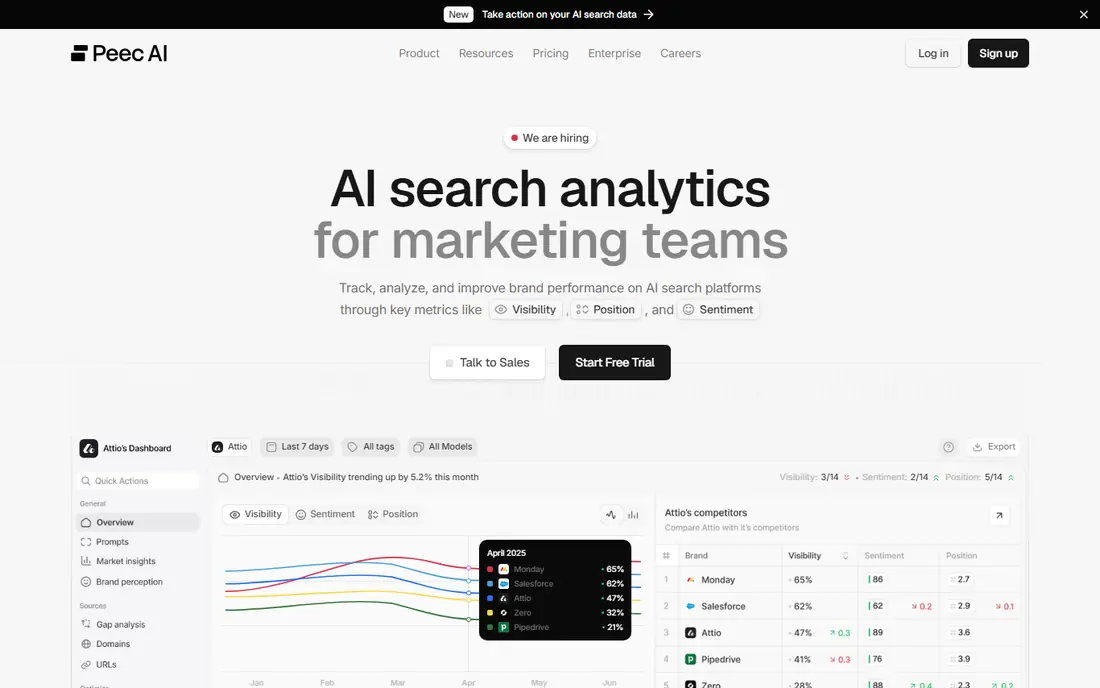
Peec AI focuses on clear, usable AI visibility data without the weight of a full enterprise suite. It separates direct source citations from general brand mentions, which helps content teams see which pages AI engines actually pull from. Competitor benchmarking shows where rivals win mentions you miss, turning a dashboard into a to-do list.
Engine coverage is narrower than AthenaHQ or Profound at the top end, so check that your key engines are included. For mid-market teams that want actionable tracking at a predictable price, Peec AI balances depth and simplicity well.
- Clean dashboards
- Distinguishes cited sources from general mentions
- Competitor benchmarking
- Smaller engine coverage than some enterprise tools
- Pricing varies by region
Otterly is the entry point for teams that want to start tracking AI visibility without a large monthly commitment. You turn keywords into prompts, track brand mentions across AI engines, and watch sentiment over time. That core loop is enough to spot whether your brand appears, disappears, or is framed poorly in common answers.
Larger teams may want deeper diagnostics, content recommendations, or multi-client reporting that Otterly does not emphasize. For a first tracker, or for a small business testing the category, Otterly offers the lowest-risk start.
- Lowest starting price in this list
- Easy prompt setup
- Sentiment tracking for brands
- Fewer diagnostic features than mid-tier tools
- Limited depth for large agencies
Writesonic pairs AI visibility monitoring with its SEO and content creation suite, which suits teams that want tracking and fixes in one place. Its action center turns citation gaps into content suggestions, so the jump from measurement to improvement is shorter than with a tracker alone. That combination helps small marketing teams with limited tool budgets.
Pure tracking depth may trail dedicated platforms such as Profound for enterprise reporting. If you already need SEO and content tools, Writesonic adds AI visibility at a reasonable incremental cost. If you only need tracking, compare it with Peec AI and Otterly first.
- Combines AI visibility tracking with SEO and content tools
- Action recommendations
- Familiar content workflow
- AI tracking sits inside a broader suite
- Depth varies by plan
Semrush adds an AI visibility toolkit to its established SEO platform, letting teams track AI search alongside rankings, audits, and keyword research. That matters for teams that already use Semrush daily, since AI data appears next to the SEO data they trust. Site audits can also flag technical issues that may affect how AI engines read a site.
Agencies managing many client domains should watch per-domain pricing, since costs rise with each brand tracked. For in-house teams already on Semrush, the AI toolkit is a natural extension. For AI-only tracking, a dedicated tool may be cheaper.
- AI visibility inside a mature SEO suite
- Per-domain tracking
- Site audits and keyword research included
- Per-domain pricing adds up for agencies
- AI features vary by plan
Ahrefs Brand Radar brings AI visibility into the Ahrefs ecosystem, with a useful twist: it shows which URLs AI answers cite when they mention a brand. That citation detail helps content teams see which pages earn trust from AI engines and which topics need stronger sources. Backlink and content data in the same suite add context for why a page is cited.
It is a newer product inside a large suite, so dedicated GEO platforms may offer deeper prompt and sentiment features. For teams already paying for Ahrefs, Brand Radar adds AI visibility without a separate vendor. For AI-first buyers, compare it with Profound and Peec AI.
- Shows cited domains and pages
- Pairs AI mentions with backlink and content data
- Trusted SEO data
- Requires an Ahrefs subscription
- Newer AI product with less GEO depth than dedicated tools
Scrunch positions itself as an enterprise platform for AI visibility, tracking how brands appear across multi-turn AI conversations rather than single prompts. That approach suits brands that care about the full customer journey inside AI answers, not just a single mention. Hallucination detection and bot monitoring add a layer that simpler trackers lack.
Price puts Scrunch out of reach for many small teams, and its depth assumes a dedicated owner. For enterprises and agencies with large clients, that depth can justify the cost. Smaller teams should start with Otterly or Peec AI and upgrade only when reporting needs grow.
- Maps brand presence across multi-turn conversations
- Hallucination detection
- Agency workspaces
- High starting price
- Overkill for small teams
AthenaHQ stands out for engine coverage, including newer engines that some trackers miss, plus content scoring that helps teams understand why a page is or is not cited. Its action center turns findings into draft optimizations, which shortens the path from tracking to content work. That combination suits agencies and brands that manage AI visibility as an ongoing program.
Cost and complexity are the trade-offs. AthenaHQ is priced for teams with a real AI visibility budget, not for casual monitoring. If broad coverage and content action matter, it is worth a demo. If you only track a few prompts, a cheaper tool will do.
- Wide AI engine coverage
- Content depth scoring
- Action center for optimizations
- High starting price
- More complex than budget trackers
HubSpot AI Search Grader offers a free health check that grades how AI engines position a brand against competitors. It is a useful starting point for teams that have never measured AI visibility, and it can spark useful planning conversations without a subscription. The output is a snapshot, not a monitoring system.
Do not mistake the grader for a tracker. It does not replace ongoing prompt monitoring, citation tracking, or trend reporting. Use it to test the category, then choose a paid tracker from this list if AI visibility becomes a regular job.
- Free to use
- Simple brand positioning summary
- Useful for pitch and planning discussions
- Not a full tracker
- No ongoing prompt monitoring or deep citation reports
How we picked these
We compared vendor pricing pages, feature documentation, and public GEO comparisons from October 2026, focusing on tools that query real AI engines and store prompt history. We included budget, mid-market, and enterprise options, plus suite add-ons and a free grader, so readers at different budgets can find a fit. We did not claim hands-on testing, and we note that engine coverage and pricing change often, so confirm both on vendor sites.
We also favored tools that show competitors and citations, since AI visibility is relative and a mention without source detail is hard to act on. That is why citation detail appears in several write-ups.
How to improve AI visibility after tracking
Tracking tells you where you stand, but content and technical work move the needle. Start with the prompts where competitors are cited and you are not, then check whether you have a clear, factual page that answers that prompt directly. AI engines favor pages with direct answers, clear structure, and credible sources, so lead with a concise answer and support it with facts.
Content, structure, and citations
Use clear headings, short answer blocks, and structured data where it fits, so AI systems can parse your page with less guesswork. Cite statistics and expert sources, keep pages updated, and make sure AI crawlers are not blocked in your robots file unless you have a deliberate reason. Also build mentions beyond your own site, since third-party coverage and reviews often shape how AI engines describe a brand.
Measuring progress fairly
Track the same prompts over time, and compare your share of mentions with competitors rather than chasing a single score. Note that AI answers vary by prompt wording and engine, so a small weekly change may reflect sampling rather than a real shift. Review trends monthly, tie changes to content you published, and keep a log of what you changed so you can repeat what works.
FAQ
What is the best AI visibility optimization tool?
Profound suits enterprise teams, Peec AI suits mid-market teams, and Otterly suits budget buyers. The best pick depends on prompt volume, engine coverage, and whether you need reporting depth or just monitoring.
What is the best AI search visibility optimization tool for small business?
Otterly is the lowest-cost starting point, while HubSpot AI Search Grader offers a free snapshot. Small businesses that want regular tracking should start with Otterly and upgrade only if reporting needs grow.
What is the best LLM visibility checking tool?
Any tool in this list that queries multiple engines and stores prompt history can serve as an LLM visibility checker. Profound, Peec AI, and AthenaHQ offer the deepest prompt and citation detail, while Otterly covers the basics at a lower price.
How is AI visibility different from SEO rank tracking?
SEO rank tracking measures positions in search results, while AI visibility measures whether AI answers mention, cite, or recommend your brand. A brand can rank well in Google and still be absent from AI answers, which is why teams now track both.
Can a tool alone improve my AI visibility?
No, a tracker measures visibility but does not create it. Improvement comes from content that answers prompts directly, credible citations, technical fixes, and third-party mentions, with the tracker showing whether those efforts work.