8 Best AI SEO Tools for Content Optimization in 2026
Compare the best AI SEO tools for content optimization in 2026, with SERP scoring, briefs, topic coverage, AI search checks and prices for Surfer, Clearscope.

- Editor's choice
 Surfer
Content teams that want a live score while they write
Starts at$49 per monthVisit surferseo.comFull review - Great alternative
 Clearscope
Editorial teams publishing revenue-critical or brand-sensitive content
Starts at$129 per monthVisit clearscope.ioFull review - Also consider
 Frase
Small teams that need briefs, research, and optimization on a budget
Starts at$39 per monthVisit frase.ioFull review
TL;DR:
- Content optimization tools score a draft against pages already ranking, so you can see missing terms, headings, and coverage before you publish.
- Surfer is the most widely used all-round optimizer, Clearscope suits editorial teams that want a clean grade, and Frase is the strongest budget route to briefs.
- AI search visibility is now part of the job, so check whether a tool also scores content for ChatGPT, Perplexity, and Google AI Overviews.
- No score guarantees a ranking, because search quality, links, site authority, and real reader value still shape results.
Quick comparison
| Tool | Best for | Starts at | Free plan? | |
|---|---|---|---|---|
| Surfer | Content teams that want a live score while they write | $49 per month | No | Visit |
| Clearscope | Editorial teams publishing revenue-critical or brand-sensitive content | $129 per month | No | Visit |
| Frase | Small teams that need briefs, research, and optimization on a budget | $39 per month | No | Visit |
 MarketMuse | Larger teams planning topic authority over months, not single articles | See website | Yes | Visit |
 NeuronWriter | Budget-conscious writers and non-English content teams | $19 per month | No | Visit |
 Scalenut | Teams that want keyword clusters and fast AI-assisted drafts | $59 per month | No | Visit |
 Semrush | Teams that want optimization plus keyword, backlink, and site audit tools | $117.33 per month | Yes | Visit |
 SEO.ai | Small teams that want AI-first content generation with optimization built in | $45 per month | No | Visit |
The best AI SEO tools for content optimization
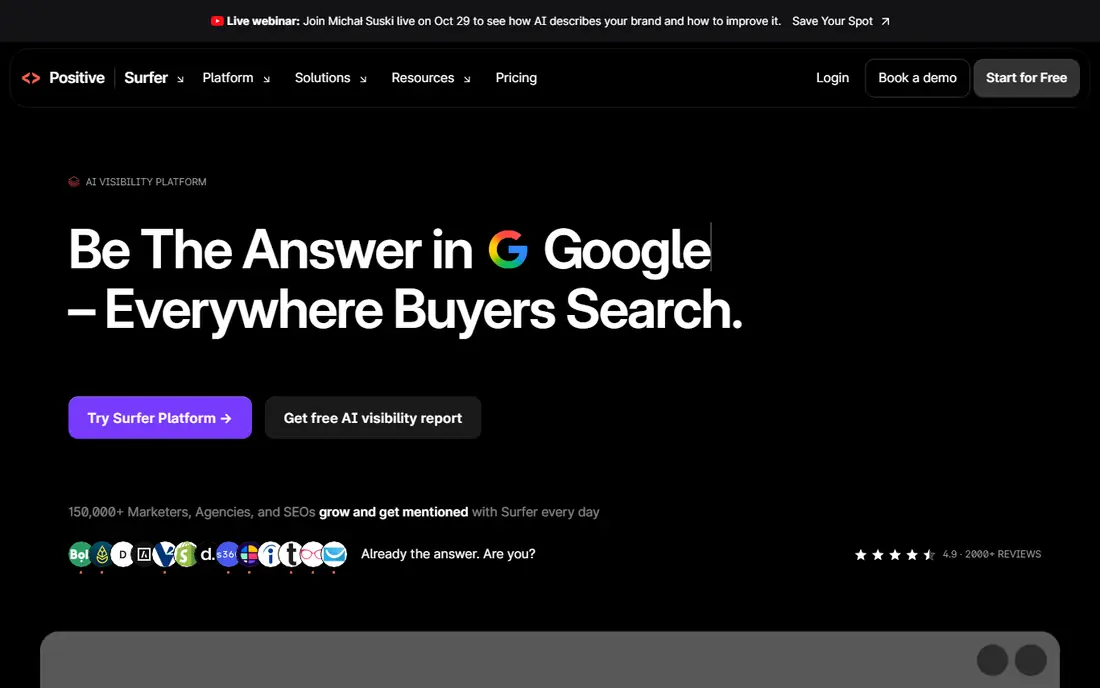
Surfer remains the default optimizer for many agencies and in-house teams, because its Content Editor updates a score as you write and shows which terms, headings, and questions top pages cover. That live feedback helps a writer close coverage gaps before an editor ever sees the draft. It also includes keyword research, audits, and AI visibility tracking, so a team can move from planning to publishing in one place. The weakness is misuse, not the tool itself. A high Surfer score does not mean a useful article, and teams that stuff terms to hit a number often produce flat, repetitive copy. Surfer also works best when an editor still checks facts, tone, and structure. Used as a coverage check rather than a writing target, it is the most practical optimizer in this list for day-to-day publishing.
- Real-time Content Editor with SERP-based terms, structure, and word count guidance
- Scores can tempt writers to chase terms instead of serving the reader, and higher plans add cost quickly
Clearscope
Best for: Editorial teams publishing revenue-critical or brand-sensitive content

Clearscope takes a quieter approach, giving writers a single content grade based on terms and coverage found in top-ranking pages, without a busy interface. Editors like it because the grade is easy to explain to freelancers and stakeholders, and because unlimited users on paid plans make it simple to scale across a large writing team. The reports focus on what to cover, not on gaming a score. The trade-off is price and scope. Clearscope starts higher than Frase or NeuronWriter, and it is not a full SEO suite for backlinks or technical audits. Teams that need those features will pair it with another platform. For publishers where accuracy, tone, and consistent grading matter more than the lowest price, Clearscope earns its place.
- Simple, trusted content grade with unlimited users on paid plans, and clear term guidance
- Higher starting price than budget tools, and fewer all-in-one SEO features than Semrush

Frase starts at the front of the workflow, pulling top-ranking pages for a keyword, extracting key points and questions, and turning them into a brief a writer can follow. That saves hours of manual research, especially for teams publishing many articles each week. Its editor then scores drafts for both classic search and AI search platforms, which helps writers cover questions that chat-based answers also surface. The limit is draft quality. Frase can generate a first draft quickly, but that draft often reads generic, because it draws on the same SERPs every competitor sees. Strong teams use Frase for research and structure, then write or rewrite with original examples, data, and expert input. At its starting price, it is the best value route to a full content loop for small teams.
- Fast SERP research and brief building, plus SEO and AI search scoring in one editor
- AI drafts still need heavy editing, and the interface can feel busy at first
MarketMuse
Best for: Larger teams planning topic authority over months, not single articles
MarketMuse looks beyond one keyword and models a whole topic, showing how well a site covers a subject, where gaps sit, and which pages deserve an update. That strategic view helps content leaders decide what to write next, rather than chasing isolated keywords that never build authority. It also offers a free plan, so teams can test its basic analysis before talking to sales. The drawback is complexity and cost. MarketMuse is built for content strategy at scale, and smaller teams may find its reports more detailed than they can act on each week. Paid pricing is not published in a simple tier list, so buyers should ask what is included. For publishers with hundreds of pages and a clear topic focus, that strategy layer is its main advantage.
- Topic modeling that shows content gaps, authority, and which pages to create or update first
- Paid pricing is sales-led, and the depth can be more than a small blog needs
NeuronWriter
Best for: Budget-conscious writers and non-English content teams
NeuronWriter gives solo writers and small agencies a capable optimizer for a low monthly price, with term suggestions drawn from top-ranking pages and a content score that updates as you write. It handles many languages well, which makes it a practical pick for teams publishing outside English or for European markets. The editor stays focused, so new users can learn it quickly without a long onboarding. The trade-off is scope. NeuronWriter does not match Surfer on audits or AI visibility features, and its template and integration options are narrower. Writers who need deep strategy or enterprise reporting will outgrow it. For a freelancer or a small team that mainly needs solid on-page guidance at a low price, it is hard to beat.
- Low starting price with semantic term suggestions and a straightforward editor
- Less depth on AI search tracking than Surfer or Frase, and a smaller ecosystem
Scalenut combines cluster research with briefs and AI drafting, so a team can move from a seed keyword to a set of related articles without switching tools. Its cruise-mode style workflow guides writers through research, outline, and draft stages, which helps newer teams publish consistently. The platform also scores content and tracks basic optimization signals as drafts develop. The weakness is originality. Like other AI drafting tools, Scalenut can produce smooth but generic copy if a writer accepts its output without adding real examples, sources, or expert views. It also suits content marketing teams better than technical publishers that need strict fact control. Used for planning and first drafts, with a human edit at the end, it offers good speed for its price.
- Cluster planning, briefs, and AI writing in one workflow, with a free trial
- Drafts need editing for originality, and optimization depth varies by topic
Semrush
Best for: Teams that want optimization plus keyword, backlink, and site audit tools
Semrush is not a pure optimizer, but its SEO Writing Assistant scores drafts for readability, tone, originality, and SEO as you write in Google Docs or WordPress. That makes it useful for teams already paying for Semrush for keyword research, rank tracking, and audits, because optimization becomes one more feature rather than a separate subscription. Its AI search visibility tools also help teams see whether their brand appears in AI answers. The drawback is cost and complexity. A writer who only needs a content score will find Semrush heavier and pricier than Surfer or Frase, and its writing assistant is less central than its research tools. For marketing teams that already use Semrush daily, though, it can replace a separate optimizer and keep research, writing, and tracking in one place.
- SEO Writing Assistant, keyword tools, audits, and AI search tracking in one suite
- Higher price and a large interface that can overwhelm a writer who only needs optimization
SEO.ai
Best for: Small teams that want AI-first content generation with optimization built in
SEO.ai is built around AI generation first, with optimization as part of the drafting flow rather than an afterthought. Writers enter a keyword, get SERP-based guidance, and generate or refine content with scores that show coverage and structure. That integrated flow suits small teams that publish frequently and want to cut research time. The limit is maturity and trust. SEO.ai has a smaller user base and fewer integrations than the leaders, so teams should test it on real topics before committing. Its drafts, like all AI drafts, need fact checks and original input to avoid generic output. For teams that like an AI-first workflow and want a lower price than enterprise suites, it is a credible smaller option.
- AI drafting tied to SERP data, with briefs and optimization scores for each article
- Smaller brand and ecosystem than Surfer or Semrush, and drafts still need human review
How we picked these
We looked for tools whose main job is content optimization, not general chatbots, rank trackers, or pure AI visibility monitors. Each tool had to analyze top-ranking pages, score a draft in real time or near real time, and help a writer close coverage gaps. We mixed leaders with budget and strategy options, so the list covers solo writers, agencies, and larger editorial teams. Prices were checked against vendor pricing pages and recent vendor-led comparisons, and where a price was unclear we used See website. We also weighed AI search coverage, because a tool that only scores for classic Google results may miss how content is surfaced in AI answers. No tool here guarantees rankings, and we treated scores as guidance, not as a quality verdict. A short trial on your own topics, with your own editors judging the output, will reveal fit faster than any feature table.
What to check before you buy
Match the tool to your workflow
If writers draft in Google Docs, check the integration. If editors assign briefs, check brief quality and sharing. If you publish in WordPress, check the plugin. A tool that forces a new workflow will be abandoned, even if its scores look strong in a demo.
Judge briefs, not just scores
A good brief should surface questions readers actually ask, related subtopics, and a sensible structure. Test each tool on three of your real keywords and compare briefs side by side. The tool with the clearest, most useful brief often saves more time than the tool with the highest score.
Keep humans in charge of quality
Use optimization for coverage, then edit for accuracy, originality, and reader value. Add examples, data, and expert quotes that competitors cannot copy from the same SERP. Check facts, remove filler, and read the final draft aloud. That edit is what separates ranking content from generic content.
FAQ
What are the best AI tools for SEO content optimization?
For most teams, Surfer is the strongest all-round optimizer, Clearscope suits editorial teams that want a clean grade, and Frase offers the best budget route to briefs and optimization. MarketMuse suits topic strategy, while NeuronWriter suits tight budgets. The right pick depends on team size, workflow, and whether you also need AI search tracking.
Do AI SEO tools guarantee higher rankings?
No tool can guarantee a ranking. Optimization tools improve coverage and structure, but rankings also depend on site authority, links, page experience, search intent, and content quality. Treat scores as a checklist, and focus on original value, accurate facts, and a clear answer to the reader question.
Is Surfer or Clearscope better?
Surfer suits teams that want a live editor, audits, and AI visibility in one tool, often at a lower starting price. Clearscope suits teams that want a simple, trusted grade and unlimited users, and that are willing to pay more for that clarity. Try both on the same draft and see which grade your editors trust and act on.
Can I use these tools for AI search, not just Google?
Many now score for AI search as well as classic search. Frase and Surfer include AI visibility features, and Semrush tracks brand presence in AI answers. Check exactly which AI platforms a tool covers, and whether that coverage is included in the plan you buy, because features vary by tier.
Are free AI SEO tools worth using?
Free plans, such as MarketMuse and Semrush free tiers, are useful for testing and for very small sites. They usually limit reports, keywords, or seats, so growing teams will hit limits quickly. Start free to learn the workflow, then pay for the tool that saves the most editing time.
Sources
https://surferseo.com https://www.clearscope.io https://www.frase.io https://www.marketmuse.com https://neuronwriter.com https://www.scalenut.com https://www.semrush.com https://seo.ai