Best AI Search Visibility Tracking Tool in 2026: 9 Tools Compared
Compare the best ai search visibility tracking tool options for 2026, from Profound and Otterly to Peec, Scrunch and AthenaHQ, with pricing and engines.

- Editor's choice
 Profound
Enterprise AI visibility
Starts atSee websiteVisit tryprofound.comFull review - Great alternative
 Otterly.AI
Low-cost monitoring
Starts at$29 per monthVisit otterly.aiFull review - Also consider
 Peec AI
Competitor benchmarking
Starts atSee websiteVisit peec.aiFull review
TL;DR:
- Profound suits enterprise depth, while Otterly.AI suits small teams that need low-cost monitoring across ChatGPT and Google AI surfaces.
- Peec AI suits competitor benchmarking, while Scrunch AI suits agencies that need share-of-voice and audit views.
- Prompt counts, engine coverage and citation tracking matter more than a headline price, because entry plans often cover only one engine.
- AI answers change often, so track the same prompt set over time rather than trusting a single snapshot.
- Free checkers are useful for a baseline, but ongoing tracking needs a prompt tracker with history and competitor comparison.
Quick comparison
| Tool | Best for | Starts at | Free plan? | |
|---|---|---|---|---|
| Profound | Enterprise AI visibility | See website | Free trial | Visit |
| Otterly.AI | Low-cost monitoring | $29 per month | Free trial | Visit |
| Peec AI | Competitor benchmarking | See website | Free trial | Visit |
 Scrunch AI | Agency audits | See website | Free trial | Visit |
 AthenaHQ | Broad engine coverage | See website | Yes | Visit |
 Goodie AI | Retail and shopping visibility | See website | Free trial | Visit |
 Semrush AI Visibility Toolkit | Semrush users | $99 per month | Free trial | Visit |
 Ahrefs Brand Radar | Brand mention research | See website | Free trial | Visit |
 Writesonic GEO | Tracking plus content help | See website | Free trial | Visit |
The best ai search visibility tracking tool
We compared AI search visibility tools that track how a brand appears in answers from ChatGPT, Gemini, Perplexity, Copilot and Google AI surfaces in October 2026. These tools do not track classic search rankings alone. They run prompt sets, record mentions and citations, and compare brands over time. That difference matters, because a brand can rank well in search and still be absent from AI answers.

Profound is the most referenced enterprise tool in this category, and its strength is diagnostic depth. It runs your prompt set against live AI engines, reports which sources were cited, how sentiment and share compare with competitors, and how results vary by region or category. For large brands that need evidence for content and PR decisions, that source-level detail is valuable.
The entry price can mislead. Lower plans may cover only one engine, so realistic multi-engine tracking starts at a higher tier. Profound also focuses on analytics, not on producing fixes, so you still need a content workflow to act on findings. We would shortlist Profound for enterprise teams with an execution budget, not for a solo site owner who needs a cheap weekly check.
- Deep prompt and citation analytics
- Broad engine coverage on higher plans
- Segmentation by region and category
- Entry plans may cover only ChatGPT
- Multi-engine tracking starts higher
- Analytics only, with no content production
Otterly.AI is the most accessible starting point for small teams. Its Lite plan covers core engines at a low monthly price, with inclusion and link visibility tracking plus scheduled reports. For a small brand that wants to know whether AI answers mention it at all, Otterly gives a clear yes-or-no view without an enterprise contract.
Prompt limits are the trade-off. Entry plans include a small prompt set, so you must choose your most important questions carefully. Some engines need add-ons, and analysis depth is lighter than on enterprise tools. We would use Otterly to start monitoring, then upgrade prompt count or move to a deeper tool once you know which questions matter.
- Low entry price
- Covers Google AI Overviews, ChatGPT, Perplexity and Copilot
- Scheduled reports
- Prompt count is low on entry plans
- Add-ons needed for some engines
- Depth is lighter than Profound
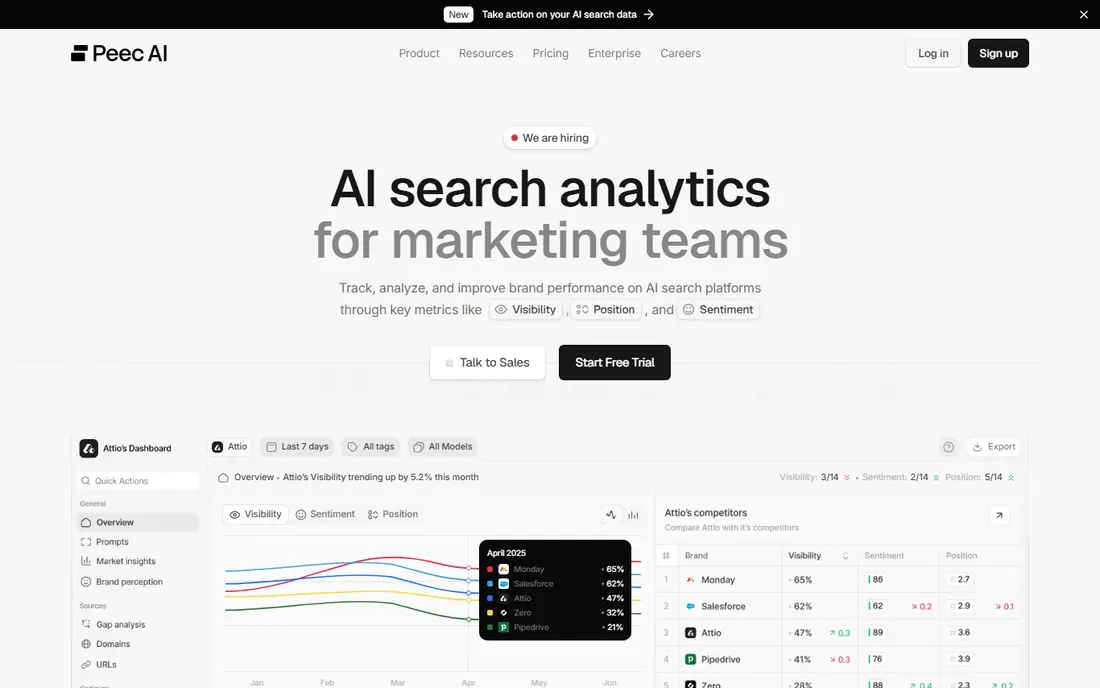
Peec AI focuses on prompt-level visibility across engines such as ChatGPT, Perplexity and Google AI Overviews, with add-ons for other models. Its competitor benchmarking helps a brand see not only whether it appears, but who appears instead and which sources those answers cite. That comparison is useful for content and PR planning.
Engine coverage depends on the plan you choose, so check which models are included before you compare prices. Prompt counts on entry plans are also limited, which suits a focused brand but not a large agency with hundreds of questions. Peec suits brands and agencies that want clean competitor views without enterprise complexity.
- Prompt-level visibility and citations
- Competitor comparison
- Clean analytics for agencies and brands
- Engine choice varies by plan
- Entry prompt count is limited
- Pricing varies by currency and plan
Scrunch AI suits agencies and mid-size brands that need audits and share-of-voice views across engines. It tracks prompt sets, compares brands, and offers guidance on pages that AI agents read, which helps teams move from measurement to fixes. For an agency managing several clients, that audit structure saves time compared with manual checks.
Price is higher than Otterly or Peec entry plans, so a single small site may find it hard to justify. Prompt counts and seats also need planning, because a large prompt set across many clients uses budget quickly. We would shortlist Scrunch when audit depth and agency workflow matter more than the lowest monthly price.
- Share-of-voice and audit views
- Broad engine coverage
- Optimisation guidance for AI-facing pages
- Higher entry price
- Prompt counts need careful planning
- Better for agencies than for a single small site
AthenaHQ uses a credit model to track brands across many AI engines, with a free plan that lets small teams test the concept. Paid plans expand engine coverage and credit allowances, which suits brands that want to check ChatGPT, Gemini, Claude, Perplexity and Google surfaces together. The free entry point makes it easy to run a first baseline.
Credit use needs attention, because each answer can use credits differently by engine and prompt set. Paid plans also start higher than Otterly entry plans, so AthenaHQ suits teams that value breadth over the lowest price. Test the free plan with your core prompt set, then size a paid plan from actual credit use, not from a guess.
- Free plan for small tests
- Broad engine coverage on paid plans
- Credit-based tracking
- Credit math needs care
- Paid plans start higher
- Optimisation features vary by plan
Goodie AI focuses on how products and brands appear in AI shopping answers, including ChatGPT and Google AI surfaces. It tracks product presence, AI-assigned labels and category dominance, then prioritises tasks to improve visibility. For retailers and brands that sell through AI-assisted shopping, that product-level view is more useful than a generic brand mention count.
Non-retail brands may find the focus too narrow, and pricing is often higher than general trackers. Task queues also need a team to act on them, because Goodie measures and prioritises rather than publishing fixes itself. We would shortlist Goodie for ecommerce and retail brands, and choose a general tracker for other sectors.
- Focus on retail and AI shopping answers
- Product shelf presence and labels
- Prioritised task queues
- Pricing is higher and often quoted
- Retail focus is less relevant for non-retail brands
- Task execution needs your team
Semrush AI Visibility Toolkit adds AI prompt tracking to the wider Semrush platform, which suits teams that already use Semrush for search, content and competitor research. You can view AI visibility beside classic rankings, keywords and site health, without learning a separate platform. That consolidation saves time for SEO teams.
The toolkit is priced per domain, and entry prompt counts are limited, so a team tracking many domains or many questions will pay more. It is not the cheapest standalone tracker, and non-Semrush users may prefer Otterly or Peec. For existing Semrush customers, though, the Toolkit is a logical first AI visibility add-on.
- Fits existing Semrush workflows
- Prompt tracking plus classic SEO data
- Useful for teams already on Semrush
- Toolkit price is per domain
- Prompt count is limited on entry
- Not a standalone cheap tracker
Ahrefs Brand Radar helps teams research how brands appear across AI answers, using a large prompt database and citation data. It suits digital PR and SEO teams that want to study mention patterns, find citing sources and compare brands, rather than only track a fixed prompt set daily. Integration with Ahrefs data adds context for content planning.
It is not a like-for-like replacement for a dedicated prompt tracker. Daily prompt-level history and alerting vary by plan, and pricing depends on the Ahrefs subscription underneath. Use Brand Radar for research and citation discovery, and pair it with a dedicated tracker such as Otterly or Peec if you need strict daily prompt monitoring.
- Large prompt database for brand research
- AI mention and citation research
- Fits Ahrefs SEO workflows
- Prompt-level tracking differs from dedicated trackers
- Pricing depends on Ahrefs plan
- Research focus over daily monitoring
Writesonic GEO combines AI visibility tracking with content tools, which suits lean teams that need both measurement and drafts in one place. It tracks brand visibility across key engines, surfaces actions, and helps draft optimised content for pages that AI answers cite. That loop from insight to draft can speed up small teams.
Engine breadth is narrower than on specialist trackers such as Profound or AthenaHQ, and AI drafts still need human editing for accuracy and brand voice. Pricing also varies by plan and add-ons. We would use Writesonic GEO when a small team needs tracking plus drafting help, and a specialist tracker when engine breadth is the priority.
- AI visibility tracking plus content drafting
- Action centre for fixes
- Useful for lean content teams
- Engine coverage is narrower than specialist trackers
- Content quality needs human review
- Pricing varies by plan
How we picked these
We compared official product pages, pricing pages and public documentation in October 2026, and we required live prompt tracking across AI engines, not only a one-off checker. We weighed engine coverage, prompt counts, citation tracking, competitor comparison and free or trial access. Tools with no clear tracking product, or no official homepage, were left out.
How to set up AI visibility tracking that is useful
Choose a small, stable prompt set first
Start with 20 to 50 questions that real customers ask, including brand, comparison and problem questions. Track the same set over time, because changing prompts every week makes trends hard to read. Add competitor prompts from the start, so you can see who appears when you do not.
Read citations, not only mentions
A mention without a citation may come from training data or general knowledge, while a cited mention shows which pages influenced the answer. Check citing sources, fix thin or outdated pages, and add clear facts, comparisons and FAQs that AI answers can cite. That content work matters more than adding more prompts.
Review weekly, act monthly
AI answers change with model updates and web changes, so weekly checks catch sharp drops. Monthly reviews should drive actions: update a page, add a comparison, fix structured data or pitch a source. Tracking without action is only a dashboard, so assign one owner for follow-up.
FAQ
What is the best ai search visibility tracking software for small businesses?
Otterly.AI is the best low-cost starting point for small businesses, thanks to its $29 entry plan and core engine coverage. Peec AI suits small teams that want stronger competitor benchmarking, while AthenaHQ Free suits a first baseline test.
What are the best brand visibility monitoring tools for AI search?
Profound suits enterprise depth, Scrunch AI suits agency audits, and Peec AI suits competitor comparison. Otterly.AI and AthenaHQ suit smaller teams that need core monitoring without enterprise pricing.
What is the best ai search visibility analysis tool for agencies?
Scrunch AI suits agencies that need share-of-voice and audit views across clients, while Peec AI suits agencies that need clean competitor analytics. Profound suits larger agency accounts with enterprise clients and deeper reporting needs.
How many prompts do I need to track AI visibility?
Start with 20 to 50 core questions that cover brand, product, comparison and problem queries. Expand only after you know which questions drive mentions and citations, because larger prompt sets raise cost without always adding insight.
Do AI visibility tools track Google AI Overviews?
Many tools on this list track Google AI Overviews alongside ChatGPT, Perplexity and Copilot, but coverage varies by plan. Otterly.AI, Peec AI, Scrunch AI and Semrush all include AI Overview tracking in some plans, so confirm engine lists before you buy.
What is the best platform for ai search visibility tracking overall?
There is no single winner for every team. Profound leads on enterprise depth, Otterly leads on low-cost monitoring, Peec leads on competitor benchmarking, and Scrunch leads on agency audits. Match engine coverage, prompt count and budget to your team, then test with a trial.