Best AI Content Detection Tools in 2026: 9 Tools Compared
Compare the best ai content detection tools for 2026, with GPTZero, Originality, Turnitin and more, plus accuracy limits and fair-use tips for teams. today.
- Editor's choice
 GPTZero
Teachers and individuals
Starts at$14.99 per monthVisit gptzero.meFull review - Great alternative
 Originality.ai
Publishers and content teams
Starts at$14.95 per monthVisit originality.aiFull review - Also consider
 Turnitin
Universities and schools
Starts atSee websiteVisit turnitin.comFull review
TL;DR:
- GPTZero is our pick for teachers and individuals, with a free tier of 10,000 words per month and paid plans from $14.99 per month.
- Originality.ai suits publishers and content teams, with credit-based pricing from $14.95 per month.
- Turnitin remains the standard for institutions, but it is sold only through institutional contracts.
- No detector is proof on its own: independent research shows false positives, especially for non-native English writing, so pair any score with human review.
- Pangram and Copyleaks are strong alternatives for accuracy and multilingual coverage, though pricing and access differ.
Quick comparison
| Tool | Best for | Starts at | Free plan? | |
|---|---|---|---|---|
| GPTZero | Teachers and individuals | $14.99 per month | Yes | Visit |
| Originality.ai | Publishers and content teams | $14.95 per month | No | Visit |
| Turnitin | Universities and schools | See website | No | Visit |
 Copyleaks | Enterprise and LMS screening | $16.99 per month | Free trial | Visit |
 Pangram | Accuracy and paraphrase detection | See website | Yes | Visit |
 Winston AI | Scanned and paper submissions | $18 per month | Free trial | Visit |
 Sapling | Support teams and sentence checks | $25 per month | Yes | Visit |
 ZeroGPT | Budget quick checks | $9.99 per month | Yes | Visit |
 QuillBot AI Detector | QuillBot users | $19.95 per month | Yes | Visit |
The best AI content detection tools
The best AI content detection software is the one that fits your stakes: a teacher needs sentence detail, a publisher needs bulk checks, and a university needs LMS integration. We compared official pricing pages and published accuracy research, and we treat vendor accuracy claims with caution.

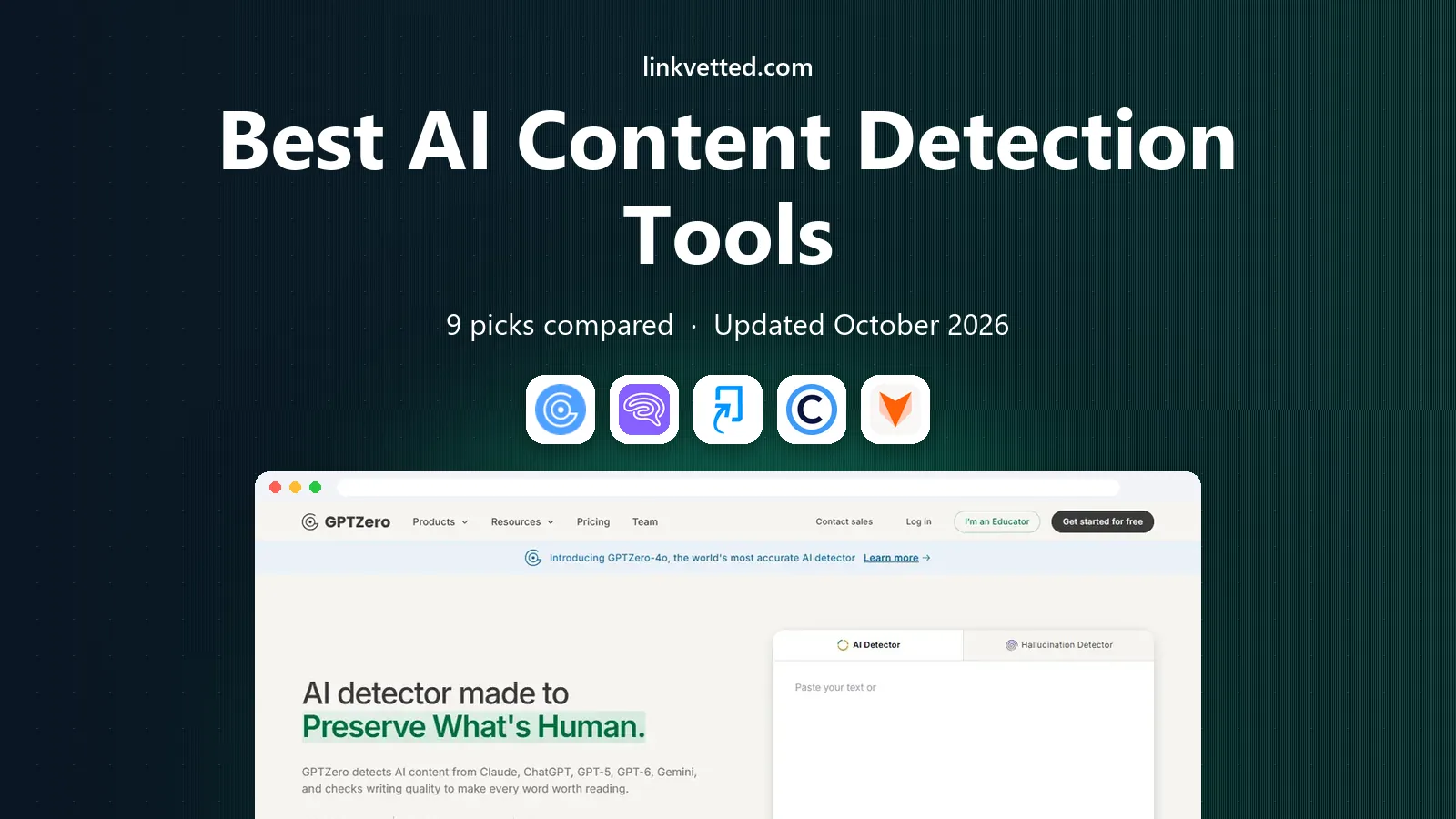
GPTZero, built by a Princeton student in 2023, is now a full platform with sentence highlighting, plagiarism checking on higher plans, and a writing replay that shows how a document was composed in supported editors. The free plan covers 10,000 words per month, which handles a few essays, and Essential starts at $14.99 per month.
The limits matter. GPTZero accuracy falls sharply on humanized or heavily paraphrased text, and independent work has flagged higher false positive rates for non-native English writing. Use it as a screening aid, not a verdict, and always read the flagged passages yourself before you act.
- Generous free tier
- Sentence-level highlighting
- Writing replay feature
- Accuracy drops on paraphrased text
- Higher tiers needed for plagiarism checks
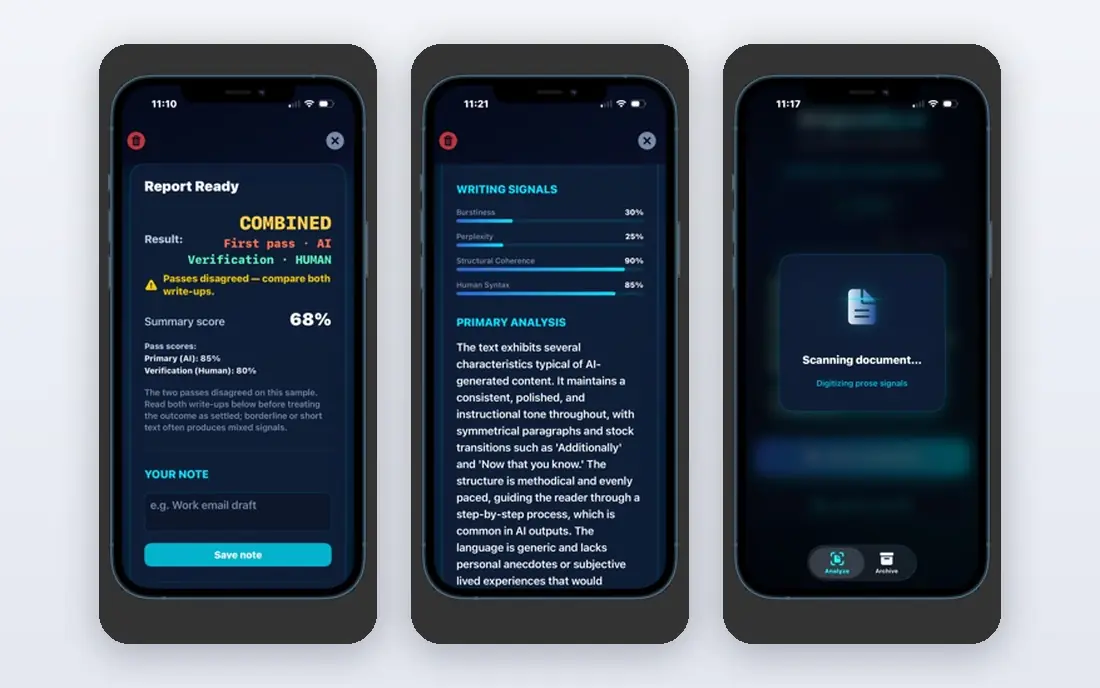
Originality.ai is built for publishers, agencies, and content teams that need to check freelance work at scale. It combines AI detection with plagiarism checking, and its credit system, with 100 words per credit, lets teams buy only what they need. Pro starts at $14.95 per month for 2,000 credits, with a $30 pay-as-you-go option for 3,000 credits.
The downside is the lack of a free tier for ongoing use, though a limited free tool exists for AI scans. Credit pricing also needs care: long documents burn credits fast. For a team checking content daily, Originality.ai is a practical and well-regarded pick.
- Combined AI and plagiarism checks
- Credit-based flexibility
- Team tools
- No lasting free plan
- Credit math takes a moment to learn

Turnitin is the institutional standard. Its AI detection sits inside the plagiarism and feedback workflow that universities already use, with LMS integration and an audit trail for academic integrity cases. For a school that needs consistent policy, that integration is the point.
Individuals cannot buy Turnitin directly, and pricing is negotiated per institution, with some reports putting it at a few dollars per student per year. Students should use their university system rather than a third-party clone. If your institution already licenses Turnitin, it should be your first check, not a paid alternative.
- Deep LMS integration
- Plagiarism plus AI detection
- Institutional audit trail
- No individual purchase
- Pricing is not public
Copyleaks offers AI detection plus plagiarism screening for enterprises, schools, and API users. Its Personal plan starts from $16.99 per month in recent listings, with higher tiers for larger volumes and LMS use. Multilingual support is a plus for institutions with diverse student bodies.
Credit limits on lower plans can bite on long documents, since credits are counted per 250 words in some plans. Check the current credit math before you buy. For an organization that needs API screening or LMS links, Copyleaks is a strong alternative to Turnitin.
- Enterprise and API options
- LMS integration
- Multilingual support
- Pricing varies by plan and credits
- Entry plan limits are tight
Pangram has gained attention in teacher comparisons for high accuracy and near-zero false positives on tested non-native English essays, plus stronger handling of paraphrased AI text than many rivals. Its free tier covers 2,000 words per day, which suits quick checks.
The brand is newer than Turnitin or GPTZero, and its paid pricing, reported from $20 to $65 per month, varies by plan. Treat its accuracy claims as promising, not proven for every text type, and test it on your own documents before you rely on it for high-stakes decisions.
- High reported accuracy
- Strong on paraphrased text
- Low false positive reports
- Pricing is less transparent for individuals
- Newer brand than Turnitin
Winston AI is useful when submissions arrive as scans or photos, not just typed text. It reads scanned work, runs AI and plagiarism checks, and presents results in a clear report. Essential starts at $18 per month, with higher tiers for more credits and features.
Its ecosystem is smaller than GPTZero or Turnitin, with fewer LMS links. For a teacher who receives paper work, or a team that checks mixed formats, Winston AI fills a gap the big names handle less well. For pure typed essays, GPTZero free tier may be enough.
- Handles scanned documents
- Clear credit plans
- Plagiarism check included
- Smaller ecosystem than GPTZero
- Credit limits on lower plans
Sapling started as a writing assistant, and its AI detector offers free sentence-level checks that support teams use to screen messages and drafts. Pro costs $25 per month and adds more volume and features. The interface is simple, which helps non-technical users.
Sapling is less of a dedicated academic detector than GPTZero or Turnitin, and its Pro price is high for casual use. It fits best where detection is one part of a writing and support workflow, not the whole job. Try the free tier first to see if its sentence detail matches your needs.
- Free sentence-level checks
- CRM and support integrations
- Simple interface
- Higher Pro price than rivals
- Detection is not its only focus
ZeroGPT is the budget pick. Free basic checks cover quick screening, and Pro starts from $9.99 per month with a bundle of writing tools. For a student or freelancer who wants a second opinion on a draft, that price is easy to justify.
Accuracy is the trade. Independent comparisons place ZeroGPT below GPTZero, Originality, and Copyleaks, with higher false positive rates. Use it as a first-pass check, never as the sole basis for an accusation or a rejection. Pair it with another tool and human review for anything important.
- Free basic checks
- Bundle of writing tools
- Low paid price
- Lower accuracy in independent comparisons
- Higher false positive reports
QuillBot AI Detector is a convenient add-on for the millions who already use QuillBot for paraphrasing and grammar. Free checks cover quick screening, and full access comes with QuillBot Premium at $19.95 per month. Reports are simple and easy to share.
It is not the most accurate detector here, and buying Premium just for detection would be poor value next to GPTZero or Originality. If you already pay for QuillBot, use its detector as a second check. If you do not, pick a dedicated tool instead.
- Free quick checks
- Handy if you already use QuillBot
- Simple reports
- Full access needs Premium
- Accuracy is mid-range
How we picked these
We compared official pricing pages, feature lists, and published accuracy research, including independent studies that show detectors misclassify some non-native English writing at high rates. We favored tools with clear pricing, sentence or document detail, and a stated policy against using scores alone for high-stakes decisions. Tools without current pricing or active maintenance did not make the list.
How to use AI detectors fairly
Never treat a score as proof. A high AI score can reflect formulaic writing, a common topic, or a second-language style, not just AI use. Check the highlighted sentences, compare with the writer's other work, and ask for drafts or version history where that is appropriate. In schools, follow your institution policy and give the writer a chance to respond.
For publishers, use detection as part of a quality check, alongside plagiarism screening and human editing. Run two tools on borderline cases, since tools disagree often. Keep records of what you checked and why, especially for freelance payments or academic cases. A detector is a screening aid, and human judgment must stay in charge.
What the research says
A widely cited Stanford study found that several popular detectors misclassified more than half of TOEFL essays by non-native English speakers as AI-generated, while rarely flagging US student essays. OpenAI retired its own AI classifier in 2023, citing low accuracy. Those findings do not make detectors useless, but they do mean any high-stakes use needs caution, second checks, and a fair process.
FAQ
What is the best AI content detection tool?
GPTZero is the best pick for teachers and individuals, thanks to its free tier and sentence detail. Originality.ai is best for publishers, and Turnitin is best for institutions that already license it. No single tool is best for every use, and accuracy varies by text type.
Are AI detectors accurate?
Detectors are useful for screening, but not reliable as proof on their own. Vendor claims often exceed independent results, and accuracy drops on paraphrased, edited, or formulaic text. False positives are a real risk, especially for non-native English writing, so pair any score with human review.
Is there a free AI content detection tool?
Yes, GPTZero offers 10,000 words per month free, Pangram offers 2,000 words per day free, and QuillBot and ZeroGPT offer free basic checks. Free tiers suit occasional screening, but paid plans are needed for bulk, plagiarism, or LMS use.
Can AI detectors detect paraphrased AI text?
Some tools handle paraphrase better than others, with Pangram and Originality reporting stronger paraphrase resistance in tests. Light editing still lowers most detection scores, and heavily humanized text can evade many tools. Do not rely on a single score for paraphrased work.
Should teachers use AI detectors for grading?
Detectors can help flag work for review, but they should not decide a grade or a misconduct case alone. Follow school policy, check drafts and process evidence, and give students a fair chance to explain. A detector score without human review risks unfair outcomes, especially for non-native English writers.
What is the best AI detection platform for publishers?
Originality.ai is the best platform for publishers, with AI plus plagiarism checks and team credit plans. Copyleaks is a strong enterprise alternative with API options. Both suit bulk checking of freelance work, but human editing remains essential for quality.