Best Ad Agency Software in 2026: 8 Tools Compared
Compare the best ad agency software in 2026, with projects, time tracking, budgets, billing, reporting and client work for creative agencies in detail.

- Editor's choice
 Workamajig
Large ad agencies with accounting
Starts at$49 per user per monthVisit workamajig.comFull review - Great alternative
 Scoro
Modular agency suite
Starts at$17 per user per monthVisit scoro.comFull review - Also consider
 Function Point
Ad and creative agencies
Starts at$53 per user per monthVisit functionpoint.comFull review
TL;DR:
- Workamajig suits larger ad agencies that want CRM, projects, accounting and reporting in one system.
- Scoro and Productive suit agencies that need profitability, budgets and resource planning in one place.
- Function Point suits creative and ad agencies that want agency specific workflows without enterprise complexity.
- Teamwork.com suits agencies that want strong client collaboration and project delivery at a lower entry price.
- The best agency software links time, budgets and billing, so profitability is visible before a project ends, not after.
Quick comparison
| Tool | Best for | Starts at | Free plan? | |
|---|---|---|---|---|
| Workamajig | Large ad agencies with accounting | $49 per user per month | No | Visit |
| Scoro | Modular agency suite | $17 per user per month | Free trial | Visit |
| Function Point | Ad and creative agencies | $53 per user per month | No | Visit |
 Productive | Budgets and profitability | $10 per user per month | No | Visit |
 Teamwork.com | Client work in the cloud | $9.99 per user per month | Yes | Visit |
 Kantata | Enterprise resource management | See website | No | Visit |
 ClickUp | Low cost all rounder | $7 per user per month | Yes | Visit |
 monday.com | Visual boards for agencies | $9 per user per month | Yes | Visit |
The best ad agency software
Ad agency software should cover the full job: winning work, planning it, tracking time, managing budgets, billing clients and reporting profit. Generic project tools often miss the money side, which is why agency specific platforms matter. We compared project, resource, time, CRM, billing and reporting features for tools that are actively sold in October 2026.
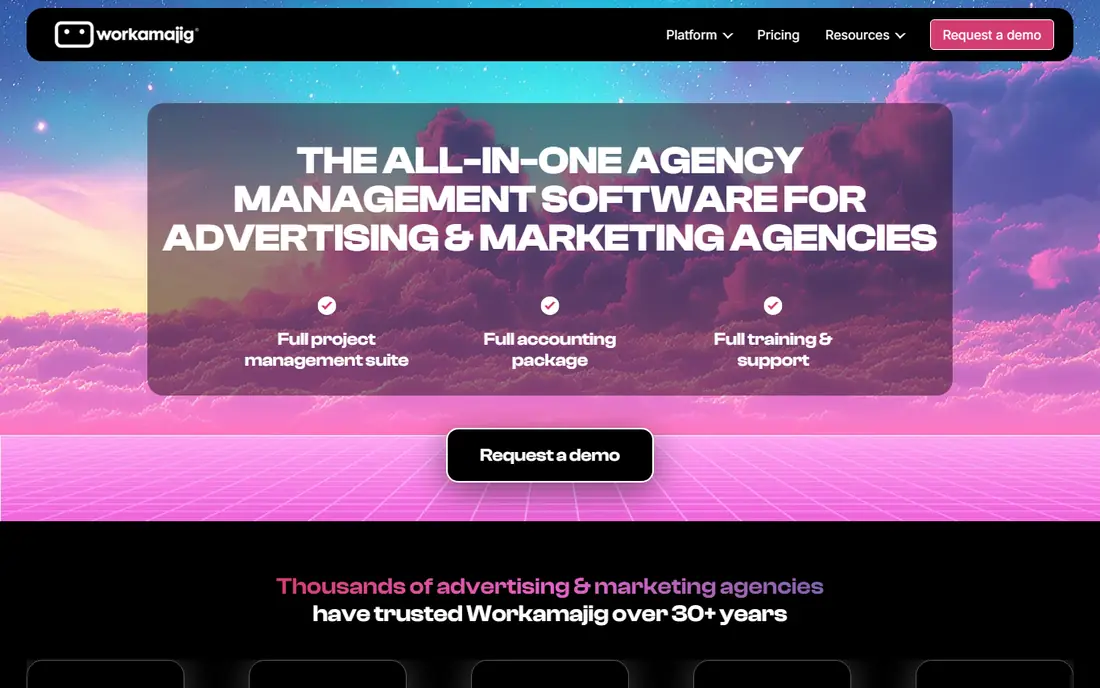
Workamajig is built for creative and ad agencies that want one system for sales, projects, resources, time, vendors and finance. It includes a full agency CRM, project management from intake to billing, staff scheduling, timesheets, vendor purchase orders and accounting, so agencies do not need separate CRM and accounting tools. Reporting covers profitability, utilisation and project status in agency terms, not generic task counts.
Pricing starts around $49 per user per month for larger teams, with a minimum user count, so small studios should compare Scoro or Teamwork first. Implementation also needs planning, because the system covers so much. For a larger agency that wants one source of truth for clients, work and money, Workamajig is the most complete pick on this list.
- Native CRM and accounting in all plans
- Agency project and resource tools
- Detailed agency reporting
- Minimum user counts apply on some plans
- Setup and training take time
- Price rises with team size
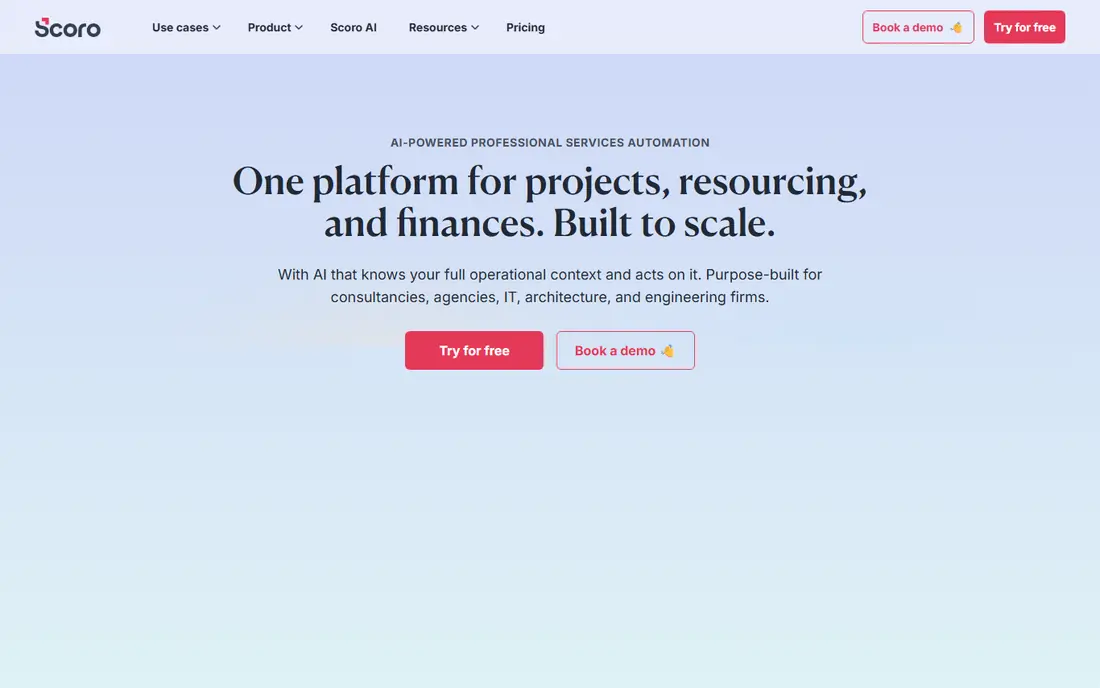
Scoro unites projects, resources, time tracking, CRM, quoting, invoicing and reporting in a professional services platform built for agencies and consultancies. Managers can plan work, track time and budgets, issue invoices from tracked work, and see profitability by project, client and team member. That link between time and money is the core value, because it shows which clients and services actually make money.
Pricing is modular and tier based, starting from $17 per user per month, with higher tiers for growth and performance features and a 14 day free trial. Teams should check which tier includes project templates, sales pipelines and performance reporting, since those features sit on higher plans. For a mid sized agency that wants a full suite without Workamajig scale, Scoro is a strong choice.
- Projects, resources, CRM and finances in one system
- Profitability and utilisation reporting
- 14 day free trial
- Feature access varies by tier
- Higher tiers needed for full reporting
- Setup needs care for complex agencies
Function Point is project management software built specifically for ad agencies, design studios and marketing departments. It covers estimates, projects, tasks, time tracking, expenses, invoicing and reporting, with workflows that match how agencies scope and deliver creative work. Business intelligence tools help leaders see utilisation, project health and financial performance without exporting data to spreadsheets.
Pricing varies by team size, with boutique teams of 5 to 9 users listed around $53 per user per month, and demos available rather than a free plan. That price can feel high for a very small studio, but it reflects agency specific design rather than generic task boards. For a creative agency that wants a tool that speaks agency language, Function Point is a natural fit.
- Built for ad agencies and design studios
- Project, time and billing workflows
- Business intelligence reporting
- Pricing varies by team size, from $53 per user per month for small teams
- No free plan
- Fewer general integrations than ClickUp
Productive focuses on what agency leaders care about most: budgets, profitability and capacity. It combines project management, time tracking, resource planning, sales and budgeting, so teams can forecast revenue, track budget burn and see margins by project and service. That financial clarity helps agencies price work better and spot unprofitable clients early.
Pricing starts at $10 per user per month, with higher tiers for deeper reporting and resource features. Productive does not include a CRM as deep as Workamajig, so teams may still need a separate CRM. For agencies where profitability and resource planning are the main pain, Productive offers excellent value and focus.
- Strong budgets and profitability reporting
- Resource planning and time tracking
- Sales pipeline and project tools
- No native CRM in the same depth as Workamajig
- Pricing rises with features
- Setup needs financial alignment
Teamwork.com is a long established project platform with strong agency use. It covers projects, tasks, milestones, time tracking, client collaboration, file sharing and reporting, with client facing features that keep work visible without endless status emails. A free plan for up to 5 users makes it easy to test with a small team, while paid plans start at $9.99 per user per month.
The limit is that Teamwork is project led, not finance led, so agencies that need deep accounting or profitability modelling may pair it with accounting software or choose Scoro or Productive. For agencies that mainly need reliable client work delivery, collaboration and time tracking at a fair price, Teamwork is a dependable pick.
- Free plan for up to 5 users
- Strong project and client collaboration
- Time tracking and billing tools
- No native CRM
- Accounting depth is thinner than Workamajig
- Advanced features need higher tiers
Kantata, formerly Mavenlink and Kimble, serves larger professional services and agency teams that need portfolio level resource management. It covers project planning, resource forecasting, time and expenses, project financials and utilisation across many teams and offices. That scale helps large agencies balance staff across clients and avoid overbooking key people.
Pricing is by quote and implementation takes time, so Kantata is not a quick pick for a small studio. Smaller agencies will find Scoro, Productive or Teamwork faster and cheaper. For a large agency or consultancy that needs enterprise resource planning, Kantata is a serious contender.
- Enterprise portfolio and resource management
- Project financials and utilisation
- Strong for large professional services teams
- Quote based pricing
- Implementation is enterprise scale
- Overkill for small agencies
ClickUp is the low cost all rounder for agencies that want flexibility without an agency specific price. It offers tasks, boards, docs, goals, dashboards, time tracking and many integrations, with a free plan and paid plans from $7 per user per month. Agencies can build project templates, client views and reporting dashboards that fit their workflow, rather than accepting a fixed agency model.
The trade is setup. ClickUp does not include agency accounting or profitability modelling out of the box, so teams need templates, custom fields and possibly accounting integrations to match Scoro or Workamajig. For a small agency on a tight budget that values flexibility, ClickUp is a strong, affordable starting point.
- Free plan
- Low paid pricing from $7 per user per month
- Flexible views, docs, goals and time tracking
- Generic design needs agency templates and setup
- Billing depth is thinner than agency suites
- Feature breadth can overwhelm
monday.com suits agencies that think visually. Boards, timelines, automations and dashboards make campaign and project status easy to see at a glance, and clients can be given limited views without full system access. A free plan for 2 seats lets small teams try it, while paid plans start at $9 per seat per month.
Like ClickUp, monday.com is a general work platform, so agency billing, profitability and resource forecasting need custom setup or integrations. For agencies that prioritise visual project tracking, campaign coordination and ease of use over deep finance, monday.com is a popular and practical choice.
- Visual boards and automations
- Free plan for 2 seats
- Easy client and campaign tracking
- Paid plans from $9 per seat per month
- Billing and profitability need workarounds
- Costs rise with seats and features
How we picked these
We compared official pricing pages, agency specific workflows, time tracking, budgeting, billing and reporting features, and public user reviews for tools that are actively sold in October 2026. We favoured platforms that link time to budgets and billing, support client collaboration, and offer a realistic price for their target team size. Where pricing was quote based, we marked it as See website rather than guessing.
How to choose ad agency software
Start with your money workflow, not just task boards. Can the tool turn an estimate into a project, track time against budget, and bill from that time without manual rework. Then check resource planning, because overbooked staff and missed deadlines cost agencies more than a missing feature. Finally, test client collaboration, since clients who can see progress clearly need fewer status meetings.
Pricing, trials and migration checks
Ask for per user pricing, minimum users, and which features sit on each tier, because agency suites often gate reporting and pipelines on higher plans. Run a trial with a real client project, including time, budget and invoice, before migrating. Check data export and integration with accounting tools, so you are not locked into a system that cannot share financial data.
FAQ
What is the best ad agency software?
Workamajig leads for large agencies that want CRM and accounting in one system, Scoro and Productive lead for profitability and budgets, and Teamwork leads for client project delivery. The best tool depends on agency size and whether finance or project delivery matters most.
What is the best marketing agency software for small agencies?
Teamwork, ClickUp and monday.com suit small agencies, with free plans and low paid pricing. Scoro and Productive suit small agencies that are ready to pay for profitability and resource planning.
How much does agency software cost?
Entry pricing ranges from free plans to $7 to $10 per user per month for general tools, and $17 to $53 per user per month for agency suites, with enterprise tools priced by quote. Always check minimum users and tier gated features.
Can agency software replace accounting software?
Workamajig includes native accounting, while most other agency tools handle invoicing and project financials but still need accounting software for full bookkeeping. Check what your finance team needs before replacing any accounting system.
What features should ad agency software include?
Look for project management, time tracking, resource planning, CRM or client management, estimates and budgets, invoicing, and profitability reporting. The best tools link those pieces, so time, budget and billing stay in sync.