Best Alternatives to Moz SEO in 2026: 8 Tools Compared
Looking for alternatives to Moz SEO? We compare 8 proven SEO tools on backlinks, keywords, audits, reporting and price to help you pick the right fit today.

- Editor's choice
 Ahrefs
Backlink research and competitor analysis
Starts at$29 per monthVisit ahrefs.comFull review - Great alternative
 Semrush
All-in-one SEO, content and PPC research
Starts at$139 per monthVisit semrush.comFull review - Also consider
 SE Ranking
Agencies and freelancers tracking many sites
Starts at$129 per monthVisit seranking.comFull review
TL;DR:
- Ahrefs and Semrush are the closest full replacements for Moz, with larger backlink indexes and wider tool sets.
- SE Ranking gives agencies strong rank tracking and reporting for less than the big two at higher tiers.
- Screaming Frog and Surfer are specialists, so pair one with a research suite rather than using it alone.
- Mangools and SpyFu suit smaller budgets, with simpler interfaces and a narrower, clearer focus.
- Always connect Google Search Console as well, since it shows real clicks and impressions for your own site.
Quick comparison
| Tool | Best for | Starts at | Free plan? | |
|---|---|---|---|---|
| Ahrefs | Backlink research and competitor analysis | $29 per month | Yes | Visit |
| Semrush | All-in-one SEO, content and PPC research | $139 per month | Free trial | Visit |
| SE Ranking | Agencies and freelancers tracking many sites | $129 per month | Free trial | Visit |
 Screaming Frog | Technical site audits and crawling | See website | Yes | Visit |
 Surfer | On-page content optimization | See website | No | Visit |
 Mangools | Keyword research for beginners and bloggers | See website | Free trial | Visit |
 SpyFu | Competitor keyword and ad research | See website | Free trial | Visit |
 Majestic | Deep backlink and trust analysis | See website | No | Visit |
The best alternatives to Moz SEO
These eight tools cover the main reasons people leave Moz: a need for fresher backlink data, a lower price, better reporting, or a sharper focus on one job. We compared official feature pages, pricing pages, and public documentation, and we kept only tools that are live and actively sold in October 2026.

Ahrefs is our pick for most people who want a direct Moz replacement with stronger link data. Its Site Explorer shows which pages earn links, which anchors sites use, and where competitors are gaining ground, and its keyword tools tie search volume to traffic potential rather than volume alone. For a small business, the cheaper Starter plan is enough to research keywords and check a handful of competitors, while larger teams will want the Lite plan for more projects and tracked keywords.
The catch is price at scale. Credits, limits, and add-ons can push the monthly bill up quickly if you track many sites or run frequent reports. Ahrefs also has no long free trial in the usual sense, though owners of verified sites can use its free webmaster tools. If backlinks are your main reason for switching, that trade is worth it. If you mainly need rank tracking, a cheaper suite may serve you better.
- Very large backlink index
- Strong keyword and content gap tools
- Free tools for verified sites
- Full plans get expensive fast
- Learning curve for new users

Semrush suits teams that want one subscription to cover SEO, paid search research, content planning, and social reporting. Its domain overview gives a fast read on a competitor, and its keyword tools show intent, difficulty, and related terms in a way that is easy to turn into a content plan. The platform also tracks AI search visibility on current plans, which matters more as search results change.
The downside is cost and clutter. Solo site owners may pay for dozens of tools they never open, and the interface can feel busy at first. A seven-day trial helps, but it is short, so plan a focused test week with a real project. For agencies and in-house teams that will use several modules each week, Semrush is still one of the strongest Moz alternatives available.
- Very wide tool set in one login
- Strong keyword and domain research
- Useful content and local tools
- Entry price is high for solo users
- Some tools feel shallow next to specialists
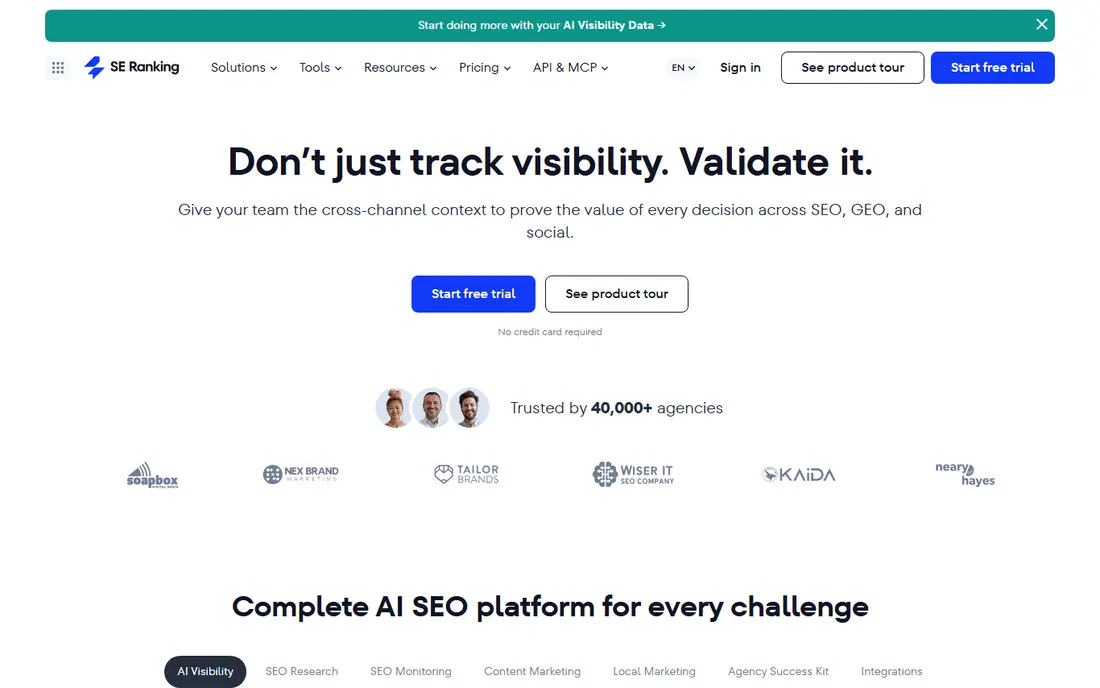
SE Ranking is built for people who manage client work. You get daily rank tracking for many keywords, site audits, backlink checks, and reports you can brand with your own logo, all without an enterprise contract. That mix explains why many small agencies switch from Moz when reporting becomes a weekly chore rather than an occasional task. The Core plan includes a useful number of projects and tracked keywords for a team of this size.
It is not the best choice if backlink research is your top priority, since its link index is smaller than Ahrefs or Majestic. It also works best when you set up projects carefully at the start, because its depth can feel scattered to a casual user. For rank tracking and client reporting value, though, few tools match it at this price.
- Generous rank tracking limits
- White-label reporting
- Clear plan structure
- Backlink data is thinner than Ahrefs
- Interface takes time to learn
Screaming Frog does one job extremely well: it crawls a website and reports broken links, duplicate titles, missing meta data, redirect chains, and other technical faults. The free version crawls up to 500 URLs, which covers many small sites in full, and the paid licence removes that limit and adds integrations with analytics and search data. Technical SEOs keep it open beside a research suite for exactly this reason.
Do not buy it as a Moz replacement on its own. It will not track rankings over time, research keywords, or monitor backlinks in the way a suite does. Think of it as the audit tool you add when you need proof of what is wrong on a site, with clear URLs and status codes to hand to a developer. Paired with Ahrefs, Semrush, or SE Ranking, it fills a gap those suites handle less directly.
- Fast, detailed site crawls
- Free version covers up to 500 URLs
- Strong technical detail
- Not a keyword or rank tracking suite
- Desktop software, not a hosted dashboard
Surfer helps writers shape a page so it covers the terms and structure that top-ranking pages use. You enter a keyword, get a content score, and see which related terms, headings, and length ranges to aim for, then edit inside its editor or a connected document tool. For teams that publish regularly, that guidance is more practical than a generic keyword list, because it turns research into a draft checklist.
The limit is scope. Surfer will not replace a full SEO suite, and heavy publishers should check how article credits work before committing. It works best for content teams that already have a keyword tool and want better briefs and edits. If your main Moz use was rank tracking or link research, pick a suite first and add Surfer later.
- Clear content scores and term suggestions
- Useful brief builder
- Integrates with common editors
- No full backlink or rank tracking suite
- Per-article costs can add up
Mangools bundles KWFinder for keyword research, SERPChecker for result pages, SERPWatcher for rank tracking, LinkMiner for links, and SiteProfiler for domain checks. That bundle is easy to learn, and the keyword tool in particular gives clear difficulty scores and search trends without a wall of extra data. Bloggers and small site owners who found Moz too complex often settle here quickly.
The trade is depth. Its backlink data and audit detail do not match Ahrefs or Semrush, and larger agencies will miss white-label reporting and higher limits. For a solo owner with one or two sites, that may not matter. Mangools is a good fit when your goal is to find winnable keywords and track a modest set of rankings without paying for an enterprise suite.
- Simple, friendly interface
- Five tools in one suite
- Good for small sites
- Smaller backlink index than the leaders
- Fewer agency features
SpyFu stands out for competitor research. You can see which keywords a rival ranks for, which ads it has run, and how its organic and paid presence has changed over time. That history is useful when you are entering a market or pitching a client, because it shows patterns rather than a single snapshot. Its domain comparison views make it quick to spot gaps in your own coverage.
It is less strong as an everyday all-in-one suite. If you need deep audits, large backlink exports, or local SEO tools, another product on this list will fit better. Use SpyFu when competitor insight is the gap in your current stack, and pair it with a crawler or a rank tracker if you need those jobs covered too.
- Long history of competitor keyword data
- Strong paid search insight
- Easy domain comparisons
- Backlink tools are secondary
- Rank tracking is less central than in suites
Majestic has focused on backlinks for years, and its Trust Flow and Citation Flow metrics remain widely cited when judging link quality. Its tools help you map a link profile, compare domains, and spot toxic or low-quality links that may need attention. For link builders and auditors, that depth is the point, and it complements a keyword suite rather than replacing it.
For most small businesses, Majestic alone will feel too narrow. It does not offer the same keyword planning, content, or reporting breadth as Semrush or SE Ranking, and its interface will not win fans among beginners. Choose it when link analysis is a core, ongoing job, and use a broader suite for rankings and keywords.
- Long-running link index
- Trust Flow and Citation Flow metrics
- Strong link history tools
- Narrow focus on links
- Dated interface for some users
How we picked these
We compared official pricing and feature pages, app and help documentation, and public reviews, and we checked that each tool is sold and supported in October 2026. We favoured tools that cover the core Moz jobs of keyword research, rank tracking, site audits, and backlink analysis, either alone or in a sensible pairing. Tools that were closed, merged into another product without a clear standalone offer, or priced only by private quote with no public trial were left out where a clearer option existed.
What to check before you switch
Start with the job you actually do each week, not the longest feature list. A rank tracker, a content editor, and a crawler are different tools, and buying a suite for one job often wastes money.
Match the tool to your weekly work
List the tasks you repeat: keyword research, rank checks, audits, link checks, client reports, or content briefs. Pick the product that does your top two tasks well, then add a specialist only if a gap remains. That order keeps costs down and avoids paying for modules you open once a quarter.
Test with a real project
Use a trial or free tier on a site you own, not a demo account. Import your main keywords, run an audit, and export one report you would actually send to a client or a manager. If the export needs heavy cleanup, or the data looks thin for your niche, that is a warning sign before you pay for a year.
Watch limits and billing
Check how projects, tracked keywords, crawl credits, and seats are counted, and whether annual billing is required for the advertised price. Some tools charge per user or per report, so a low headline price can rise fast for a team. Confirm the renewal price too, since first-year discounts are common in this market.
FAQ
What are the best alternatives to Moz SEO?
Ahrefs and Semrush are the closest full replacements, SE Ranking is a strong value choice for agencies, and Mangools suits smaller budgets. The right pick depends on whether backlinks, rank tracking, or content work matters most to you, so test one suite on a real project before you commit.
Is there a free alternative to Moz SEO?
Yes, in part. Ahrefs offers free tools for verified sites, Screaming Frog has a free crawl limit, and Google Search Console is free for your own site. No free tool fully replaces a paid suite, but together they cover basic keyword, audit, and performance checks.
Which Moz alternative is best for small businesses?
Mangools and SE Ranking are good starting points for small teams, since both are easier to learn than enterprise suites and cover keywords and rankings well. If backlinks matter more, start with Ahrefs Starter and add a crawler only if audits become a regular task.
Do I still need Google Search Console with a paid SEO tool?
Yes. Paid tools estimate rankings and traffic, while Search Console shows real impressions, clicks, and queries for your own site. Use both, and treat the paid tool as research and the Search Console data as ground truth for your own pages.
Can I use Surfer or Screaming Frog instead of a full suite?
You can, but only if you already cover the other jobs elsewhere. Surfer improves pages and Screaming Frog finds technical faults, yet neither tracks rankings and backlinks at suite level. Most teams pair a specialist with one research tool rather than relying on a specialist alone.